Rowing the Atlantic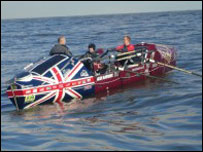 | | Atlantic challenge - the crew aboard Vivaldi Atlantic 4 |
The Vivaldi Atlantic expedition was a British Atlantic record crossing attempt that took place in the summer of 2005. The crew were all members of the 2002 Skandia Atlantic crossing attempt that ended after 21 days when their rudder was ripped off in a storm. Their aim was to break the existing Atlantic Rowing Records and to create a new one for rowing directly to mainland UK. | The crew | Steve Dawson from Boston, Lincolnshire
Nigel Morris from Ingleby Barwick, Teesside
George Rock from Ingleby Barwick, Teesside
Rob Munslow from Monmouth |
They set off from St. John's, Newfoundland, Canada on 01 June 2005 and intended to finish in Falmouth, Cornwall, England less than 55 days later. Their route covered 2100 miles of Atlantic. Dangerous ventureIt is dangerous. Five men have died trying to row from Canada to the UK and the record of 55 days was set more than 100 years ago. But that record was to a line at sea drawn from the Bishops Rock lighthouse. More than 100 miles west of the British mainland. No one has rowed land to land. This crew wanted to be the first, but their main reason was the sense of achievement. Fixed routineThe routine was set from the start - two men, two hours on, two hours off, propelling 1500kg of boat more than 2000 miles. | The boat | Name: Naturally Best
Length: 29 feet
Weight: 320 kg
Designed and built by Woodvale Events. |
The only time off is time to rest. There are two sleeping bags - for four
absolutely no privacy. By day five the crew had cleared the Grand Banks; a treacherous stretch of water where "The Titanic" sank. Stormy passageIt was on day five that their luck almost ran out. They rowed into a massive storm. The boat was tossed about like a cork - but she held together and upright. It was back to the daily grind of putting on the miles and suffering the injuries. Setting daily targets helped them through. Sometimes as good as 80 miles a day. But on this day they were in for the worst storm of the crossing. "We were looking at waves towering above us. They were huge. They were not bungalows they were tower blocks. "There were times when we did not think we would be coming home. We did not think we would make it."
After the second big storm conditions improved dramatically. Again they survived. Disaster strikesDay 34, around 300 miles to go. Disaster almost struck. An oar broke. There was one spare left. If it happened again they would be down to one man rowing. By Day 37 they were expecting the wind and the currents to push them towards England. Nine times out of 10 that is what would have happened. But not on Day 37. George: "There has no change for five days - we are getting nearer to the French coast
the current is pushing us south."
Their dilemma - strike north to Falmouth for a land-to-land crossing and risk being pushed backwards into the Bay of Biscay. Or go all out east for the record; cross the line drawn from Bishops Rock lighthouse; and get a tow the remaining 100 miles or so to the Scilly Isles. Differing opinionsCrew members expressed differing views. Rob: "I got on the boat not to finish at the Scillies - it is Falmouth for me. The Isles of Scilly never interested me." Steve countered, "If we end up being swept into the bay and asking for help it's no good." Nigel summed it up: "It is the world record; we should not be bloody beating ourselves up about it. "The most important thing is that we end this as friends."
| The record | The Naturally Best crossed the finish line near Bishop Rock lighthouse, off the Isles of Scilly on 11 July, taking 39 days, 22hrs, 10mins 30secs and smashing the previous 55-day record. |
Record breakersEventually, they voted to go for the record and crossed the official finishing line on Sunday 10 July 2006. They had smashed the record by 16 Days. And were the first four-man crew to complete the west to east crossing of the North Atlantic. North to Falmouth was now the goal, but the wind and the sea were against them. A tow to the Scilly Isles was quickly arranged, and the Scillies were waiting for them. Nigel: "It was a fantastic reception"
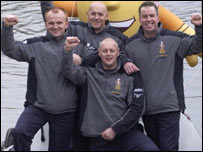 | | The four rowers celebrate on their arrival in Falmouth |
Family reunionsThe next day the guys finally got to their original destination - Falmouth and their families. They were not stars; they were ordinary guys who raised the money themselves for their crossing. That was the strength of their achievement. Nigel: "We are not from privileged backgrounds. We are just normal lads. It really shows what everyday blokes can achieve." Rob: "It was a privilege. On a small boat. A thousand miles from anywhere, with three good friends."
Links relating to this story:The BBC is not responsible for the content of external websites | 



 Inside Out - North East: Monday September 25, 2006