Royal chapel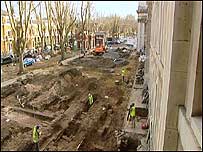 | | Work in progress - excavations underway |
by David Baldwin, Serjeant of the Vestry St James's Palace Excavations by The Archaeology Service of the Museum of London have recently unearthed remains of the eastern end of the Chapel Royal of the old royal standing house originally constructed by King Henry VII, but otherwise destroyed by the building of the Royal Naval Hospital from 1692. The Chapel Royal is not a building. Instead it was in origin, and remains, the body of clergy, singers, musicians and vestry directly responsible for the spiritual welfare of the sovereign. Greenwich genesis The site at Greenwich has its origins in the Anglo-French wars during which King Henry V's Chapel Royal conducted Mass upon the battlefield at Agincourt in 1415. By Act of Parliament in 1414, lands of "alien priories" - daughter houses of monasteries in France owing allegiance to the King of France - had their lands in England sequestered. Among these were "priories at Greenwich and Lewisham", given for the construction of a Carthusian Charterhouse on the banks of the River Thames at Shene, near Richmond. Some of this 'Shene' land at Greenwich, which included the manor, was exchanged in 1433 for other more convenient land held by the Duke of Gloucester, who in 1445 had lent the House for their honeymoon to Henry VI and Margaret of Anjou. They, after Gloucester's arrest and sudden death in 1447, took it over, putting in terracotta tiles bearing her monogram and filled the windows with glass. In 1466 Edward IV settled the house upon his Queen for life. It was this structure that King Henry VII took over, largely demolishing and rebuilding it between 1499 and 1505. During this time Henry VIII was born there, and as part of this building enterprise the Chapel Royal, now recently unearthed, was constructed at the eastern extremity of the new Greenwich Palace riverside range. Surviving evidence Several 16th and 17th Century illustrations of the Chapel Royal's outside appearance have survived in the form of drawings, paintings and even a woodcut, but to date no useful illustration of its interior has come to light.
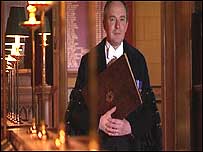 | | Researching the past - the Serjeant of the Vestry |
The unearthing of the Sanctuary area of the Chapel Royal is therefore of immense historical value in interpreting those descriptions which do exist of its actual usage. Of direct import are surviving contemporary manuscript descriptions of the conduct of various Divine Offices and Chapel Royal personnel, together with some of their varied activities at the Chapel Royal in Greenwich. Such descriptions, contained within The Old Cheque Book of the Chapel Royal (1558-1744), include the royal Baptism of Princess Mary on 1st May 1605. The description of the event includes references to the Dean of the Chapel Royal, Archbishop and others "under the cell compassing the font", the Earls waiting at "fower corners of the Cell", the "Musicall Instrumentes" helping the Chorus, the "rayles which inclosed the ffont", and the "Trumpeters
standing in the Lower Chappell". The Chapels Royal staff It was, and remains to this day, the duty of Chaplains to the King or Queen to preach with the Chapel Royal by Lord Chamberlain's Warrant. In practice, though, it was often the Clerk of the Closet who recommended who from amongst them would be chosen. The Clerk of the Closet, who had the rank of Bishop, had a particular duty to attend upon the King there - together with the Vestry Officer known as the Keeper of the Closet: an office that still exists at St James's Chapel Royal. 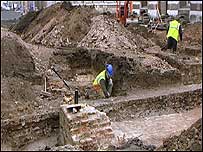 | | Excavations - digging for clues on site |
Some other activities of Chapel Royal personnel working at Greenwich now come to life in terms of the geographical location of their whereabouts: - such as the "suspicion of stealing three coapes out of His Majesty's vestery at Greenwich" by Yeoman of the Vestry Henry Alred in 1611, and: - the removal of furniture without the Dean's permission and "bringing of false massages to the Sub-Dean as from the Dean" by Cuthbert Joyner, Serjeant of the Vestry, in 1618. The term "vestry" appears in late seventeenth century plans as an extension further to the Eastward of the Chapel Royal. John Leland's De Rebus Britannicus Collectanea of 1774 gathered documents together, including some describing King Henry VII's attendance at Greenwich Chapel Royal for Christmas Eve 1487 and the feast of the Epiphany 1488. The latter was an occasion upon which both King and Queen wore Crowns in accordance with the custom of ancient Crown-wearing days. The King washed feet on Maundy Thursday, blessed Cramp Rings to cure Epileptics and Crept to the Cross on Good Friday, and waited to the right of the Altar whilst the furnishings were stripped. Present day The Chapel Royal survives today. Its choral headquarters has been at St James's Palace since 1702, following a fire at Whitehall in 1698. The Chapel Royal there was destroyed, to the extent that Christopher Wren was commissioned to make archery butts out of the ruins. It conducts services upon every Sunday throughout the year, with the exception of the months of August and September. The services take place at the Henrician Chapel Royal in St James's Palace - constructed between 1531 and 1536 - from October until Good Friday, but relocate to conduct services thereafter until the last Sunday in July at the Queen's Chapel in Marlborough Road. Choral services are maintained simultaneously by daughter establishments in the form of the Chapel Royal at Hampton Court and at the Tower of London, in the Chapels Royal of St Peter ad Vincula and from time to time in the Norman Chapel Royal of St John the Evangelist in the White Tower. All are subject to the authority of the Dean of the Chapels Royal, under the ultimate authority of The Queen. | 



 Inside Out - London: Monday February 20, 2006