 | "I ended up with seven dealers living in my house. There was prostitution, robbery, mugging, murder
" Clarence Spencer | Evidence of crack abuse |
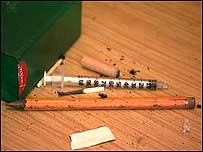
Crack houses We look at how drug dealers are taking over the flats of vulnerable people in London and turning them into crack houses. In 2004 the government brought in new legislation to allow the police to shut down crack houses permanently after they were raided. The success of this policy has pushed drug dealers to look for alternative venues to conduct their business. As the police clamp down more effectively and close drug dens across the capital,the crack dealers are having to feather new nests targeting the homes of the helpless to ply their trade. In some parts of London this has resulted in dealers talking their way into the homes of vulnerable people and turning them into crack houses. Cuckooing Cuckooing is a new type of crime which involves a drug dealer befriending a vulnerable individual who lives on their own. Like a cuckoo, the dealer moves in, takes over the property, and turns it into a drugs' den. Homeless charity ThamesReach has noticed an upsurge in cuckooing amongst vulnerable people they have rehoused. 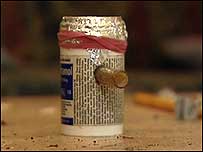 | | A crack pipe - part of the drug users' equipment |
One of the drug dealers' victims was Martin. After spending most of his adult life wandering the streets of London, he was finally found a home by Thames Reach. Independent living was a major step forward, but with a history of alcoholism it didn't take long for the local crack dealers to befriend him and take advantage of his vulnerability. Martin explains what happened: "I've never had a flat of my own before. And I was given this flat by the people who did it and I was so proud and keen to make the most of it. "One day I was walking down the road to get some tea bags or something and I was approached by a woman and she looked very respectable. "And she asked if it's alright if me and my husband move in - I thought about it and she looked quite decent and I said, 'okay - just for a week'."
Martin was an easy target - the couple he trusted turned out to be drug dealers and very quickly they took over his one bedroom flat. The people who had invaded his flat terrorised him - threatening him with violence, and Martin was left helpless: "I confronted the dealer
I asked them to leave. They went ballistic, threatening me with violence. "There were too many of them. I can fight but I can't fight 13 people."
Cuckoo's nestFifty-five-year-old Clarence Spencer had a similar cuckooing experience.  | | Cocaine explosion - the white powder |
He had always had a regular job and a home. The backbone of his life was his sister, but when she left the country to go back to Jamaica, his life fell apart. And he started using crack cocaine. Dealers quickly moved into his home and to make sure they stayed there, they fed his addiction, as Clarence explains: "I ended up with seven dealers living in my house. There was prostitution, robbery, mugging, murder
all kinds of things were happening for them to get their money. "And I ended up with a £1,000 a day crack habit."
For Clarence, like many other victims of cuckooing, going to the police was not an option. His flat was raided, he lost his home and was made subject to an ASBO. He's spent the last six months in a homeless person's shelter. Now completely clean of drugs, Clarence is starting to re-build his life. After six months living in the hostel, he's moving out into a shared flat, and feels much more positive about himself. Homeless charity | | Crack House sign - but how do the dealers get driven out? |
Outreach workers at ThamesReach are increasingly having to move tenants as their homes are invaded by violent dealers, users and prostitutes, sometimes resulting in the vulnerable person returning to using drugs. Terri, an outreach worker for ThamesReach, explains how the dealers target the vulnerable: "It's people who are isolated. People who have had problems with vulnerability
" Maybe they're having some sort of an addiction with drugs already. Maybe it's alcohol or maybe they have some mental health issues where they need some support. "And if someone shows them some attention, that's a way in."
As the drug dealers move into new homes, the charity is concerned that this is having a severe impact on the wider community, as Terri explains: "You'll have increased crime in the area, people will feel unsafe
you and I will feel unsafe to walking along the street."
Dealers often approach the vulnerable person with an offer of free drugs for the use of their home - at first this seems attractive but as more and more users and dealers arrive, the situation spirals out of control. At this stage the homes become known to the police who, working in partnership with the local authority and ThamesReach - raid the premises. Instead of arresting the tenant they arrange for them to be rehoused, treating them as a victim rather than a criminal. Protecting the vulnerable
Today, victims of cuckooing are no longer seen as criminals.
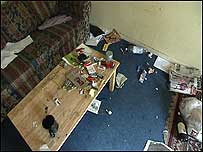 | | Cuckoo's nest - a typical crack house with drug paraphernalia |
ThamesReach works closely with the police and local councils to rescue and protect them from the drugs dealers. The first thing is to get the tenant to acknowledge that there's a problem. But even if you can drive out the dealers, there's still the fear that they'll move on to a new property and find another vulnerable person. Links relating to this story:The BBC is not responsible for the content of external websites | 



 Coming Up : Inside Out - London: Friday March 23, 2007