 | Celebrations but what's the real cost of the Games? |
London 2012 - the real costLondon's Olympic bid came up trumps, but can the capital afford the greatest show on earth? The bill has already gone up by £1 billion. BBC London's Inside Out has been leaked an internal report which shows that Games organisers are worried. We ask, 'what is the real cost of the London Olympics?' and who will end up paying? Political footballThe team bringing the Olympics to London are battling a wave of bad headlines that are threatening to derail plans for 2012. Inside Out has seen their exclusive document which proves that, whatever the public face of the Games, organisers know they're facing real problems.  | | The document paints a grim picture of budget worries |
Titled 'Project GAB' (A Campaign to get the Agenda Back), it outlines worries over the budget, rising costs, the legacy and political interference. The Games, it says, are becoming a "political football". But with "no clear budget" and "no transparency", London 2012 is finding it "harder to raise funds". The team's "number one priority" is to agree a budget and announce it to the public as soon as possible. It also says that damaging headlines are "affecting public support". True costs?So were the public deliberately misled over the true cost of the Games, and as the costs go up, who'll end up footing the massive bill? Ian Monk from Ian Monk Associates says that one way or another, London will have to pay: "The question of budget is central to the whole enterprise
all the public have had is a series of ever spiralling costs, a drip feed of half information and the impression that it's going to rise and rise out of control. "I don't think anyone really thought through before hand how to gain and maintain public support."
To make matters worse, Britain has a disastrous track record in recently publicly funded projects including the Dome and Wembley Stadium. The euphoria of winning the Games has now been replaced by scepticism and worries about the challenge ahead. How will Londoners pay?
Thirty eight pence per week is the average sum each London council tax payer will fork out for the next 12 years under the funding deal for the Games. For this they've been promised not just the greatest show on earth, but thousands of new jobs and homes in some of the most deprived parts of the capital. 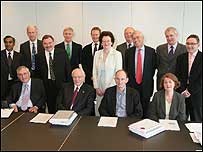 | Happier times - inaugural meeting of the Olympic Delivery Board |
The promise of regeneration has excited staff and pupils at Rokeby Secondary School which lies close to where the Games will be held. Assistant Head, Lesley Baker, Rokeby Secondary School remains cautiously optimistic about the benefits for the community: "Locally the job market isn't there - there are not the opportunities available. They have to travel. We're hoping that if they choose to stay in Stratford, there will be the opportunities that are not there now." "There's going to be job opportunities for architects, engineers..."
Many people in the area feel proud that Newham, Stratford, and parts of Hackney have been chosen for the Games. Abu Miah is living proof of what we're told will happen
the 25-year-old has just landed a job on the Olympic site. He's one of around 100 locals working on laying electricity cables underground: "It makes me feel proud... it'll bring a lot of employment to the local community and a lot of income."
Counting the costWhen London won the bid, the International Olympic Committee praised its budget as being "robust and well thought out". But now serious questions are being asked whether this was indeed the case. The original budget was based on a study carried out by construction company Arup in May 2002.  | | Who will pay the price of the Games says Don Foster? |
It predicted the cost of the Games to be £1.8 billion. The Government then commissioned another report in 2004. The accountants Price Waterhouse Coopers (PWC), who assembled these figures, put their budget at closer to £3.2 billion. When they went public with the figures, PWC went for a midway option - £2.4 billion.
Don Foster MP says that this seemed realistic at the time: "Everybody knew this was provisional budgeting but apparently based on very good estimates by real experts. So yes we were confident."
But was it misplaced confidence - the MP's had to trust a 12 page summary of the 250 page report. It had no detailed figures in it and has never been made public. Underestimate of costs?Dr Will Jennings is a specialist in risk management for Mega Events like the Olympics.
"We don't know anything about the actual breakdown of the costs. So it's almost impossible to tell how reliable those predictions are," he says. For the last year Dr Jennings has been trying to get to the bottom of what was in the original Olympic report. He's been using Freedom of Information Laws to try and get hold of the Government's figures, but to no avail. The latest reply to his requests makes interesting reading: "Dear Will
I'm very sorry but we're unable to give you a substantive response today. The report is a long and complex one and we have to consider and consult. I will be in touch in the next 20 days, either with a substantive response or to update you on where we are."
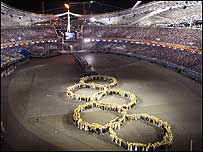 | Athens Olympics - but will the torch burn bright in London?
Photo - PA Images |
Karl asks, "Let's not forget that was done nearly five years ago... and it's still not publicly available... "What does that say about the transparency of a process where lots of public money is being spent?... it leaves us with a lot of unanswered questions." Like many others Dr Jennings finds it hard to believe that anyone ever thought that £2.4 billion would pay for the 2012 Olympics: "Every Olympics has cost inflation
Given that we know that Athens cost nearly £9 billion and that around the time of the predication were going that was the cost that was known, I'd have thought that that was quite a significant underestimate
"And I think that people at that time would have thought that too."
Budget gapAccording to information received by Inside Out shortly after London won the Games, the government asked a high profile firm of accountants to take a look at the budget once more. Very early on, we were told, they realised the £2.4 billion wouldn't be enough - and figures closer to £4 billion were being talked about. This was never made public and no official report was ever written down. Eventually Tessa Jowell appeared before a committee of MPs in November 2006 and made a frank and embarrassing admission that costs had gone up by 40%.
Don Foster MP, the Lib Dem Culture Spokesperson, says: "I think her performance at the select committee was frankly abysmal. I think she wasn't as well briefed on the issue as she should have been."
One of the reasons given for escalating costs was that steel prices had doubled. Although steel prices have been volatile, since the bid went in the cost of steel has only gone up by 1 or 2 per cent. Michael Ankers, Chief Executive of the Construction Products Association says,"I think she was mistaken in blaming steel particularly for the increase in costs over what the original bid had said". 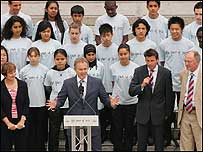 | Tony Blair with the Olympic movers and shakers.
Photo - Getty Images |
We asked the Government and the Olympic Delivery Authority where they got their figures from and how much they put the original steel prices at, but two months on we're still waiting for a reply. We are also waiting for a new figure on how high the bill could go - Tessa Jowell has already warned that £3.3 billion won't be the end of the matter. And Olympic insiders we've spoken to have told of their frustration at getting a final budget announced. But David Higgins, Chief Executive of the Olympic Delivery Authority, defends the budget plans: "I'm not going to speculate on what the final budget will be. What I am saying at the start is that it's really important that the government has a real understanding of what is a realistic budget, a very sensible contingency and whatever tax treatment it deems necessary. "So it's important to have that agreement now and that the sources of that funding is identified at this stage rather than emerging some time later on - that's when the real problems occur."
Calculating the costThe government is expected to release its findings in March 2007. But in the meantime Inside Out has made its own calculations: * Security - originally budgeted at less than £200 million. This won't be enough, especially following the London bombings, but critics say that the authorities should have known that terrorism would be a threat before putting the bid in. The security budget for the last Olympics in Athens was said to be close to £1 billion. * VAT - wasn't included in the original bid budget. The extra VAT could add another £250 million to the total. * Contingency - additional unexpected costs need to be added especially with delays in compensating businesses being relocated.
According to some experts we spoke to, the final bill could easily be as high as £7 or £10 billion. Meeting a shortfallSo how will London meet the shortfall? One option would be to hit Londoners even harder in their pockets. 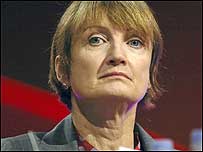 | | Tessa Jowell - under attack over escalating costs |
But Ken Livingstone has said that he doesn't want the London council tax payer to pay any more than he said they would. However, the ultimate decision will lie with the Government. The Government may have to contribute more, possibly from the National Lottery which is already paying £1.5 billion towards the Olympics. It's clear that wherever the Government gets the extra money from, there'll be an outcry.
Links relating to this story:The BBC is not responsible for the content of external websites | 



 Coming Up : Inside Out - London: Friday February 2, 2007