Allotments gallery | 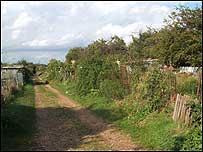 | Down on the allotment | |
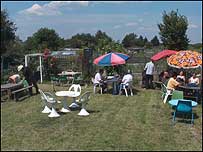
Down on the allotmentAllotments have long been a feature of London's urban landscape. In recent years there has been revived interest in them from a new generation spurred on by a desire to enjoy fresh, organic produce - and fresh air! However many sites have been sold off meaning that waiting lists for plots are now in the thousands. Inside Out visits Hackney where a group of allotment holders are trying to save their own site from redevelopment by Olympic planners. Read the London Assembly's report on disappearing allotments Plots of goldManor Gardens Allotments in Hackney comprises 80 allotment plots which provide food for over 150 families For some of these plot holders, the allotment produces all the food they need. Take Hassan - everything he eats is from the garden including tomatoes, cucumber, rocket, chilli and even sorrel, all of which are lovingly grown on his plot. "We sit down and talk - we eat something, drink a cup of tea..." | Hassan on the allotment community |
In the 16 years Hassan has been working on his plot, he has brought a little bit of the Mediterranean to East London with olive and fig trees. Since he started, Hassan has also made lifelong friendships with the other gardeners.
One of his best friends is Reg, the real elder statesman of Manor Gardens. He started coming to the allotments with his father when he was just eight-years-old and he's seen many changes in that time. "I started coming up here before the war with him, and then during the war we got moved off of here and the Army took this site over. "When I first started coming up here, it was all the like, East End of London people... you know, dockers and all that sort."
Reg can remember the man who made all this possible - the wealthy local landowner, Major Villiers. 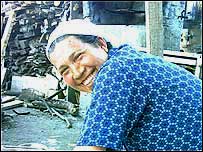 | | Allotment holders find a sense of place and community |
He gave away some of his estate to be used as allotments by people in the area - Villiers told the plot holders that the allotments would go on in perpetuity. "He said, 'you'll never be thrown off here... you'll be here forever'," recalls Reg. But it appears that that the allotments are slap bang in the middle of the Olympic site and are subject to compulsory purchase order by Olympic planners, the London Development Agency. It defends its decision to acquire the land:
"The allotment site is at the heart of the Olympic park that we're looking to develop and, obviously, we're trying to assemble all the land to make that happen."
Fighting off the bulldozers
Far from losing the plot, the gardeners here are happy to take on the London Development Agency and stop their plans to bulldoze this site.
They've been holding a few planning meetings of their own under the guise of the Manor Gardens Society. 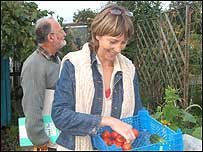 | | Food for thought - Julie Sumner and the allotment holders fight on |
The London Development Agency has offered them an alternative site, but moving locations isn't as simple as it sounds. It wants the plot holders to get off the land by March 2007 which means that the gardeners can't plant anything to harvest next Spring. They also reckon that it will take them at least five years to get up and running properly again. On top of that, the new site will only be available for six or seven years, requiring them to move a second time. The plot holders would prefer to find a permanent solution before Manor Gardens is gone forever.
They are keen to stress that they are not 'anti-Olympics', but they would like to find a compromise solution.
Green Olympics?
Julie Sumner, the Society Secretary, points to a missed opportunity for the Olympic planners:
"There's all this kind of talk about
the Green Olympics
and yet they're taking out the greenest thing they've got."
But it's not just the environment that will suffer, the allotments are a meeting place - local people are united simply by their love of the land. "It's like one big family
tell you something, this is like my second home over here." | Eddie, allotment holder |
It's also a joy which is passed on down the generations - many children get involved on the allotment.
Nine-year-old Josephine has gained a lot of gardening know-how from her grandfather Eddie - she has been helping on his plot since she was just knee high. Her friends also come over to the allotments every weekend and join in, sometimes camping overnight. The campaign to save the allotments is not just about fruit and vegetables - it's about friendship and a sense of community. If the allotments are lost, then a small piece of London's community life will be broken up forever. London allotments - the factsThe London Assembly has recently carried out the most comprehensive survey of allotments in the capital - and its main findings were: * more than 1,500 plots have been lost over the past 10 years an area the size of more than 50 football pitches;
* Londons loss of allotments is occurring at three levels the number of sites, the number of plots, and the land area used for allotments; * demand for allotments has never been higher due to the growing interest in organic food, particularly among women and young families; * there a re more than 4,300 people in London's allotment waiting lists 3,000 more than a decade ago. * in some areas there is a 10 year wait for allotments and many popular sites have closed their lists completely.
The report recommends that London's boroughs share information about the allotments they have, and look at ways of increasing supply. One idea is to insist that g developers of high density housing allocate a proportion of land for new allotment sites. Mr Hulme-Cross from the Allotments Regeneration Initiative says: "All over London, where the pressure for land is intense, allotments are losing ground in our urban landscape... "Allotments bring so many benefits, including strong social networks, the health and financial advantages of growing fresh produce, and a real sense of community. "It is essential that action is taken to protect the capitals allotments, and I believe the recommendations in this report outline the first steps towards their sustainable future."
Links relating to this story:The BBC is not responsible for the content of external websites | 



 Coming Up : Inside Out - London: Monday October 30, 2006