RICHARD III AND BOSWORTH FIELD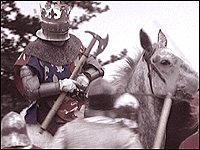 | | Shakespeare's image of a murderous villain has stuck |
King Richard III is often depicted as a ruthless tyrant, but new evidence suggests he's been much maligned. Inside Out takes a trip back in time to Bosworth to uncover the 'real Richard'. Think of King Richard III and most people conjure up images of an evil tyrant with a hunched back and murderous appetite for power. We can blame Shakespeare for discrediting the monarch who ascended to the throne amidst some of the greatest power battles in English history. But the real Richard was far removed from Shakespeare's monstrous caricature who died at the Battle of Bosworth Field in Leicestershire. RICHARD III
FACT FILE | 1452 - Born at Fotheringay Castle in Northamptonshire 1461 - Richard became Duke of Gloucester
1471 - Took a leading part in the battles of Barnet and Tewkesbury. Married Anne Neville 1483 - Named Protector of the realm and Edward IV's heirs
June 1483 - Edward IV's sons bastardised by Richard October 1483 - Princes in the Tower disappear in mysterious circumstances July 6, 1485 - Richard III crowned king August 22, 1485 - Richard III killed at Bosworth |
The real RichardHistorians have uncovered new evidence which further discredits the Shakespeare view of Richard III as a power- hungry despot. Richard's reputation as a symbol of evil only started after his death. Most of the bad press around Richard III was initiated by Tudor propagandists, including Thomas More and William Shakespeare. Richard was also depicted by Tudor artists with a hunchback and withered arm and limp. But these pictures were painted long after Richard's death. Earlier portraits show no signs of the king being physically deformed nor is there any written evidence of any disability. Who was Richard?Richard was the youngest son of Richard Plantagenet, Duke of York, who was the heir to the line of descent of Edward III. Richard was created Duke of Gloucester in 1461 after his eldest brother, Edward, had deposed Henry VI and been crowned Edward IV. When Edward IV died, Richard became protector of the realm for the dead king's son, the 12 year old Edward V. Richard waged a campaign to get the boy and his brother declared bastards, and proclaimed himself king. Reputations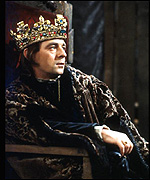 | | Richard was a reformer and champion of the common people not a despot |
The Richard III Society is dedicated to reclaiming the reputation of the monarch who died over 500 years ago. They are keen to pint out that in his own lifetime, Richard's reputation was high particularly in the North where he defended England successfully against the Scots. Richard also introduced many reforms and bettered the living standards and liberties of the common people. The Princes in the TowerOne of the worst accusations levelled at Richard III was that he murdered the Princes in the Tower. Once Richard had been crowned and his nephews bastardised, some historians believe that the young princes were no longer a threat. But their disappearance led to a great controversy around Richard and accusations of murder still linger. Bosworth Field - a kingdom for a horseRichard III's reign ended in an ignominious defeat and his death at Bosworth Field in Leicestershire in 1485. 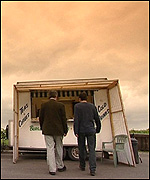 | | Was the new king of England really crowned in a lay-by where there's now a burger bar? |
Henry Tudor's troops came head-to-head with the king's army at Bosworth.
Although Richard boasted a bigger army, he was defeated and became the last English king to die on the battlefield.
Today's Bosworth Field boasts a visitor centre and a battlefield trail, but is it the real site of the battle? It seems strange that Richard III crammed all his troops into a small hilltop visible to the enemy's forces. A new theory suggests that the battle site is not here but eight miles away on the Warwickshire border near Atherstone.
The battle of Merevale?Some historians believe that the climax of the battle and crowning of Henry VII took place in what is now a layby next to the A444.
The evidence for a new battle site is: - There are many local place names referring to Richard III in the Atherstone area
- Richard's army were unlikely to have camped on top of Ambion Hill near Market Bosworth for all to see from a distance
- Henry VII paid compensation to Merevale Abbey near to the new battle site.
Others aren't so sure, claiming that Bosworth was the battle site and that it was Richard's suspect battle tactics that led to him camping on high ground. A historic puzzle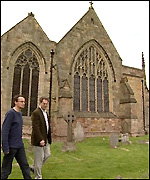 | | Merevale has a medieval window which links to the battle between Henry and Richard |
The debate about the real battle site continues but another mystery remains. What happened to King Richard's body? Some believe it ended up in the river in Leicester. At least three skulls have been recovered from the river that could be the head of Richard III.
Whilst there is no solid evidence to suggest that two are Richard, the third skull remains in the hands of a collector whose identity is a secret. One thing is certain - the true Richard III remains an enigma just like the mystery of the battle of Bosworth Field itself. | 



