Bouncing back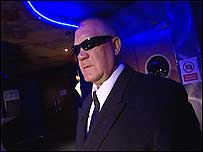 | Working the doors - the image of bouncers is changing |
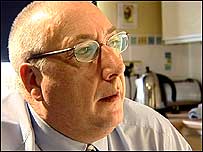
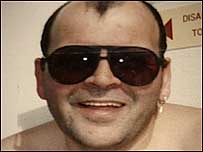
Ten years ago the image of bouncers in Nottingham hit rock bottom. Undercover reporter Donal McIntyre spent 11 months "working the doors" in the city's pubs and nightclubs. His documentary revealed a seedy underworld of drug dealing and criminals. Inside Out East Midlands investigates how the club scene and door supervision has changed since then. Door supervisorsOur first discovery is that door staff aren't bouncers any more.
Nowadays they're called door supervisors and their image is changing.
The makeover started 10 years ago. After the McIntyre film went out, the authorities had to act. Gone are days when anyone could walk off the street and get a job on the doors.
First, local councils introduced compulsory training and badges.
Then came the Private Security Industry Act - that made it illegal for anyone to work on the doors without a licence from the Security Industry Authority.
Jackie Munn from the SIA says the national scheme introduced a national standard: "There was a recognition that things had to change. I personally knew of door supervisors who had convictions for murder. We couldn't continue as we were."
In 2006, on a Friday or Saturday night, door staff outnumber the police on duty by a ratio of 10 to one.
Inspector Paul Winter from Nottingham's central police station told us, "We need them and they need us. We have 350 licensed premises in the city centre and without the help of door staff, keeping the peace would be virtually impossible." Training as a door supervisorOur presenter Marie Ashby decided to find out for herself what it's like to train as a door supervisor.
To get your badge today you need to be police checked, you need to get through four days of training, pass some exams and then hand over £190.
The modules cover everything from drugs awareness to civil and criminal law. 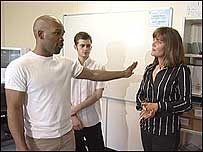 | | Conflict management - Marie Ashby learns the tricks |
Marie joined a class of students studying conflict management.
The emphasis is on defusing the tense situations that crop up every night outside our pubs and clubs. Trainer Jason Brown told us good communication skills are better than bulging biceps: "A lot of the time, just by talking to the potential troublemakers and perhaps empathising with them, you can calm the situation and stop it from escalating."
After the theory, the practice - Marie got her chance to work in a real nightclub on student night at Isis on the edge of Nottingham.
Her mentor was 65-year-old Don McCalman, a doorman with experience spanning three decades who has written a book, 'Bouncing Back' about his experiences.
Don showed Marie just how tough it can be to look after everyone in a nightclub full of 2,000 students determined to have a good time.
At the end of a long shift Marie has gained a real insight into a world few of us see:
"Making this film has been a real eye-opener. We're not saying all door supervisors are angels but after tonight I've got a lot more respect for the work they do." Links relating to this story:The BBC is not responsible for the content of external websites | 



 Inside Out - East Midlands: Monday October 2, 2006