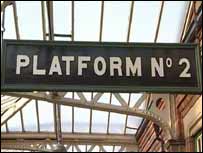
The Great Central RailwayThe Great Central Railway began life as the Manchester Sheffield and Lincolnshire Railway (MS&L), in itself an amalgamation of three smaller companies. Had it not been for Edward Watkin, General Manager in 1854 it would have stayed that way too. Great Ambition
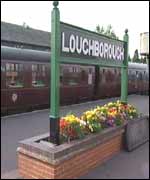 | | Loughborough was a busy station for both passengers and freight |
Watkin was a man of great ambition and proposed the building of a Channel Tunnel in order to expand Manchester and Sheffield’s industries to European markets. He became the Chairman of South Eastern Railways as well as the Metropolitan Railway. Watkin spent years haggling with other companies to create links from the MS&L to London, but made little headway. The London ExtensionIn 1899, proving that if you want a job doing properly, do it yourself, Watkin opened the London Extension. 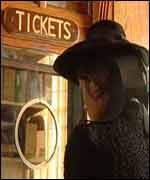 | | "Rapid Travel in Luxury" |
The directors changed its name to Great Central Railway to reflect its new trunk line status. Sadly Watkin retired due to ill health before the rest of his ambition could be realised. The Central Railway became noted for its attractive locomotives, living up to its slogan "Rapid Travel in Luxury". DeclineIn 1923 it became part of the London and North Eastern Railway and with Nationalisation in 1948, it became part of British Railways. Its decline began in 1960 with the withdrawal of the daytime Manchester to London express. In 1966 long stretches were closed and three years later the Nottinghm to Rugby section closed completely. Fortunately, its history continues to live on in glorious working order, as steam engines run along the double track at Loughborough's Great Central Railway. | 



 Inside Out - East Midlands: Monday 18th October, 2004