TO SEE OR NOT TO SEE - NATURAL VISION CORRECTIONNearly 75% of British adults wear glasses or contact lenses to correct vision. But there are some who believe that perfect vision, like beauty, is in the eye of the beholder. Inside Out takes a closer look alternative vision improvement. With almost 17 million eye examinations taking place in England last year, vision correction is big business. Many glasses wearers are now choosing to ditch the traditional specs and are opting for contact lenses or even laser corrective surgery. Neither option comes cheap so an alternative approach to vision correction is bound to grab attention. A closer lookThe theory of alternative vision improvement is by no means a new one. It was created by Dr William Horatio Bates, an American ophthalmologist, almost a century ago. 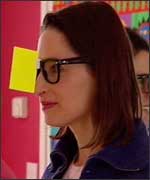 | | Alex firmly believes her vision is improving |
Known as the Bates method, the technique, which is "educational" rather than medical, involves relaxation, eye-exercises and eye-care. Users of the method claim to reduce the magnitude of their lenses and in some cases, become entirely spectacle free. With no medical evidence to prove his controversial theory, Bates was shunned by the medical profession. That did little to deter the practice developing however and Inside Out's very own be-spectacled Jess Whittaker is putting the theory to the test. In focus| "All of a sudden my eyesight cleared and I could walk down the street and see faces and eyes - amazing! " | | Alex who practises the Bates method |
Users of the Bates method claim fairly dramatic improvements in their vision. "My vision is getting better on a week by week basis," agrees Francis. "I've only been at it (Bates method) six months, and I'm very hopeful that the day will come when I can discard my glasses entirely." With a lack of medical evidence to support these claims, Inside Out's Jess Whittaker prepares to undertake a three month course of the relaxation technique Palming, to see is she can ditch those specs for good. Testing, testing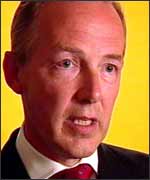 | | Simon remains sceptical about the Bates method |
Eye Consultant Simon Hardman Lea from Ipswich Hospital carries out Jess' initial eye test. Simon confirms that she is indeed short-sighted and admits to being sceptical of alternative vision improvement treatments. "If the theory doesn't fit the available facts then the theory is probably wrong," he says. "The theory Dr Bates put forward 100 years ago flew in the face of all scientific evidence of the time and since, so the conventional medical answer is we wouldn't expect Bates to make any difference to your short-sightedness." Eyes in trainingJune Godfrey of Chelmsford would be the first to defend the Bates method. She is one of 30 people teaching the technique in the UK. Colour, light, movement, meditation and children's toys are used to retrain the eyes to see surroundings differently. The relaxation technique of Palming is the exercise June teaches Jess. 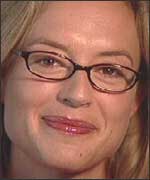 | | Like many other glasses wearers, Jess would like to be spectacle-free |
Jess can perform this exercise as often as she likes and over time, June believes it will help enormously. And, according to Jess, it does. Three months on and Jess admits she can feel an improvement in her vision. She suspects however that it may be a case of mind over matter. June is quick to dispel this. "We see with our mind so emotions will affect the eyesight. But if you mean "am I imagining it?" No certainly not. "You've proved to yourself that you're seeing better and that is what really matters." The end of glasses?It may be all that matters to those who experience improvements in their sight, but the medical profession insists on evidence so it's back to the opticians for Jess. | "I've never been convinced and looking at your tests before and afterwards, there is no evidence that it works." | | Simon Hardman Lea, Eye Consultant |
Although Jess says she felt an improvement in her vision, Simon reveals that there is no change in her vision test results. With no measurable improvement in Jess' eyesight the Bates method remains controversial and unsuccessful in the eyes of the medical profession. Many who practise the Bates Method however, remain convinced that their vision is improving, but for Jess - it's back to the glasses. | 



 REALPLAYER REQUIRED