BEING DIFFERENT- LIFE WITH ASPERGER'S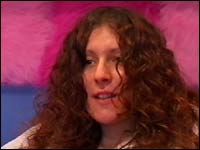 | | Nita Jackson is trying to live a normal life |
Nita Jackson has Asperger's Syndrome, a socially debilitating condition similar to autism. Nita tells her own story; of how she feels and how she is trying to help people understand her. Can you tell when something's wrong just by the tone of a person's voice? Do you know how they feel about you by the way they're sitting? Most of us can interpret the little signals people put out, and use them to decide how to react. But that's not the case for Nita Jackson. As a person with Asperger's she has an inate inability to read people's body language. She has trouble keeping eye contact with others and making friends. Reading Body Language"The trouble is that on the surface there doesn't seem to be anything different about me," she says. "I look normal, but I'm not like other people. I find it hard to read body language, facial expressions or tone of voice." "Conversations are like, they're [non-Asperger's people} playing tennis getting a good rally going when you're useless at tennis." As well as difficulties in decoding other people's speech, Asperger's sufferers also tend to speak in an unusual way themselves. Though their grammar is correct, their style of speech may be repetitive and jarring. "You know I'm British," Nita says. "I've been to lots of places and I've picked up the accents and they've just stuck. "Every time I go somewhere I pick up another accent, a little facet of that accent incorporates with the one I've already got and it ends up as a completely weird, random, scatty." Obsessive Thoughts?And Nita admits to having had obsessive tendencies. "It's okay to be in love with a popstar, it's okay to have their posters on your wall. It's okay to listen to a radio show over and over and go 'he's got such a beautiful voice'," she says.
"But it's not okay to try to get to know that person on an intimate level. There is a divide. "A lot of people with my syndrome don't realise that because of the social interpretation and stuff like that."
People with Asperger's may also appear to have a "one-track mind" when it comes to hobbies. Obsessions with cars, trains, history or literature are common. There is no cureApproximately one in 300 people are thought to have Asperger's Syndrome - and three quarters of them are boys. Like autism, there is no treatment for the causes of Asperger's, but autism is usually more severely disabling.
Those with Asperger's Syndrome tend to be more able to get on in normal society. And doctors are finding ways to treat some of the more severe symptoms. 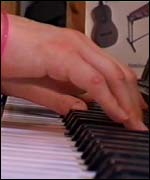 | | Nita is an accomplished pianist |
What can be done?Nita has been taking part in sessions in social skills to help her become more independent. She has been given special training in shopping and other key tasks that involve social interaction. A range of medications are also available to treat different aspects of the disorder, such as anxiety, obsessions, and irritability. But one of the key things sufferers like Nita want is a wider awareness and understanding of Asperger's by other people. "Although I have help, life can be very lonely," she says. And life can be lonely for the families of those with Asperger's as well - particularly if it has gone undiagnosed. Partners, and especially children, may feel crushed by their loved-one's inability to connect with them emotionally, sharing triumphs and disappointments. If they are made aware the apparent lack of feeling is due to a neurological condition and not their own failings, this can help families to cope. Having Asperger's doesn't mean you're stupidNita is extremely bright and keen to succeed. Although only 19, she has written a play, had one book published (another is on the way), and is also a gifted pianist and artist.  | | Nita enjoys drawing. This is one of her portraits |
In fact it is believed that some of the world's most famous historic figures may secretly have had undiagnosed Aspergers. Researchers at Cambridge and Oxford universities believe both Einstein and Newton displayed signs of Asperger's Syndrome. Newton hardly spoke, was so-engrossed in his work that he often forgot to eat and was lukewarm or bad-tempered with the few friends he had. If no one turned up to his lectures he gave them anyway talking to an empty room. In her book, 'Standing Up Falling Down - Asperger's Syndrome from the Inside Out', Nita examines her own and other people's attitudes to Asperger's. "It's so so hard," she says. "That's why you can read fifty books on the subject and still not know enough. "That's why my mum is continually reading books, continually talking to people - it's such a complicated syndrome." "You have to study it intensively for twenty years before you have even half a grasp of what it is."
"If more people understood Asperger's, people like me would feel part of society. And I for one feel I have a lot to give." | 



