CANCER SCREENINGNina Hobson swaps her role as Inside Out reporter, to share with us her frightening and very moving experience of ovarian cancer. When Nina was 18 months old, her grandmother died of ovarian cancer. More recently, her mother died of the same disease. Nina therefore runs a high risk of developing the disease too. After developing abdominal pain, Nina took action and went to visit her GP.
No available testingNina was shocked to learn screening is not readily available for this type of cancer. At the moment, only breast cancer and cervical cancer are routinely screened for. Breast cancer is the most common cancer in women, yet ovarian cancer is more common than cervical cancer. Nina’s GP explained that as yet, there is no reliable test for ovarian cancer. So instead, Nina is referred to a genetic counsellor. Genetic counselling Like Nina, you may be forgiven for imaging that genetic testing would involve a simple blood test. Genetic counsellor Ann Kershaw explains that the procedure is far more complicated than that.  | | Both Nina's mother and grandmother suffered from Ovarian cancer |
A blood sample from an affected family member is first required in order for the gene fault to be identified. Once the gene fault is detected, they can then test the patient's blood to see if they too carry the gene responsible. Without blood from an affected family member, the process becomes almost impossible. Both Nina’s mother and grandmother died from the disease, making genetic counselling little help in this case. Left with no option, Nina pays privately for an ovarian scan and within two weeks is in hospital awaiting surgery for suspected ovarian tumors. Surgery| Cancer rates | A league table of cancer types and incident rates for women in Norfolk. breast 575
skin 554
colon 166
lung 166
ovary 141
uterus 97
rectum 63
lymphoma 61
bladder 53
melanoma 51
pancreas 44
osophagus 36
cervix 30 |
Simon Crocker, consultant gynaecologist and obstetrician explains that in high risk families, any abnormality is acted upon immediately. Simon says; "From a practical point of view, we are taking away all reasonable risk,"
Nina goes into surgery unsure whether she will need a hysterectomy, but with even the slightest chance of cancer, she knows the surgeons will take no risks. Once out of surgery, Nina’s worst fears are confirmed. Finding several cysts on her ovaries and an enlarged area, surgeons were forced to carry out a hysterectomy. Understandably, this is devastating news for Nina; "Knowing I can no longer have children is hard .. I’ve got two lovely kids and I should be grateful for that, but it doesn’t make it any easier and I’m really struggling."
Difficult decision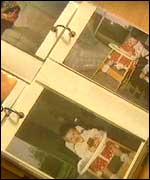 | | Nina has two children, but that doesn't make her hysterectomy any easier to deal with |
To make her decision all the more difficult to deal with, Nina’s ovaries turn out to be free from cancer. Unfortunately surgery was the only way of discovering this. Although as Nina reasons, "It was too big a risk to do nothing." Just four weeks after the operation, Nina returns to work and life begins to return to normal. Developing ovarian cancer was a risk too big to ignore. Nina can now look forward to a healthy life free from the fear of ovarian cancer. She hopes that future medical developments will bring a screening test to save other women going through a similar experience; "I’m going to move on from this and be strong and if this video helps just one person deal with what we’ve dealt with over the past few weeks, then it’s been worth every second… "Maybe we’ve all learnt to expect too many medical miracles, but that doesn’t stop me hoping that history won’t repeat itself for my children."
| 



 Inside Out - East: Monday 20th January, 2003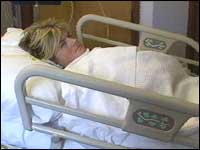
 REALPLAYER REQUIRED