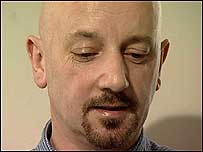
 | "Hungary can say what it likes. It doesn't alter the fact it does not own the treasure."
Ludovic de Walden |
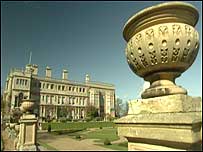
Sevso treasure Castle Ashby is the spectacular family seat of the Marquess of Northampton.
But its glorious facade hides a grim financial reality - it's losing money - and lots of it. To save his family heritage, Spencer Compton, the 7th Marquess, says he needs to sell the world's most stunning collection of Roman silver. But the treasure worth millions is gathering dust in a secret vault, at the centre of an international tug of war. Tug of war
The story starts in Hungary near the town of Polgardy. Legend has it that a fabulous collection of silver was housed at a Roman palace, belonging to a nobleman called Sevso. The site is now dominated by an open quarry. 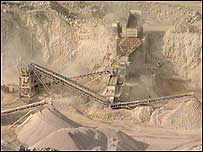 | | The quarry in Hungary - connected to the treasure? |
Thirty years ago, according to locals, a young quarry worker - Jozsef Sumeargh - hit something hard in the ground with his shovel. They believed it was the Sevso silver - treasure beyond his wildest dreams. Bela Vukan, a detective with Hungary's National Bureau of Investigation, took Inside Out to the spot, in an old wine cellar, where it's rumoured, Jozsef kept the hoard hidden in a hole in the ground. But it wasn't long before the Sevso curse claimed its first victim. Jozsef was found hanged... just inches away from his dazzling find, which then vanished. Suicide or suspicious death? The official version was that Jozsef committed suicide. 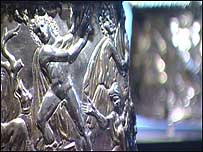 | | Fabulous Roman craftsmanship on one of the pieces |
But Bela Vukan does not believe this. He showed us how the hanging theory has been tested - and believes that Jozsef could not have killed himself with the belt he was supposed to have used: "In 1980 the case was closed and recorded as suicide. "But in 1990, after local rumours were investigated, I came to the conclusion this was not suicide - this was a case of murder."
Shortly after Jozsef's mysterious death, pieces of the Sevso silver started to appear on the London market. Lord Northampton bought all 14 pieces, for around £10 million. In 1990, he put them up for sale in New York, but he was in for a shock. The sale was halted by the Republic of Hungary which claimed ownership. Trail of silver Dick Ellis, a former Scotland Yard detective, now living in retirement in Suffolk, was asked to investigate the trail of the silver. He thinks the Hungarians have a strong case: "From the evidence I've seen, the only country which has come up with a substantial degree of evidence is Hungary. "The Hungarians have produced substantial evidence that it (the Sevso silver) originated in their territory."
 | | Nightmare - Northampton has argued his case for 25 years |
Lord Northampton himself won't be interviewed about what he calls his 25 year nightmare. Instead, his lawyer Ludovic de Walden argues his case for the Sevso treasure: "Hungary can say what it likes. It doesn't alter the fact it does not own the treasure.
"It belongs to the Marquess of Northampton Trust settlement of 1987. And unless, and until, someone comes along to unseat his title, it belongs to the Trust."
So, Hungary's claim remains unresolved. But for Dick Ellis, one thing is for certain - the movement of the silver to London involved fraud, deception and theft by ruthless middlemen. Investigation The police investigation then turned towards Lord Northampton: "We received a telephone call from Ludovic de Walden begging us not to arrest his client because, frankly, that was our next step. "And we were then able to talk to Lord Northampton and he was able to do something he had always wanted to do - that was to actually talk to us."
After which, Lord Northampton was cleared of any wrong doing... but in Budapest the campaign for the silver's ownership was stepping up. 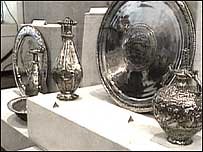 | | Tainted treasure? Who really owns the silver collection? |
The Hungarians claim to have more evidence the treasure is theirs. They believe a silver folding table - called a quadruped - held at the museum is part of the Sevso treasure. It's the same age and was found in the same place - the craftsmanship is very similar. They want to see it re-united with the rest of the treasure at their national museum. Zsolt Mrav, Museum Curator told Inside Out: "We strongly believe that the silver folding table from Polgardi is connected with the Sevso silver because of its similarity in decoration; because of its date; its style and, mainly, its provenance. "If it came to Hungary I would be very, very pleased. "Then I'm sure the Sevso treasure, along with the folding table, would be exhibited very soon. Probably in the Hungarian National Museum in Budapest, which is one of the oldest museums in Europe."
That doesn't cut any ice with Lord Northampton. It's understood that he values the collection at between £50-100 million. So far the Hungarians have offered nothing like that sum. Put up or shut up Ludovic de Walden says it's time they put up or shut up: "Look, the position of Hungary is no different from anyone else interested in buying the treasure. "The treasure has always been available for sale. It remains available for sale. "It's Lord Northampton's intention to sell it within his lifetime. "If the Hungarians were serious about entering into negotiations then, of course, we would. "The problem with Hungary is that we see no evidence of seriousness. If the Hungarians have got a change of heart, they know where I am."
But as things stand, with the ownership in dispute, no one is likely to want to pay anything for the treasure. 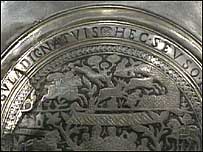 | | Secret of the silverware - we may never know the full story |
The name Sevso is thought to derive from the name of the Roman General, whose villa once housed the original collection. One of the big hunting plates contains this dedication: "May these - Oh Sevso - yours for many ages be, small vessels fit to serve your offspring worthily."
We'll probably never know if the Sevso silver actually served anyone - worthily or otherwise. What we do know is that a compromise will have to be reached before the Curse of the Sevso silver becomes the blessing it was originally designed to be. Links relating to this story:The BBC is not responsible for the content of external websites | 



 Coming Up : Inside Out - East: Friday March 23, 2007