Crane - gallery | 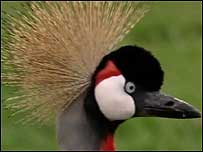 | "I think they are the most romantic sort of bird..."
John Buxton. | A Crane in its full glory | |
The secret life of CranesThere are 15 species of Crane in the world but only one has ever been native to Britain. The Common Crane, also known as the European Crane, was once common in Britain, especially in East Anglia. Inside Out investigates the comeback of this stunning rare bird which is the subject of important conservation work in Norfolk. Visit the Cranes photo gallery
Hunted to extinctionAny town with the word 'Cran' in its title might have a history of Cranes - such as Cranwell, Cransford or Cransley. Drainage of wetland habitats and persecution of these majestic birds for banquets caused their extinction by around 1600.
Wild Cranes now have only one known nesting site in the country because of a stroke of luck 30 years ago. 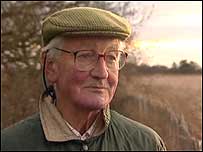 | | Crane champion - conservationist John Buxton |
A pair of migrating cranes were flying over Norfolk and settled on a marsh managed by a dedicated naturalist. He knew their survival depended on him protecting them and keeping them secret. John Buxton is the only person who knows the exact location where the Cranes nest. He has protected the birds from curious visitors - hence the secrecy, but now he has agreed to tell Inside Out how the Cranes survived, and to show fantastic footage of these wonderful birds. John explains the attraction of these graceful, long legged creatures: "I think they are the most romantic sort of bird. They do all sorts of things like dancing which no other bird I know does.
"I think they're very special birds. Although they've always been in this area, they last bred here 450 years ago before they started this time in the early 1980s. "I believe that protection by security and secrecy is a very important thing for rare birds."
Reintroducing CranesThe good news is that there is now another attempt to breed Cranes in captivity and reintroduce them to the wild at the privately owned Norfolk reserve Pensthorpe. 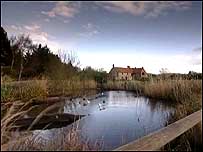 | | Pensthorpe - helping to re-establish Cranes |
Bill Jordan, the reserve's owner, is passionate about getting the numbers of the bird increased. Recently the reserve had a lucky break when a wild Crane landed in the reserve. It may have come from John Buxton's site. It now seems to be attempting to mate with one of the captive females, which will be a welcome boost to the breeding programme. The arrival of the wild Crane is also useful in that it should help the captive birds' chances of learning to survive in the wild, by teaching them to fly and evade predators. Mimicking bird behaviourAnother method employed at Pensthorpe is a Crane "glove puppet". The Park Manager, Andrew Reeve, uses it to act out wild behaviour, thus helping the young Cranes to learn what to do. 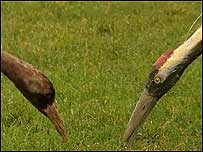 | | A young Crane learns from a 'puppet' bird |
Its a technique learnt from the International Crane Foundation in America where it has been successful, as Andrew Reeve explains: "You have a puppet which goes onto your hands and arm which looks like a Crane's neck. "And basically you teach them to behave like a Crane."
The Great Crane Project aims to boost numbers of the birds and to breed them in captivity. It's all to make sure that the birds grow up behaving like wild Cranes and not to get too reliant on humans. The results of the project will be long term - the conservationists hope that, in their children's lives, the East Anglian skies will once more be graced by these beautiful birds. In the meantime the birds are one of Norfolk's best kept secrets. Links relating to this story:The BBC is not responsible for the content of external websites | 



 Coming Up : Inside Out - East: Friday February 2, 2007