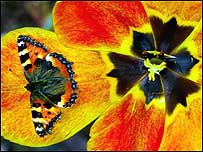
 | Butterflies - early sightings are increasing. Image - PA. |
Nature and climate change Inside Out investigates the impact of global warming on wildlife across England. Mike Dilger travels from the South West of England, almost to the Scottish border, on his quest to find out how climate change is affecting wildlife. Coastal changes
Mike starts his journey in Plymouth fish market in Devon where every week day catches from all over the country are brought to be sold. Fish have been caught in the waters around the coast of South West England for hundreds of years. But traders are finding is that warm water species are regularly turning up that were very rare a decade ago. 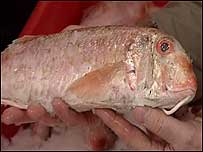 | | Red Mullet - the new British fish with chips? |
As this region is one of the warmest places in the country, it's perhaps not surprising that we're starting to witness some evidence of climate change. On our visit to Plymouth fish market we saw Couch's Sea Bream and Red Mullet. Gilt Head Bream and Common Octopus were spotted on other occasions. All these are well beyond their usual range. Could this be the impact of climate warming? Not everybody is agreed because different factors can make fish move around. But what's certain is that sea temperatures around our coasts are getting warmer, and we're getting lots more curiosities like these. Rock pool wonders It's not just in the sea that we are seeing changes - it's also evident on the beach where the make-up of our wildlife is changing. Mike's next stop is Wembury beach, just a few miles up the coast from Plymouth - a great place for rock pooling. 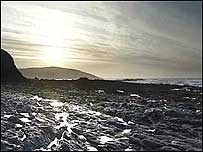 | | Wembury beach - the climate is changing at beach level |
Here warm water species are becoming more common such as purple top shells, and experts are finding, that as warm water creatures increase, the cold water ones lose out. Nove Mieszkowska of the Marine Biological Association has been carrying out a four year study of our rocky coast. She's found that cold water barnacles and limpets are now being outnumbered by warm water species: "These are bottom of the food chain
so real sentinel species - early warning indicators of what's happening elsewhere in our marine environment".
Mediterranean wildlife Elsewhere the warmer winters mean plenty of Mediterranean creatures are moving in. For example, Little Egrets, which began breeding in Dorset for the first time in 1996, are now breeding on several sites. Another creature that's spreading is the False Widow Spider, a relative of the infamous Black Widow Spider. 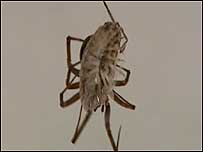 | | Bug life - some species like our new warmer climate |
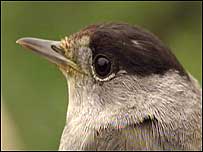
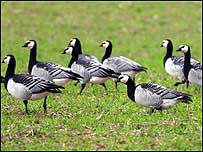
These spiders were first recorded in Torquay in Devon in the 19th Century. They arrived as stowaways on crates of bananas from the Canaries. They remained on the south coast in small clusters. But with the recent run of mild winters, they've increased in number and distribution. One study has showed that where they meet our native spiders, they either push them out or eat them! Changing wildlife We're also likely to lose some of our wildlife, who find it warm enough elsewhere. In the last 10 years the population of winter wading birds has fallen by between 10 and 15 per cent. 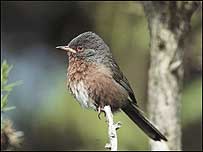 | The Dartford Warbler is expanding its range.
Photo - RSPB Images |
As the temperatures rise on the continent, many birds realise they don't need to come to Britain for the winter. They can stay close to their breeding grounds and save energy. The Dartford Warbler was once found only on heathland along the south coast. Now they've been seen in East Anglia and South Wales. Out of harmony? Mike Dilger also heads north to the Dark Peaks of the Peak District, an area of high moorland sandwiched between Sheffield and Manchester. This area boasts the only English population of Mountain Hare. In winter they turn white to camouflage them in the snow, hiding them from predators. The trouble is there's not much snow anymore. 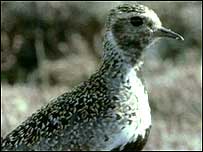 | | Out of synchronisation - dangers for the Golden Plover? |
The Hare might eventually stop turning white, but in the meantime they stick out like a sore thumb. The Peaks are also the southern extreme of blanket peat bog, a habitat that's as rare as the rainforest, and internationally important for breeding birds.
The Golden Plover comes to nest here in the spring, feeding on the insects in the spagnum pools. But research shows that as it's become warmer, the Golden Plover have started nesting earlier. The fear is the insects they feed on won't similarly adapt, and the birds will be out of synchronisation with the food they depend on.
But the long, dry summers are causing potentially a much bigger problem. The peat itself is drying out, and eroding. Once the peat loses water, it's difficult for it to regain that water holding capacity. It also starts releasing carbon. Wilderness refuge Mike's final destination is close to the summit of Helvellyn in the Lake District, not far from the Scottish border. At 950 metres above sea level, this mountain is one of the coldest and most inhospitable places. Yet it's one of the last refuges for some really special wildlife. After a long steep climb Mike finds what he's been looking for.
Purple Saxifrage is one of a community of alpine flowers that are ice age relics. 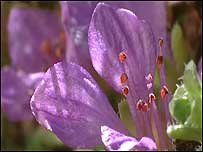 | | Purple Saxifrage - could be driven out by other plants |
You can find them on the north and east faces which are the coldest parts of the mountain. Purple Saxifrage is the best known because in April there's a dramatic display of purple flowers. These plants survive here because they have no other plants to compete with. There are so few species that can stand the cold, hostile conditions. But as temperatures rise, other more aggressive plants are likely to move in, and the Alpine plants, with nowhere else to go, are likely to disappear. Butterfly effect
Butterflies, like birds, are very visible and they can and do react quickly to climate change by expanding or retracting their range.
This makes them very good indicators of the effects of warming.  | Speckled Wood Butterfly - expanding its range.
Photo - Natural England/Glendell |
Two of our butterflies - the Comma and the Speckled Wood - have expanded their range dramatically. Fifty years ago in England both were largely restricted to the south. Last year the Speckled Wood was seen at sites in County Durham, and the Comma has now reached Scotland. Researchers reckon they're moving north between one and five kilometres every year. Wildlife impact To many people climate change seems far away. Yet we know it's happening and its effects are complex: synchronisation, habitat loss, competition, changes in distribution, and some very obvious winners and losers. It's clear that wildlife is one of the best indicators of climate change whether it's on our coasts, in wilderness areas or in our very own back gardens. Links relating to this story:The BBC is not responsible for the content of external websites | 



 Coming Up : Inside Out England: Friday March 30, 2007