Timber Framed Houses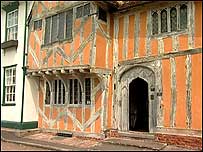 | | Dream home or living nightmare - the reality of wattle and daub |
For many of us a timber framed cottage is our dream home, surrounded by wild flowers and topped with a healthy roof of thatch. But many people are now wishing they'd spent less time sniffing the roses and made more of an effort to check out some hard facts after their vision of a perfect English idyll turned into a nightmare. You'd have thought that timber houses that have stood the test of time for hundreds of years would be a safe bet as a home. And with East Anglia having thousands of picture postcard cottages, it's easy to be tempted into buying one. But some of the advice you get when buying your dream cottage could be a load of old wattle and daub
.
Dream cottagesPaula Sunshine always dreamed of living in a country cottage. She fell for a 16th Century cottage and forked out for a full structural survey. 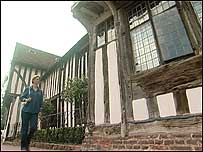 | | What lurks behind the white washed walls? |
It passed the survey, but 10 years later she's still putting right the serious faults she discovered only after moving in. The trouble is, when it comes to buying a timber framed building, beauty may only be skin-deep. Lurking behind the whitewashed walls and under stone floors can be all kinds of horrors waiting to catch out the uninformed buyer.
What's worse, as Inside Out East has discovered, is that some surveyors know so little about these historic buildings they can even fail to spot the most obvious faults, such as missing beams. Repair nightmarePaula Sunshine has spent thousands trying to repair her Suffolk cottage after her surveyor missed a whole range of problems including rotten timbers, damaged cement renders and even a beam, which was supposed to be supporting the roof, being cut in two. "Timber-framed buildings need to be able to breath," she says. "The problem is that many of them have been repaired with inappropriate concrete renders and paints which suffocate the buildings, trapping the moisture inside the walls and causing the timber frame to rot away, sometimes with disastrous results."
Paula has been so shocked by the lack of knowledge about these buildings that she's gone back to basics, learning traditional skills such as using wattle and daub to restore her 15th Century cottage. 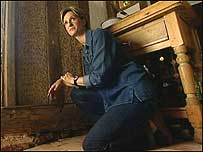 | | Time to stop the rot - Paula Sunshine checks for damage |
But like many other owners, she is still left with thousands of pounds worth of work to be done. She says surveyors should be more knowledgeable about timber-framed buildings so they can alert potential buyers to the pitfalls. Bret Hallworth of the Royal Institution of Chartered Surveyors says that not every surveyor will have an in-depth knowledge of timber-framed houses and many will not have received specific training in these types of properties.
Therefore he says it is up to the potential buyer to checkout a surveyor's credentials to ensure they have the experience and understanding to conduct the survey. Living nightmarePaula is not the only person to get caught out by a survey - Mark Davies bought his Suffolk cottage five years ago. It turned out the whole house had been rendered in cement, and concrete floors had been laid. "It's taken away years of my life. I should have spent the last five years living the dream, instead it has been a nightmare - there are times when I've hated the house etc
and I'm nowhere near finished." | Mark Davies |
It meant the house couldn't breathe resulting in trapped moisture rotting the timbers. Mark Davies estimated the cost of putting his home right would be £70,000 so he took the surveyor to court. He eventually won £52,000. Mark's experience is just one of scores of similar stories that Paula Sunshine has heard. Hit hard by her own experience, she's leading a campaign to educate buyers about these houses and make sure that owners employ a surveyor who understands timber framed buildings. The Royal Institute of Surveyors says that it's planning to make changes to the way that they look at timber framed houses.
Links relating to this story:The BBC is not responsible for the content of external websites | 



 Coming Up : Inside Out - East: Monday October 23, 2006