| 28 October 2014 |

| |
| BBC Homepage | | |
| |||
| Contact Us | | |
About Raw TalentYou are in: Humber > Entertainment > Music > Raw Talent > About Raw Talent > Rob Wright on the hellish life of a music journo 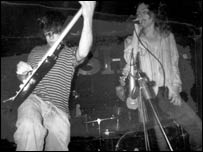 Rob Wright on the hellish life of a music journoRob writes for the BBC and for Sandman magazine but recalls the early days when deadlines beckoned and nerves began to bite... What Am I Doing Here? Everyone has to start somewhere; that place is usually somewhere low key, low rent and fraught with peril. And you can almost guarantee that something will go irretrievably wrong, or at least amusingly ca ca. For instance, take me. Please. I haven’t always been the seasoned, hard-nosed, cliché-for-every-occasion music journalist (please insert obvious comment here) . In fact, it was only two years ago that I started doing it at all, on the half baked reasoning that a) it was something I might be able to do and b) I could get some free music into the bargain. Rising through the ranks of Sandman fairly rapidly (okay, maybe an exaggeration) due to my unnerving ability to write to deadlines, I was asked to do my first interview. This was real heart in the throat stuff, because up until that point I had been enjoying the enviable position of being ‘detached observer on ‘ guest list.’ ‘Interviewing’ would require me talking to people. Taking relative pity on me, Tom Goodhand, then editor, suggested I interview Vatican Jet: four guys who I already knew indirectly from never having seen but promising to go and see for some time and who hadn’t been interviewed yet so would be in a similar position to myself – scared poopless. Choosing mutually neutral ground, the Brudenell Social club, I fished out and dusted off my Dictaphone, did a sketchy amount of research and compiled a list of questions that weren’t too stupid and were fairly open ended – lots of why’s and what’s, with room to improvise. I still make sure that I have a good supply of questions to go to interviews with; it’s always better to have too much material than too little. Besides, if things go totally secondary sexual characteristics up, you can always hide behind your crib sheet. So there I am, in the club, sitting behind a laminate-topped table on a threadbare sofa-bench, checking that my Dictaphone works and sipping a Guinness to steady my nerves. A mutton-chopped man who may or may not be Elvis (this is Las Vegas of the North, after all) is giving me funny looks and the barman is cleaning glasses to the hits of the 50’s, 60’s and 70’s. In the adjoining room, an angular indie pop band is sound checking, making the barman scowl. I smile at him. It is not returned. I am hoping the band arrive soon as, though I am not yet fearing for my life, if a chopper pulls up outside I may well start to fear for parts of it. Fortunately, all four members of Vatican Jet arrive before the chopper does. I swallow a large clump of jitters, wash it down with a drop of the black stuff, smile amiably and usher them in the direction of somewhere a bit more peaceful. Roger ‘Dodge’ Tyers, lead singer and spitting image of a young Robert Plant, saunters coolly towards the pool tables, followed by Ian ‘Dobbo’ Dobson, Matt ‘Max’ Flint and Wayne ‘Insane’ Insayne… for the purposes of this piece, let us drop one of the Insanes. With four collective plomps, the band settle themselves in a corner suite; I perch upon a stool opposite and set up my recorder on the table and my pad in front of me. I set the tape running, give it a quick check and begin my questioning. I warm them up with a few gentle opening gambits: what’s your name about, where did you meet, what are your influences - that sort of thing - and am getting some pretty good responses, almost confessional as I build up the rapport. Dodge is definitely a talker, Dobbo provides excellent support, Max throws in the occasional comment and Wayne… well, he’s your archetypal lively drummer. I start moving the questions on, riffing on themes, pursuing lines not considered before the interview: life on tour, the preference for vinyl over cd, the circumstances of the previous drummer’s departure. It’s all going swimmingly. I can feel my confidence building. Until Max brings it all crashing down. “Isn’t there supposed to be a red light on on this thing?” I look down at the recorder. The tape spindles are motionless. On rewinding the tape, I discover that the only thing I have managed to capture is my sound check, asking “Is this thing working?” Abandoning any pretence of professionalism, I let forth a stream of obscenities, much to the amusement of the band. I recover and grin sheepishly. “Do you mind if I ask a few of the same questions again – just to get it on tape.” It is a nightmare come true. All of the spontaneity that I had ‘captured’ on the first take is lost and would now be replaced by mechanical repetition. Plus, any confidence I had managed to build up had vanished along with that little red light. Somehow, we managed to get through the interview again. I still had a few questions in reserve and, at that time, my memory still functioned reasonably well, so it was not completely disastrous. In fact, seeing me cock up so monumentally probably put the band even more at ease than before. Or maybe not. Since that interview, I always make sure that my recorder is recording properly (I’ve graduated to using an MP3 recorder – much handier and doesn’t need tapes) and that I have spare batteries, spare pens, spare paper… the whole kit and caboodle. In fact, for the next couple of interviews after that, I’d take a spare recorder. Just in case. Suffice to say, I am more of a professional now. Rob Wright is a regular contributor to BBC Raw Talent and also a writer for regional music magazine Sandman last updated: 05/11/07 SEE ALSOYou are in: Humber > Entertainment > Music > Raw Talent > About Raw Talent > Rob Wright on the hellish life of a music journo |
| | About the BBC | Help | Terms of Use | Privacy & Cookies Policy |