Fact File : Second Moscow Conference
9 to 19 October 1944
Location: Moscow
Players: British Prime Minister Winston Churchill, Soviet leader Joseph Stalin and their advisers, including Anthony Eden and Molotov; US ambassadors and military officials.
Outcome: Decisions about Russia's entry in the war against Japan; post-war division of the Balkans; the future of Poland.
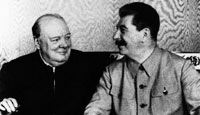 Soviet leader Joseph Stalin and British Prime Minister Winston Churchill, pictured here at the Kremlin in Moscow©
The Allied conference held in Moscow in October 1944 was codenamed Tolstoy. It involved Stalin, Churchill and their advisors. America was represented by the US ambassador Averell Harriman, as an observer, and the head of the US military in Moscow, General John Dean.
The two allies were meeting, as far as Churchill was concerned, to decide on a timetable for Russia to enter the war against Japan - an issue that he had raised 11 months earlier at Eureka.
But first, Stalin was anxious to establish the balance of power and influence that the two countries should have in the Balkans. Churchill wrote details on a piece of paper dividing Romania, Greece, Yugoslavia, Hungary and Bulgaria between the Allied powers. Stalin simply put a tick against Churchill's suggestions.
Russia did very well in the deal, winning 90 per cent of Romania, ten per cent of Greece, half of Yugoslavia, half of Hungary and three-quarters of Bulgaria. Churchill's primary interest was in Greece, and with Stalin's approval he communicated with his staff that British soldiers could be dispatched to Greece.
These issues weren't easily resolved. The British and Russian foreign secretaries (Eden and Molotov) debated over ratios and the percentages of Bulgaria and Hungary were altered to suit the Russians.
The future of Poland was also raised. Churchill proposed a meeting between the leader of the exiled Polish government (based in London) and the Soviets to determine a Polish-Soviet frontier, but nothing came of this proposal.
The fact files in this timeline were commissioned by the BBC in June 2003 and September 2005. Find out more about the authors who wrote them.