Fact File : Washington Conference
22 December 1941 to 14 January 1942
Location: Washington, United States
Players: Churchill, Roosevelt, British and American Chiefs of Staff, General Douglas MacArthur and General George C Marshall, the chairman of the US Joint Chiefs of Staff.
Outcome: A strategic policy pooling Anglo-American military resources under one command, and an agreement that Germany was still the primary enemy.
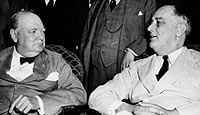 Prime Minister Winston Churchill and President Franklin D. Roosevelt©
The Arcadia conference took place two weeks after Pearl Harbor and resulted in the decision to pool British and US resources and develop a strategic policy that would win the war for the Allies. According to General George C Marshall, the chairman of the US Joint Chiefs of Staff, this conference provided: '... the most complete unification of military effort ever achieved by two allied nations'.
Also agreed was the dispatch of US troops to Northern Ireland and Iceland, and the wording of the United Nations Declaration issued on 1 January 1942. This did not mean, however, that Arcadia committee members were not without their differences of opinion. As Churchill once claimed, the differences were about 'emphasis and priority' rather than 'principle'.
An invasion of North Africa was proposed and rejected, and General Douglas MacArthur made requests for immediate action in the Philippines and the inclusion of the USSR in the Lend-Lease agreement. They were wavered.
Churchill had been concerned that the focus of the Allied effort might become Japan, but General Marshall presented a memorandum at the meeting which was met with relief: 'Notwithstanding the entry of Japan into the war, our view is that Germany is still the prime enemy and her defeat is the key to victory.'
Roosevelt's endorsement of the conference was to be lauded, as the US people were clamouring for revenge after Pearl Harbor and felt less urgency in securing the defeat of Hitler.
The fact files in this timeline were commissioned by the BBC in June 2003 and September 2005. Find out more about the authors who wrote them.