Fact File : Indian Ocean Raid
Late March 1942 to 9 April 1942
Theatre: South East Asia
Area: Ceylon (now Sri Lanka) and the Indian Ocean.
Players: Allies: Naval force under Admiral James Somerville (three carriers and five battleships). Japanese: Task force under Vice Admiral Nagumo (five carriers and four battleships).
Outcome: The Japanese destroyed several Allied ships and planes, but then retired as planned, and the island of Ceylon remained under British control.
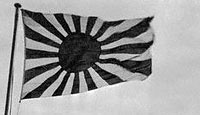 The Japanese wartime flag ©
Japan's rapid progress through Burma caused the British to worry for Ceylon, a British-controlled island just south east of India. Its capture would have enabled Japan to disrupt British supply routes to the Middle East and South Africa, as well as sea routes to India and Australia. Ceylon was also a crucial source of natural rubber that became even more important after the fall of Malaya.
The British posted six brigades on the island in March 1942, and built up a naval force comprising five battleships and three carriers. When news came of plans for a large Japanese offensive into the Indian Ocean, the British force split into two parts.
The faster group, Force A, was on patrol until it was sent to refuel at Addu Attol in the Maldives, nearly 1,000km away. On 5 April, over 100 Japanese planes attacked the harbour at Colombo (Ceylon's capital), causing considerable damage. Another air attack came that afternoon and sank two cruisers. Admiral Somerville's two forces were too late to be of use and retreated to East Africa and Bombay.
The Japanese struck again on 9 April, sinking 23 ships in the Bay of Bengal. However, Japan did not want to invade Ceylon; the offensive was a defensive manoeuvre to raid the British forces and provide cover for their own troop reinforcements being sent to Rangoon by sea. As a result, the Japanese then withdrew and, for the most part, left India and the Indian Ocean alone for the rest of the war.
The fact files in this timeline were commissioned by the BBC in June 2003 and September 2005. Find out more about the authors who wrote them.