

- Contributed by
- Bill Weaver
- People in story:
- Bill Weaver
- Location of story:
- Various
- Background to story:
- Army
- Article ID:
- A4635597
- Contributed on:
- 31 July 2005
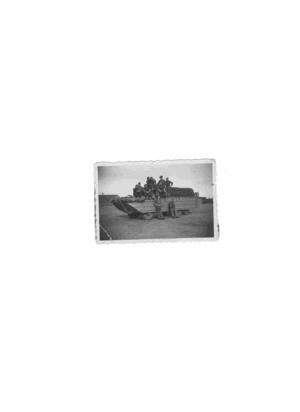
The Royal DUKW in Germany just after VE day
The first of my family, my mother, a V.A.D (Voluntary Aid Detachment) nurse was called to serve on September 1st 1939 and on the 2nd September, my brother Harry who had joined the T.A that year was also called up, the next day war was declared.
My father who was a builder and his business partner had already built a substantial air raid shelter between the two houses, No 17 and No 19 Holly Grove, Penn Fields Wolverhampton, our house being No 19.
My eldest brother John and myself were working back stage at the Grand Theatre, Wolverhampton and my sister Ena was still at school.
Within a few days, Harry was sent home, being only 16 at the time. Mother was away considerably longer but eventually came home and spent the rest of the war as a night nurse in an industrial complex.
Before I begin with my experiences, I will briefly explain what my family did. Mother I have already mentioned. My father and mother had been in the army during WW1, in this war my father repaired war damage, etc and also served in the home guard.
My brother John joined the RAF, eventually going to India.
Harry was recalled to the South Staffordshire Regt, before becoming a Para; then served in North Africa before dropping into Sicily in 1943 where he was taken prisoner, spending the rest of the War as a P.O.W.
Ena remained at school.
My work at the theatre kept me occupied, mostly repertory; different plays every week during their season. During the winter months we had pantomime, I really enjoyed my work and met many well known stars, especially when we put on Sunday shows. I also did civil defence work, fire watching, etc.
When the air raids began in 1940, I spent many hours on the roof of the theatre keeping an eye out for incendiary bombs. This high vantage point also gave me a birds eye view of the bombs falling on neighbouring towns and cities.
In October 1940 our house became a victim, suffering quite a lot of damage when a land mine was dropped in the playing fields of Beckminster school. The children from the school were in shelters only yards from the edge of the massive crater.
My bedroom was open to the sky and my bed was smashed under piles of mud and rubble, fortunately no one was seriously hurt although our dog was never the same again, becoming stone deaf.
This helped me decide that I had to do more and while still carrying on with my theatre work, I took on another job in engineering with Rubery Owen making tank parts. After a week or two I was operating four machines; I did both jobs for some time but the oil gave me a terrible rash and I was told by the doctor to give up the factory work.
So it came about, that toward the end of 1942 I enlisted in the Argyle and Sutherland Highlander’s (my mother being a Scot) at the age of 17; I served with the Highland regiment mostly in Scotland; but whilst on a training exercise at Leigh on Sea in Essex, I was involved in an incident with a stun grenade which damaged my right eye. I was sent back to Scotland for reassessment; I was told I could return to the regiment as a training NCO or go for something else, I chose the latter.
Late 1943 saw me along with some other infantry men in Bakewell for a driving course but after the first day we were told in no un certain terms to get rid of our cap badges, etc as we were now in the RASC.
I had some driving experience and this saw me through the driving test in Sheffield very quickly so I was also able to take a motor cycle course which was most enjoyable getting about all over Derbyshire, not always on proper roads.
At the end of my training at Bakewell I was posted back to Scotland to Ardrossan and Saltcoats joining 705 infantry brigade company. The company was preparing for amphibious training and I was soon on my way to Towyn in Wales where I was introduced to the DUKW; a vehicle I have fond memories of. We did our training on the Dovey estuary before heading back to Gullane on the Firth of Forth for a major amphibious exercise which although the weather conditions were atrocious was said to be a great success.
At the end of March 1944 we were on the move again to a new camp, B5 at East Boldre in the New Forest; our DUKWs being parked on Beaulieu Heath. The camp was a disaster area, leaking bell tents, mud, terrible food, that was until an American unit took over. They soon sorted things out, laying roads and paths, waterproof tents and a mess tent to write home about, our mess orderly G.I. Joe had flowers on the tables, we made many American friends.
We seemed to be the only ones on the heath at first but soon it began to fill up until all you could see was guns, tanks, vehicles of every description.
Towards the end of May 1944, my DUKW F33, was loaded with a six pounder gun and a ton of ammunition and told I would also be carrying troops.
The company began to move to various embarkation points along the south coast, I went along with seven other DUKWs to Southampton and loaded onto the tank deck of a US Navy L.S.T. I was the last on and close to the bow doors, we then moved out to anchor in the Solent , this was the 1st June 1944.
Our stay on the L.S.T , where we again tasted hospitality of our American hosts, began to take a more serious note when we were briefed on our destination and what to expect. On the evening of June 5th our last letters home were sent ashore, religious services were held and as we moved out into the channel we were ordered back to our vehicles on the tank deck and all the hatches were closed, there was now no way out.
Those L.S.T could certainly pitch and toss to extraordinary angles, nearly everyone was seasick. At 5.30am the rum ration was given out and at 6.30am the bow doors opened and we seven DUKWs from F platoon 705 coy prepared to launch as we were to make the 5 or 6 miles to shore under our own power. Through the doors we could see quite a stretch of the French coast and the great array of ships of every size and shape around us, by this time a dozen soldiers of the Hampshire Regt had joined our DUKW and at each side of the bow door the press and photographer’s had gathered , camera’s were flashing as we moved off down the ramp. (I’ve never see any photographs that were taken.)
With my DUKW F33 crew, Bill Weston and myself ,we also had on board our 2IC, Captain Goodhew, along with the Hampshires and our load , made our way towards our destination Jig/Green on Gold beach at Le Hamel. The shells passing over us on the way to the shore defences and the rocket ships closer to shore were so deafening, they numbed the brain so that you forgot about the fire from the shore defences and we were so busy trying to avoid any obstacles in our path. We finally made landfall between two landing craft that were ablaze.
All seven of us made shore, but we were still under fire from the fortified positions on the hill between us and Arromanches. We now had to make our way inland to deliver our cargo to Meuvaines; along the way we passed burning tanks, and casualties, both British and German. Still under sporadic fire we began to unload, some of us carried ‘A‘ frame cranes, which when connected to the winch on the DUKW, made unloading the heavier equipment from our and other vehicles much easier.
It was late afternoon when we arrived back on the beach and began unloading ships standing off shore. This was to become our daily routine working between ship and forward areas; we also acted as a rescue craft during the storms and heavy seas when other craft capsized, or were in difficulty. After the first few days we began to use the slipway at Arromanches and had a base at Le Hamel.
There was plenty of activity while the mulberry harbour was being completed, POW’s and wounded going out, stores of every description coming in.
When the breakout from Normandy began, we moved out through the ruins of Caen and the carnage at Falaise. Our first base, when we began the ‘Red Ball‘ convoys was at Albert, from there we drove day and night between the dumps in Normandy to the advancing areas. After a rail head had been established near Brussels, we began to work between there and Antwerp, and the doodlebug raids, until the Scheldt estuary and Walcheren were cleared. However, we were unable to get through to the Paras at Arnhem.
That winter of 1944 was bitterly cold, the roads collapsed under the weight of the traffic. Life was very difficult and then at Christmas we were positioned in the Ardennes area to supply the Americans, conditions were appalling, it was that cold I had my first cigarette and cupped my hands around it just to try and get a little heat.
In March 1945 we crossed the Rhine; on our journey’s we saw the devastation caused by allied bombing in places we had heard of in news bulletins, such as Essen and Cologne. We also delivered supplies (mostly medical) to camps, seeing the terrible suffering of the inmates. A memory, the horror I felt, can never leave me.
After taking stores to the forward areas we were bringing POW’s back and we were on our way to the rear POW camp near Recklinghausen. On May 8th 1945 when the convoy commander called us and told us the war in Europe was over. We delivered our prisoners and we were taken to a shower and laundry unit for a good clean up and a change of clothes. I didn’t last the day out, I began to feel really ill and was rushed to a military hospital where I spent the next seven days.
Soon after that I was posted to another company, 536, working on the Rhine bridges with DUKWs until the end of the war in the Far East, and continued until I was demobbed in 1947.
© Copyright of content contributed to this Archive rests with the author. Find out how you can use this.


 Recommended story
 Story with photo