

- Contributed by
- NRC
- People in story:
- Shimshon Shandor Alexander Ratz, Wladislaw Ratz, Anna Ratz
- Location of story:
- Auschwitz concentration camp, Poland
- Background to story:
- Civilian
- Article ID:
- A8905395
- Contributed on:
- 27 January 2006
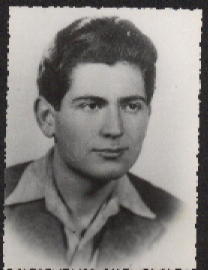
The late Shimshon Shandor Alexander Ratz, about two years after surviving Auschwitz, at the age of 18.
My dad, who was known as Shimshon, was born in Hungary in 1929 as Shandor Alexander Ratz. Unfortunately, he passed away at the age of 51, in 1981, after surviving Auschwitz and building a family and a new life in Israel.
It seems that the hardships of life in Israel, and the loss of his 19 year old son, Gabi, who was killed during his army service, took its toll, and he never survived long enough to tell his story.
As his daughter, I feel it’s my duty to tell of his experiences in Auschwitz concentration camp, and that in spite of all the darkness, he believed in life, never lost his hope, and always stood up tall, smiling.
He used to get up every dark morning in Auschwitz, gathering all his energy, thinking “I need to survive today. I need to do things to keep going. I must stay positive. I must stay alive”.
As a child, my dad spent a lot of time in the countryside with his grandparents, who were land owners, riding horses, visiting the local farmers who lived on the land and forming good relationships with them.
My grandfather, Wladislaw Ratz, was an opera singer and a cantor in the local synagogue in Mischcoltz. My dad was brought up in a traditional Jewish home, and as well as a good Jewish education, his parents were very keen for him to learn foreign languages, particularly German. Later on, my dad believed that his good knowledge of the German language helped him somehow to stay alive.
My dad was 15 years old when the Nazis marched into Hungary in 1944 and started deporting the Jews to Auschwitz. My dad didn’t really have to go on the dreaded train journey from Budapest to Auschwitz. My grandfather arranged with one of the local farmers, who lived on their land, for my dad to stay with them. It was all arranged for him to live with them, as their son, until the end of the war.
My grandfather managed to avoid going to Auschwitz for a while, by joining the Hungarian army, well before Hungary had been occupied by the Nazis, but unfortunately was shot and killed by pro Nazis in the streets of Mischcoltz, after returning from Auschwitz.
My grandmother, Anna Ratz, who was a nurse, survived the war with the help and generosity of the non- Jewish doctors and nurses who worked with her in a hospital in Budapest.
The only ones who couldn’t escape the journey to Auschwitz were my dad’s grandparents. When the transportation day arrived and my dad’s grandparents had to go, my dad, who was 15 and very close to his grandparents, decided to accompany them on the train journey to Auschwitz instead of staying in the safety of the countryside.
I remember my dad saying to me “I couldn’t let them go on their own. They were too old. I had to go and take care of them”.
My dad’s plan to care for his grandparents couldn’t happen. As soon as they arrived at Auschwitz they were separated. My dad had been ordered to one side, and his grandparents to the other. My dad already knew that his grandparents were going to their deaths. He used to say that he could hear his grandfather’s last words, which were “I am going to throw you my gold watch, it will help you to get food,catch it” and my dad shouted back “no, no, don’t throw it”. He feared that his grandfather would be killed on the spot for doing it. That was the last time my dad saw his grandparents.
My dad was reluctant to talk about everyday life in Auschwitz concentration camp.
He would never allow us to wear, or have anything at home with stripes, as it reminded him of the striped clothing that he was forced to wear in Auschwitz. To find out what happened I had to ask questions. As a little girl I was intrigued about the number which was tattooed on his arm. I asked him if the Germans used a special pen to write the number on his arm when he got to Auschwitz, and he said:
“No. They used a special machine, like a sewing machine with a needle, to tattoo the number into my arm”.
“Did it hurt?” I asked.
“Not really. It happened very quickly” he replied, emotionless, carrying on talking about everyday survival. How, for example, he approached the dreaded Dr. Mengele, speaking in German, hoping to impress him. Luckily, dad was tall, well built and fit to work, so he passed Dr. Mengele’s measurement test, and marched to the side of the living, while the small and thin had been sent to their deaths.
“What type of work did you do?” I asked.
“To survive” he answered, “I had to keep busy and show that I am useful. I could see that there were bodies lying everywhere. People were dying from exhaustion, hunger, disease and cold. At that moment I got together with some people in my age group who were still able, and together we started to collect the bodies and tried to give them decent burials. The German SS soldiers let me get on with organising those burials, and somehow they left me alone, but I knew that work alone was not enough to survive.
As food was in a very short supply, I started losing weight and got weaker. I knew that I had to meet Dr. Mengele every few weeks, and if I didn’t pass the measurement test because of the weight loss, I would be sent to my death.
There was a hospital in the camp, which only the lucky few got into. It was mainly to show outsiders that there was some sort of care in the camp. One day I looked through the hospital windows from outside, and I felt very lucky. I could see a familiar face inside. One of my grandfather’s friends, a Jewish doctor, had been appointed by the Nazis to work in their model hospital”.
The Jewish doctor was very willing to help my dad in any way he could. He admitted my dad to the hospital, pretending he was ill, so he could rest and eat a bit more, as the hospital had a little bit more of a food supply. He also arranged for him to work in the hospital, so he could keep an eye on him when he wasn’t well.
By January 1945, my dad had already spent a year in Auschwitz. The freezing cold and the hunger started to take its toll. He had lost a lot of weight. He was dreading Dr. Mengele’s visits. He didn’t think he would pass the measurement test for staying alive, but he was very tall, and just passed it, believing that the fact he answered all Dr. Mengele’s questions in German, somehow also helped to save him. By that time he was already very weak, and started thinking that he wouldn’t survive the next measurement test.
The winter was at its peak. Auschwitz and all the surrounding area was covered with heavy snow. As the end of the war was approaching, the Germans decided to empty Auschwitz from its prisoners. In freezing temperatures and with hardly any clothes, my dad and all the other able- bodied prisoners had been dragged into the deep snow, forced to walk in it. A lot of people didn’t survive this walk, which is known as the “Death March”.
“How did you survive this Death March?” I asked.
“I really thought that was the end” he replied. “While I was walking, my legs froze and I felt that I couldn’t move. Around me, people who collapsed were being shot. Next to me was marching an armed German SS soldier. In my desperation I found the courage to start talking to him in German.
“I can’t walk anymore I said. Please shoot me!”
The German SS looked at me for a while, and then said in German:
“Soon we are going to stop at a deserted farm for a while. Keep walking!”
“When we got to the farm, there were a lot of mattresses scattered about. The same German SS soldier looked at me and said:
“We are only going to stop here for a few minutes,go and rest in between the mattresses”.
“As soon as he walked away, I knew I had been given another chance of surviving. I found a pile of mattresses, dragged myself in between them, covered myself as much as I could, and fell asleep. When I woke up the place was empty. Everybody had gone. I had been left on my own in a deserted farm.
I got up and luckily found some scraps of food in the deserted kitchen on the farm. I knew I had to keep going to find some more food and shelter. I was still afraid that I might be discovered”.
My dad decided that it would be better to carry on walking at night under the cover of darkness. During the day he would hide in barns, which he found while he was walking, trying to get some sleep under stacks of hay. After a few days, when the hunger started getting to him, he found the courage to knock on doors of houses he passed by, asking for food; still worrying that somebody might discover that he was a prisoner from Auschwitz on the run. Some people offered food, clothes or permission to sleep in their barn, and some just slammed the door in his face.
After days of walking, he got to a main city and realised that the war was just about over, and trains were starting to run again, offering free transport. He got on the train that was heading to Budapest, Hungary. While he was on the train, he realised that the passengers on the train were going to have a border check by the local police at the entrance to Czechoslovakia, before reaching Budapest. As he didn’t have any documents he feared that he would be stopped by the police and sent back to Poland.
“So, what happened next?” I asked.
He looked at me with a twinkle in his eyes, and said:
“Whilst I was on the train, I noticed a group of young girls who were Czechoslovakian sitting not far from me. One of them looked particularly kind. I went over and asked if I could sit next to her in a mixture of Hungarian and sign language. Luckily, she understood some Hungarian. I told her who I was and where I came from, and if she would be ready to help me to pass the border so I could head back home to Hungary without being stopped.
As soon as the border police arrived, with the girl’s agreement, we acted as young lovers, while the other girls in the group were giggling and saying that we just got married. The policeman looked at us with some embarrassment and walked away. My life had been saved again, thanks to that girl, who I have never seen since then.
On arrival to Hungary I found that there was nothing left of my home and my family were not around. I was young and just approaching my 17th birthday. I wanted to start a new life. Israel was the place that sprang to mind” he answered.
Getting to Israel wasn’t simple, as Israel in 1945 was part of the British Mandate, which put a restriction on the number of Jewish refugees who could enter.
With the help of the Jewish Agency, which sent people from Israel to help survivors; my dad joined a group of young survivors, who were prepared to start a new life in Israel, an experience which, in Hebrew, was called Hachsharah. It took place in a remote corner of Italy, where the young survivors were taught the Hebrew language and learnt about living in a kibbutz. They were also trained to use guns, as, after all, they needed to learn how to protect themselves after Aushwitz.
The plan was to transfer them from Italy to Israel by boat, as tourists with forged passports, as British restrictions on immigration didn’t allow them in to the country.
“In Italy we stayed in a farm, which had been hired by the Jewish Agency” said my dad.
“We knew that the Italian fascists were still around and we had to be very careful not to be identified as a Jewish group who were prepared to become illegal immigrants in Israel”.
Moving out and about wasn’t that safe, and getting food supplies for the group took some courage. My dad’s horse riding skills, his fluency in the German language and his smart looks, gave him the courage to ride to the surrounding villages, on a horse (which he got from the farm), to introduce himself as a German aristocrat, who owned land in the area, and was buying food for his workers. His plan worked and the supply of food continued safely.
Living life on the verge of danger seemed to carry on for my dad, and the feeling of safety when he reached the shore of Haifa was mixed with fear of being discovered, carrying a forged passport. Fortunately he passed the border control without problems, and he managed to enjoy a few weeks of calm, in a kibbutz, in the north of Israel.
The relative calmness was broken with the beginning of the 1948 War of Independence, where my dad found himself on the front line, fighting for his life again.
For me, my dad was a hero, and so were all the survivors. Let their stories and the memory of all of those who died remind us that it should never happen again.
© Copyright of content contributed to this Archive rests with the author. Find out how you can use this.


 Recommended story
 Story with photo