

- Contributed by
- Herbert_Lowit
- People in story:
- Herbert Lowit, Rear Admiral Friedrich Frisius, General Alois Liška
- Location of story:
- Dunkirk, Leamington Spa, Aldershot, Czechoslovakia
- Background to story:
- Army
- Article ID:
- A8553495
- Contributed on:
- 15 January 2006
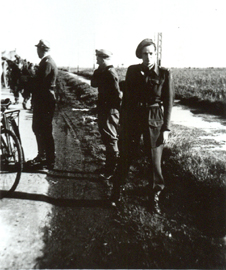
Herbert Lowit supervising the surrender of the German garrison of Dunkirk 10th May 1945
On 1st May 1941 (which happened to be my 18th birthday) I reported for military service with the Czechoslovak Independent Brigade at their HQ in Leamington Spa, Warwickshire. After an initial training period I was transferred to the brigade’s Anti-Tank Battery (OKPÚV) which was housed in the near-by hamlet of Butlers Marston.
After attending the brigade’s driving school in early 1942, I was allocated the unit’s water tanker and sent on a British Army training course on water purification at Aldershot. In the summer of 1942, OKPÚV re-located to Yeovil, and subsequently over the following months to Lowestoft, Dovercourt, Huntingdon, Galashiels and Bridlington.
In August 1943 the brigade was joined in England by the Czechoslovak contingent from the Middle East. OKPÚV was strengthened to become fully operational, comprising three batteries of four anti-tank guns each. Originally equipped with so-called ‘six pounders’ (57mm), we were later issued with the standard British ‘seventeen pounder’ (76.2mm) anti-tank guns. Consequent to this reorganisation, I was detailed to No.1 gun of the 1st battery. In due course I was made its commander and sent on a training course at the British Army’s Armoured Fighting Vehicles Establishment near Aldershot.
In mid-August 1944 the brigade embarked in London (having spent the last few days encamped on Wanstead Flats, dodging ‘doodle-bugs’), crossed the English Channel, and disembarked at Mulberry Harbour near Arromanches in Normandy. Now part of the First Canadian Army the brigade proceeded to the vicinity of Falaise.
In early October we reached the outskirts of Dunkirk, where a German garrison was firmly entrenched. OKPÚV was allocated the perimeter’s southern sector. 1st battery moved into forward positions in abandoned farmhouses and bunkers in and around the hamlets of Armbouts-Cappel and Spycker. Our task was to defend our positions against occasional (and mainly night-time) enemy attacks, and to undertake (mainly day-time) aggressive patrols or raids into no-man’s land and behind enemy lines. The aim was to prevent the enemy consolidating existing and / or gaining additional footholds. From a more personal point of view we also made it our special task to capture German weaponry, like Mauser rifles, Schmeisser machine pistols, Luger revolvers, also portable trench mortars of various calibres. Our ‘pièce de résistance’ however was an 88mm Flak anti-aircraft gun which fell into our hands undamaged and complete with a supply of ammunition and which we were able to direct successfully against enemy positions.
On Saturday 5th May 1945 we heard on our (captured) wireless that the German High Command was about to send emissaries to Rheims to negotiate the surrender of all German Forces. Dunkirk’s German garrison took this news as a signal to use up their ammunition. Since our positions were well known to the enemy we presented an easy target for their heavy artillery. So, for the next two days and nights we experienced a heavy and sustained bombardment which kept us more or less pinned down in our fortunately well-protected underground bunker. By the early hours of Tuesday, May 8th, the guns had finally fallen silent. At daybreak we received a signal from our HQ that a cease-fire would officially come into effect at one minute past midnight. On hearing this news some of us emerged from the bunker for a breath of fresh air. Someone had the presence of mind to take a photograph of this memorable occasion.
Later that morning, whilst we were discussing how best to celebrate, a group of unexpected visitors arrived from across no-man’s land: shouting “Kamerad! Kamerad!”, German soldiers appeared looking for food and cigarettes - probably the very same who had fired on us just a few hours earlier. After offering them our rations we showed them recently arrived photographs of Belsen and other liberated concentration camps which they dismissed out-of-hand as “Greuelpropaganda” (unsubstantiated horror stories).
In the early afternoon two groups of high-ranking officers, one from our Headquarters and one from the German Kommandatura, and each carrying a field telephone, arrived at our bunker. Their task was to establish direct means of communication between the two Headquarters. Being fluent in German, Czech and English I was entrusted with the operation of this telephone link. For the rest of the day I translated and conveyed messages to facilitate meetings between liaison officers and to discuss problems which had arisen during these meetings. It had become evident that the German Kommandant, Vize(Rear)Admiral Friedrich Frisius, although agreeing to observe a cease-fire as from midnight, was not yet willing to lay down his arms and surrender. He claimed to be uncertain whether the surrender terms which the German High Command had accepted at Rheims included his ‘Festung (fortress) Dünkirchen’, and insisted on seeking further clarification from his new ‘Führer’, Großadmiral Karl Dönitz.
At midnight all members of our unit assembled on top of a small hillock in front of our bunker and, overlooking the enemy’s position. At one minute past midnight we ignited a huge wooden “V” (for victory, or vítĕzství) and let off a shower of rockets and multi-coloured flares. Then we sang our National Anthem and did not feel ashamed to be seen wiping our eyes. At about the same time the German Kommandatura had managed to establish contact with their superiors at Flensburg and been ordered to lay down their arms.
Shortly after nine o’clock the next morning, 9th May, Vizeadmiral Frisius presented himself at General Alois Liška’s Headquarters at Wormhout and personally delivered the signed letter of capitulation. It was agreed that the surrender would become effective at 16.00 hours. Late that evening (after we had emptied a few bottles of Champagne specially reserved for the occasion) I was roused from the first decent sleep I had had for several days and called to the telephone. I was instructed to take down the detailed schedule concerning next day’s hand-over of the German garrison’s weaponry, translate it into German and convey the document at once to Vizeadmiral Frisius. I did, in fact, dictate it, just before midnight, to his deputy, a certain Oberstleutnant (Lt.Col.) von Loeben
The hand-over of the weaponry was to commence at 06.00 hours the next morning, 10th May, at the demarcation line not far from our bunker, and I was ordered to be present. I must confess that it was an awe-inspiring sight when at the appointed time and place I was confronted by what seemed to me the entire German garrison, armed to the teeth and looking rather belligerent. After a somewhat frosty verbal exchange with the officer in charge I was handed the typewritten ‘Waffenabgabeplan’ (time-table for the hand-over) which I promptly pocketed as my personal souvenir. It soon became apparent that the quickest and smoothest way of conducting the hand-over of weaponry was for us to lend the Germans some of our motorised vehicles (their own transport being largely horse-drawn) and for German soldiers to drive, under escort, through our lines to the designated storage places.
Halfway through the morning I received a message that Major General Alois Liška, the brigade’s commanding officer, would shortly be passing our way en route to Dunkirk’s town hall where he was to officiate at the hoisting of the victorious Allies’ flags. When a high-ranking German officer appeared and reported that he was to act as an escort to our General I realised that General Liška would actually stop and probably expect me to report to him. On arrival of the motorcade I instructed the German officers to salute and bring their men to attention. General Liška did indeed alight from his car, acknowledged my, and the German liaison officer’s, reports, and invited the latter to join him in his car.
As the hand-over of the garrison’s weapons was now running smoothly I was relieved from my post for a well-earned rest. We spent the next day preparing our homeward journey but also found time to visit near-by cemeteries to take our leave from those of our comrades who would not be returning home with us.
The brigade left the outskirts of Dunkirk on the morning of May 12th, drove across devastated Germany and arrived at the Czechoslovak border at midday on May 18th. Later the same afternoon we entered Plzeň (Pilsen) to a tumultuous welcome. Now part of the 3rd U.S. Army we presently proceeded southwards to the Czech / Bavarian border. Because of my linguistic and clerical abilities I was put in charge of OKPÚV’s HQ offices.
On 1st September 1945 the Independent Brigade was merged into the regular Czechoslovak Army’s First Armoured Corps. At my request I was released from active duty on 23rd September 1945 to enable me to continue with the education / career which had been interrupted by my war-time military service.
© Copyright of content contributed to this Archive rests with the author. Find out how you can use this.


 Recommended story
 Story with photo