

- Contributed by
- jamestale
- People in story:
- James Jenkinson, Doris Jenkinson , Sidney Jenkinson
- Location of story:
- Hever, Kent to Alam Nayil, Egypt
- Background to story:
- Army
- Article ID:
- A6694095
- Contributed on:
- 04 November 2005
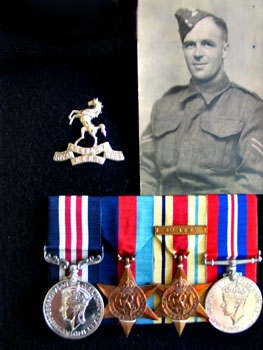
Cpl. Sidney Jenkinson, Royal West Kent Regiment with Military Medal and campaign medals.
My name is James Jenkinson and I was born on 28th May, 1939 at Hever, Nr. Edenbridge,in Kent. For the duration of the second World War I lived with my Mother, Doris Jenkinson and my Father Sidney Jenkinson, although for much of the time my Mother and I were alone as were many children with their mothers at that time. For my part I can vividly remember as I grew old enough a searchlight and anti aircraft unit at the bottom of our road and I can remember seeing a spitfire which had crash landed in a cornfield on my way to school at Hever Primary School one morning. There was also the fear of the V2 rocket 'doodlebugs' on their way to London. All the while they could be heard there was no problem but once the sound stopped it meant their engine had cut out and they could come down at any point. Many failed to complete their journey to London. My Mother used to tell me how the skies had been thick with fighting aeroplanes over Kent during August and September 1940 during the Battle of Britain. During the Blitz over London my Grandparents were living in the East End of London and my Grandfather was a Stevedore at the East India Dock. Thankfully their home was not bombed and they survived the Blitz. Finally there was the VE day party with the jubilations held at our primary school. I will now continue with my Father's war story during which he was awarded the Military Medal.
My Father, Sidney Jenkinson was born on the 10th October 1910 at Kilnwick, Nr. Driffield in the East Riding of Yorkshire. He had moved from Yorkshire to Kent where he was employed as a gamekeeper. He married my Mother at Knockholt, Kent in 1936.
At the outbreak of the second World War he volunteered for military service and joined the 4th Battalion of the Queens Own Royal West Kent Regiment and was attached to "C" Company.
On 20th March 1940 his Battalion embarked from Southampton and sailed to Cherbourg in France as part of the British Expeditionary Force being part of the 132nd Brigade. The Battalion reached Audenarde on 14th May 1940. Following various actions in that area, things became critical and on the night of 28th May orders were received for the Battalion to pull out. The Battalion split into small Company parties and made their way to Dunkirk for evacuation to England. On 30th May my Father was one of those to embark on the s.s. Dorien Rose, reaching Folkestone late that night.
There followed during the remainder of 1940 and 1941 various training exercises in England.
On the 31st May 1942 the Battalion embarked at Liverpool on the s.s. Laconia, a twenty thousand ton Cunard liner, forming part of the 132nd Brigade of the 44th Division. The convoy, comprising about 30 vessel formed up off the North Cape of Ireland and together with an escort of destroyers and the battleship HMS Nelson set sail for Egypt.
Two days before their arrival at Capetown in South Africa, Tobruk had fallen and it was no doubt it was this disaster which decided the fate of the Division which was now urgently need in Egypt. The s.s. Laconia, which could not keep up with the pace of the convoy, eventually arrived at Port Tewfik. The Battalion eventually joined the rest of the 44th Division at Katatba on the edge of the desert.
Shortly after the Division arrived in Egypt, General Montgomery had taken over command of the Eighth Army and the Division began to move further up the desesrt on the 14th August to stem Field Marshal Rommel's expected attack on the Alemain Line. On the 16th August the 132nd Brigade came under the command of General Freyberg of the 2nd New Zealand Division.
On the 3rd September orders were received for an operation to take place that night with the 4th Battalion occupying an area overlooking the Munassib Depression in the desert. The company comanders had hardly completed their orders when it was time to move off. The Companies marching towards Alam Nayil were clearly visible to enemy reconnaisance planes but the assembly area was reached as dusk was falling. At about 22.30 hours the final advance commenced with "C" Company and my Father on the right of the formation. A very heavy battle ensued and just before first light the Battalion received orders for a general withdrawal of two thousand yards.
Casualties had been heavy that night and my Father was one of the wounded. It was during that night, 3rd/4th September 1940, that he was awarded the Military Medal.
The citation reads: "On the night of 3/4 Sept42 at Alam Nayil the battalion carried out a night attack. This N.C.O. was commanding one of the leading platoons. Throughout the action his example and conduct were outstanding and accounted to a great extent to the success of his platoon."
At this time he held the rank of Acting Sergeant but was promoted to full Sergeant some time after that date.
My Father spent some time in hospital at Johannesburg in South Africa before returning to the Military Hospital at Netley, England. ~ This was the end of his war service.
I can remember later going with my Mother and Father to Buckingham Palace where he was presented with his Military Medal by King George VI.
I am proud that my Father's name appears in the book "From Kent to Kohima" the history of the 4th Battalion Queens Own Royal West Kent Regiment, to which I have referred for correctness of dates. His Military Medal and citation, together with his campaign medals will be passed down to succeeding generations of my family.
My Father died in 1988 aged 78 years and sadly there were many more memories that went with him when he died, moments that I desperately wish now that I had asked him about when I had the opportunity.
© Copyright of content contributed to this Archive rests with the author. Find out how you can use this.


 Recommended story
 Story with photo