

- Contributed by
- CSV Media NI
- People in story:
- Harry Cookman
- Location of story:
- Omagh, Burma
- Background to story:
- Army
- Article ID:
- A6053195
- Contributed on:
- 07 October 2005
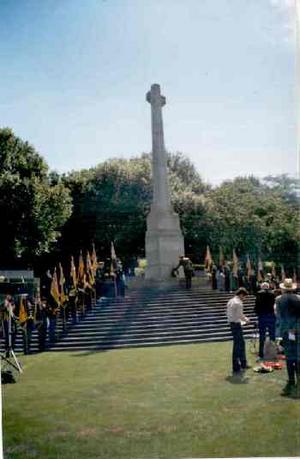
wreath-laying at Dublin war memorial, 10th July 2005
[I joined ] The Royal Inniskilling Fusiliers.
They’ve been an Irish serving regiment in Ireland since back in the 17th Century, and a very famous Irish regiment. And the fusiliers always carried more equipment than the rifle regiments then, also the Ulster Rifles.
The Royal Inniskilling Fusiliers were based in Omagh, but their badge was based on Enniskillen castle. The regiment is spelt with an I, the castle is spelt with an E. a very famous regiment, they always used to have 2 bands — a pipe band, and I suppose you’d call it a … band with drums. And so they always could do a lot of marching.
My father had served in WW1, and he was called up. He was learning farming in the North of Scotland, Aberdeen. He previously had volunteered — he’d been on what would be today’s Territorials. And so when the war was about to start he was called up in July 1914, and so he had to give up farming in Aberdeen, and go down and report to Woolwich barracks. And so he collected his uniform and so-forth as an officer, 2nd Lieutenant, and then his first job was to go down to the docks of Southampton to help load the guns. They were 18-pdrs in those days, going across to Harfleurs in France. And so another Lieutenant came along to him and said “That’s the first time I’ve seen guns being loaded. Could you help by telling me something about it, and I can give you a hand.”
My father was talking to him. So this Lieutenant said “I’ve a feeling we’ve met before” and so my father said “I think we have met before”. The Lieutenant said “Where are you from?”
“Ireland”
“What part?”
“Outside Inniskorty”
“Ah, now I know. We met at Castlebora” — which is a very large place — Victoria used to visit, the church there she used to go to every Sunday. And who was it? Prince Edward! He became Prince of Wales, and eventually became King! So they were both, as Lieutenants, very very good friends. They were out in France together. So they kept in touch all the way through. My father was invited over for his coronation, and of course after that things became a little but different because of things that were building up here [in the Irish Free State].
I volunteered for Indian Army duties in 1944 before the D-Day things. The colonel said “I’m looking for 6 young officers to volunteer to go help train the Indian army. And anyone who volunteers will get and extra week’s leave on top of what you normally get.”
Because the officers always got a month’s leave, unless you were going overseas, then you got embarkation leave. And so he dismissed the Officers’ Parade. As I was walking away I felt that someone was walking behind me. I looked over my shoulder, and it was the Colonel. He came up to me and said “Well, Cookman, what about it? The old saying is - Once a volunteer, always a volunteer.”
So I said “well, I’ve been thinking about it. But I’m not too certain about the leave situation, because leave has now been banned to southern Ireland.” And he said “oh, I didn’t know about that. How’d you find that out?”
“Well, a certain young ATS lady in the battery office told me about it, and she gave me a copy of the part 2 order to read.”
He said “part 2 orders? I haven’t had any part 2 orders this week? Let me read it, because I haven’t heard anything about the leave situation for going to southern Ireland.”
So I said “please don’t put her into trouble for it. She was only trying to be helpful.”
And so he said “no, there won’t be any trouble. I’ll go to the battery office now and find where the other copies are, because we always have 6. There must be 5 missing somewhere. So come into my office as usual — I always see officers after 4 o’clock, and I’ll sort out any problems that have arisen in the corse of the day. Do that, and I’ll see what I can do for you.”
A couple of days he was in touch with Brigade HQ, Brigade HQ was in touch with Army HQ, so they got me leave. So he said “If you’re going, will you bring some of the other lads with you? Some of them are very interested, but they’ll only go if you’re going.”
When I told them I was going, we needed 6, we ended up with 8.
So we all went out to India together. We weren’t all going out to the same arm of the service. We had a choice when we headed out to India. I’d always wanted to get into Field Artillery, because my father had been in field artillery with the 18-pdrs. So I knew plenty of what he used to be talking about. Also I was good at maths, and geometry was necessary. This is what I aimed for. So I was commissioned in the field artillery. I enjoyed it from there on. I picked up a poison in the jungle in the central province of India, in the jungle for training purposes. After that I went up to the jungle in Burma. In the north part, not the south part. That was ok, but I had 2 more visits to hospital because of the poison.
I was back in the jungle again, and the week before they dropped the atomic bomb I collapsed as I had doen on the other occasions. I came to when I was in a giant-sized marquee where 2 nurses were scrubbing the mud off me, because we were in an early monsoon. And we got spells of heavy rain, then nothing, and the ground would be very muddy and as I didn’t believe in privileges my Indian gunners slept on the ground, on groundsheets, so I tried sleeping on the ground. As an officer, I’d do the same. It doesn’t matter who you’re dealing with — if you look to the people you’re in command of, and treat yourself the same way they have to be treated from tradition, everyone respects you far more. And my Indian gunners did. They were delighted that I was doing it. I was then covered in mud, as they were.
And so when I went into the marquee tent, 2 nurses were scrubbing the mud, and even trying to cut it off me. All my uniform was falling apart. In those days we had the new kind of jungle green, just plain green, and it wasn’t very strong material. It didn’t take very long in the jungle — the trees, and moving equipment about and so-forth. It would start tearing in places. So they cut off what was left.
© Copyright of content contributed to this Archive rests with the author. Find out how you can use this.


 Recommended story
 Story with photo