

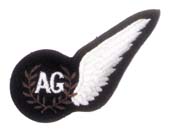
Air Gunner's Brevet
- Contributed by
- Clare Hardy
- People in story:
- Anthony Douglas Winser
- Location of story:
- Lincoln and North Europe
- Background to story:
- Royal Air Force
- Article ID:
- A4365894
- Contributed on:
- 05 July 2005
(continued from part 2)
“Did you lose any of your close friends?”
“I was very friendly with a chap - Phil Waldon - he was a lovely looking fellow, more or less the same age as me, and he was blond, and he was in another crew, and I always remember this, because when we were sitting for briefing, he was sitting with his other crew, and we always used to look at one another when we knew where the target was, and I remember old Phil looking across at me, and going like this with his nails…” Tony nibbled his fingertips feverishly, “as if to say ‘Strewth, I don’t like the look of that one?’ And we went on this trip - it was quite a nasty trip, and when we got back - because as I told you we had to sign the blackboard - and of course, the pilot, his name wasn’t up there. And I said to Les, ‘I don’t like the look of this. It’s been a long while now and they haven’t come back. They haven’t signed in.’ And when we went for interrogation, I happened to say about my friend, Phil Waldon, ‘I don’t seem to see he’s signed up on the board yet.’ And they said, ‘No, we’ve got bad news for you. They took off and developed a couple of engine problems, and they couldn’t get the height they wanted…’ One engine you can, with one engine you can still get the height you want, but with two you can’t - and they did say to us at briefing that ‘there may be fog problems when you come back, and you’ll probably be diverted so listen out for your instructions’. And of course, they’d gone quite a way, and they had to turn back, still got their bombs on board, and they came back to base, and were circling round, and of course, it was very foggy - they couldn’t land, and the control tower were giving them instructions of where they were going to be diverted to, but they’d have to go into the North Sea to jettison the bombs. You can’t land with a bomb load. And they were flying around, and apparently it turned over on its back, the aircraft did, and went straight down into our bomb dump. And they were blown to pieces. Blown to smithereens, it was dreadful, they reckoned there was bits of fingernails… I couldn’t go down there, I just couldn’t go down to the bomb bay. And anyhow, after I got demobbed, we went round to Ringland, a little village round here, and we went into a pub on the corner, and I sat there drinking my half pint, and I looked across at the mantelpiece. And I said, ‘My goodness,’ I said, ‘I know that fellow’s face.’ It was a photograph of an airman. And I went over; I picked the photograph up, and I said, ‘Well, that’s Phil Waldon!’ And I looked at the barman, and I said, ‘I used to be stationed with this fellow - at Wickenby!’ And he looked at me, and he said, ‘Did you?’ He said, ‘His father lives around the corner.’ And I said, ‘Well, does he?’ And he said, ‘Yes - he’d love to see you.’ And I said, ‘Well, I’ll have to go round and see him.’ And when I went round, he was exactly like old Phil, you could see that was his Dad, and I introduced myself to him, I said, ‘I was on the Squadron with your son, Phil, and he was a great friend of mine.’ Well, he couldn’t have got me in quick enough, and he says, ‘Well, what happened to Phil, because all we’ve had, notification, is ‘Missing, Presumed Dead’? You see, because with all the worry, it’s killed his Mum. I’ve lost her through all the worry of Phil.’ And I said, ‘Well, I know exactly what happened to Phil, your son. If you would prefer to carry on thinking he’s missing, presumed dead, I won’t say anything about it. I’ll just leave you, and not say anything.’ And he said, ‘Well, it’s been on a long while now, and I would like to know what happened to my son.’ And then I told him what happened. He just burst into tears. Couldn’t believe it. He said, ‘Why on earth didn’t they say what had happened to him?’ It was at base! It wasn’t as though he was abroad and he had bailed out! They had no chance at all. Just blew to smithireens.”
“It was a bit of a cover up, really,” I ventured.
“Well it was,” Tony replied. “You see with only two engines… I suppose he banked over too far, with all his bombs on - there’s a lot of weight there, he just turned on his back. But I thought that was very hard, really, to say that. Because though they were blown to pieces, there was no sign of anybody, I mean they knew very well what had happened. I thought that was very bad, really. I can see him sitting there now, biting his nails.”
“You were one of the lucky ones then.”
“I was, but I was nearly a gonner over Nuremburg. What happened was when we were briefed, they told us that there would be no ground markings at all, that it would be ten-tenths cloud over the target, and that we’d have to bomb on Wanganuie flares, they called them - flares that are suspended on a parachute above the cloud, different colours. We’d have to bomb just one of those, whatever colour you were briefed at, you see. And so we were expecting there to be ten-tenths cloud over the target, and when we were approaching the target, it was nothing like it, there was moonlight - it was as clear as daylight! The fighters were up; the flak was up; we were combed in searchlights for about 20 minutes or so, and once you’re combed in searchlights they pump the flak up at you really hard, because they know exactly where you are. It was terrifying. You can see the aircraft coming down all over the place, and it unnerves you when you see that happening; and all the flak was coming up, and the problem was that the flak was getting very, very close. And it was so close that you could actually hear it exploding. And when I got back, the armourer came to the dispersal, and helped me out of my turret, and he says to me, ‘My goodness! Whatever’s happened to your rear door?’ I said, ‘I don’t know,’ because you see, you can’t look round, you can’t move when you’re sitting in the turret there. Anyway, he says, ‘Whatever’s happened to your rear turret door?’ And I said, ‘Well, to be honest, I did feel a bit of a draught when I rotated.’And he said, ‘Get outside, rotate your turret.’ And there was a hole about like that in my rear door!” Tony cupped his hands in a circle, describing a hole of about 6 inches in diameter. “And I said, ‘Whatever’s that?’ And he said, ‘Were you near flak?’ I said, ‘Yes, it was so close to me that I could hear it - it was actually vibrating the aircraft - didn’t hit me.’ So he said, ‘Well, there’s something weird here. We’ll search the fuselage, because I think it’s at the back, it’s come through your clear vision panel, missed your head, and has gone out the door. If it’s in the fuselage we shall find it.’ And I said, ‘Oh, I’d love to find it because I shall have it as a souvenir.’ Well, we hunted and hunted and hunted, couldn’t find it. We went out next day and hunted in the daylight, but couldn’t see it. And he said, ‘Well, I don’t think, Tony, you’ll ever find it because I can guarantee you what has happened, it came through your turret when you were rotating, and went out into the sky.’ In any case, we managed to get back all right. It was a terrible trip though, and the PFF had to eventually do ground markings. They were doing Langanuie flares, but they found they weren’t any good when it was clear like that. And so as soon as we got back, they said, ‘You know, we’ve lost a lot of aircraft.’ And of course we heard later on when we got back to the Mess we’d lost 98 aircraft. There were seven in a crew, and I wouldn’t say they were all killed: some of them might have bailed out, been taken prisoner of war, I don’t know really what happened to all the crews, but one of my best mates was in that: Bill Cox, and he lived in London, he was a bus driver - London Transport - he was one of my best mates actually. He was in one of those aircraft and he was a rear gunner. What happened to him, I don’t know from that day to this: whether he was prisoner of war, whether he was killed or what. It’s a shame, but that’s how it is. You don’t know really what happens, when you eventually leave squadron and that, you don’t know.” I was later able to find out from the internet that Bill Cox had indeed perished that night over Germany.
“Did you ever do day raids?” asked Giles.
“We did just one day trip,” recalled Tony. “Well, I say one, it was two actually: Calais and Le Havre. What it was, you see, Jerry was hanging out there and we gave him up to 3 o’ clock in the afternoon to surrender. If they didn’t, we were going to bomb them out. And so we went over, because they didn’t surrender, and of course we had to bomb so low because we only had the thousand pounds; we didn’t have the cookie on; we didn’t have the twelve thousand pounder on; and we had to bomb so low that you could see the old Jerries running about, I was going at them with my guns and they were trying to fire rifles up at us and eventually they did surrender, and that was one. And then we did Le Havre as well. But no, the others were at night time. There was no opposition really on the day trips. There were no FE-109s or anything like that coming after us, like when you’re doing night trips. I mean if it was fairly bright moonlight, then you got fighters, you got searchlights, you got everything coming up - flak, everything.”
Reminiscing about the time he spent living on a knife edge between life and death, Tony relived the moment with a justifiable sense of pride. Just two years later, following a television documentary that made much of the human suffering inflicted on the German people by Bomber Command’s policy of dropping incendiary bombs on heavily populated areas, Tony’s pride had turned to shame. “I don’t know what to think, Clare,” Tony sighed. “We were just doing our job - what we were told to do. We went over there, dropped our bombs on the target and cleared off. They weren’t all towns you know. Most of them were military targets. I feel ashamed now.”
“You mustn’t think like that,” I said. “What really counts is that you were willing to give your life for the war effort. You weren’t responsible for the moral issues. The point is that without our air power, we would never have won the war. You had to destroy the transport networks and the infrastructure so that our troops could land safely. If cities were bombed and people killed, you can’t be held to account for that, because you were not the ones making the decisions. It may have been justifiable, or it may not have been, but that’s nothing to do with you. The bottom line is that for the values you believed in, you were prepared to sacrifice your life, and that’s the only thing that matters.”
War rewrites the moral code, and at a distance of 60 years, it is easy to criticise military tactics, and to forget the cost, and that is why I wanted to hear the story of one who was there. Many of those who thought they would have something to tell the grandchildren never even had children to tell, their futures snuffed out in a barrage of flak, a well aimed bullet or an engine failure over hostile territory. For those who did make it back to tell the tale, they have earned our respect, just as they earned freedom for this generation.
© Copyright of content contributed to this Archive rests with the author. Find out how you can use this.


 Recommended story
 Story with photo