

- Contributed by
- pete probst
- People in story:
- REGINALD KENNETH PROBST
- Location of story:
- Bath
- Background to story:
- Civilian
- Article ID:
- A4011788
- Contributed on:
- 05 May 2005
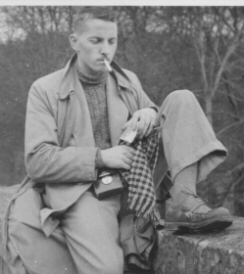
Reginald Kenneth Probst 1940, Bath
My father Reg Probst wrote his memoirs. This is his story of his life during the period 1938 — 1945. Reg worked for General Electric Company in the Engineers Department prior to 1938 and then joined the Admiralty as a Draughtsman in the Civil Engineering Department. It is necessary to introduce my mother, Maggie. She was employed by GEC and during the war worked on lighting; analysing lights from German equipment and even a captured U boat. She also worked on fluorescent strip lighting. In addition I need to mention my grandfather, Johann Probst. Grandfather had left Bavaria in some “interesting” circumstances in about 1892, escaping probable court-martial in a German Army base near Friedrichshafen. He was a fully indentured tailor. At the age of about 19 or 20 he restarted his life in England. He refused to speak German and learnt English. He would not allow his children to speak German either. He gained British Nationality in the 1920’s. Grandfather became a top London tailor and was head cutter at Jays, who at that time were among the top couturiers in London. He was occasionally called to Buckingham Palace to fit visiting royalty. He tailored for the Swedish Royal Family on their visits to London. Winston Churchill’s wife, Clementine Hozier, and Lilly Langtree were among his more prominent clients.
WAR MEMOIRS OF REGINALD KENNETH PROBST
16th April 1914 - 17th September 1991
The General Electric Company began to build air raid shelters on any available ground in the estate at Wembley and sensitive areas were sand bagged. I received a positive reply to one of my job applications from the Civil Engineer in Chief's Department at the Admiralty and was interviewed by a Mr Allen. I got the job as a basic design draughtsman and joined the department with the view that I was to gain some more experience before moving on to another branch of engineering that I liked.
I reported for work at Great Westminster House, Horseferry Road, starting a career that was to take me through the rest of my working life. Life seemed settled and pleasant like the quiet before the storm.
I started work on the general site completion of Singapore Naval Base. Chamberlain was waving olive branches at the Fuhrer and the Cheko-slovakian and Polish cries were getting louder. But a bigger crisis hit a colleague. A photographer for the Daily Mirror in St James's Park had taken a picture of Chamberlain rushing across the park. It was published on the front page. Just behind him and very plain to see on a park bench was Trant canoodling with one of the Telephonists! I wonder what became of him? We started to stick tape over the office windows to stop flying glass from the bomb blasts. Finally arrangements were being made to evacuate the non-essential departments to provincial towns. The Admiralty was to move to Reading, but later a decision was made to go to Bath.
Our Scout Group, the older section, was beginning to break up as preparations for war proceeded. Some joined armed forces units, Territorial Army and some like myself prepared to move away from London. Maggie was remaining in London as the laboratory complex of GEC was difficult to move. I was starting to lose touch with all the friends of childhood and growing up. The fateful decision was made and England was at war with Germany.
We were told to go home from the office, after parcelling up our own equipment, and pack enough personal clothes and effects, collect labels, attach them to our luggage and to report on Monday to Paddington GWR station. For the weekend I had arranged to take Maggie to friends in Pinner and decided to take my final leaving of home forthwith. By the time I got home on that lovely sunny day to collect my possessions, my mother was in a state of shocked despair at the prospect of another dose of 1914/1918. I let them know the news of my move, but omitted telling them I was not leaving London till Monday. At least Dad was a naturalised UK citizen and had been for some time; then the air raid sirens sounded. It was a shock, but a false alarm.
"Oh! What a tangled web we weave." On the Monday when I arrived at Paddington I was told that not enough carriages were available to take the whole Admiralty and certain departments, including the Civil Engineers, should go home and contact the office for further instructions. I went to the control point and told them I had cut my all my commitments and had no contacts in London and could I travel today. There were many trying to get an extra few days so I was put on the train then and there. Off to Bath I went. It was an uneventful journey and we were eventually mustered in the Pavilion from where volunteer car drivers took us to our billets. I was billeted in Upper Oldfield Park, with a young couple, Bernard and Lillian who had a young baby, in a new three-bedroom house with views over Bath. From the back it overlooked Blackmore and Langdons Nurseries, famous for begonias and delphiniums. Later a chap called Riche from our office joined us. An altogether new life started for me.
We settled down to the early days of the War in Bath; Riche's wife came down and stayed a while but soon they searched around, found rooms and moved out. Quickly the billeting office brought over two girls, Anita and Dodo, clerical officers, who shared the main room. One was a Scottish lass with a broad accent, the other was a sweet girl, with a problem. She had fallen deeply in love with her Stepfather, unfortunately he had reciprocated. How the problem resolved itself I never got to know. The two girls went off with their own company. I was billeted in Ivy Grove. Bernard and Lillian Matthews, my billetees would take me out for trips in Bernard's Fathers Austin 10, which was very pleasant. It helped me and I soon got to know the surrounding countryside and made many friends amongst my colleagues and local people.
The office had set up in the Domestic Science College at Brougham Hayes in Bath. We had use of the college tennis courts and other facilities. Fortuitously the G.W.R. ran at the rear of the office and the small station halt of Oldfield Park was a few yards up the road. The B.B.C. was also moving out of London and had chosen Bristol as its centre, using the Colston Hall for the symphony orchestra. The early evening train from Bath to Bristol came through at about 6.00pm, it gently steamed the short distance from Bath main station to Oldfield Park where it stopped for half a minute before setting off to Bristol. On concert nights, as we heard the train leaving Bath station we would whip out of the office, rush across the road and over the bridge in time to get into the carriage. On arrival at Temple Meads we would catch the bus or trot down to the city centre in time to hear that evening's concert.
I remember one occasion when Sir Adrian Bolt was conducting; he was Dr Adrian at that time. I arrived breathless and a little late, but the concert had not begun. An Ambassador from one of the allied countries, of which one I have no recollection, was running overtime on a broadcast. The red light was blinking over the auditorium entrance. I could not get in, but managed to find a side entrance and went down a corridor near the stage hoping to slip in when the concert began. As I waited, pacing anxiously, down the corridor came Adrian Bolt. He came up to me, gripped my arm and said "Can you go in and ask him to stop, we are already late for the start." I replied that perhaps it would be better to have the concert late, than to have a diplomatic hiatus through interrupting the Ambassador of one of our allies; he thought this made sense and left me to go backstage, the concert started some twelve minutes late.
It was during the long lovely Indian summer of the phoney war that one Saturday after playing tennis in the afternoon I was to join Bernard and Lillian for an evening of bridge and a most unusual series of events developed, which I have always thought Brian Rix could have used in one of his farces. Bernard, Lillian, Keith, their little boy, and Bernard's father and mother had been up to the Downs for the afternoon. The fact that Bernard and Lillian played bridge was quite a bonus, Bernard's father played, but his mother did not, so we made up a good foursome while Bernard's mother looked after Keith. We finished our evening meal, cleared up and settled down to play a few rubbers of bridge. We stopped at about 10.30pm as Bernard's father was feeling tired. While the family went through the garden to the car I packed up the cards and folded the table. Suddenly Bernard rushed in saying, " Dad's feeling very ill. I must get to the phone, will you give Lillian a hand." I ran down the garden to find Bernard’s Dad collapsed in the back of the car breathing very heavily. His pulse was racing, then his breathing raced. Bernard came back. He had contacted Dr McQuistan who had told him to get Dad to bed and he would come as soon as he finished the case he was on. Dad was a heavy man and it would be impossible to get him out of the car, let alone across the garden and upstairs to bed. The only thing we could do was to belt down to the Doctors with him in the car and then onto hospital, which we thought would be necessary. At this moment a young man, who was a local newspaper reporter, came by and offered to help. Bernard felt that his mother, who had recently had a stroke, would need himself and Lillian to get her back to the house and settled.
So it turned out that I, with the reporter supporting Bernard's Dad, drove down to the Doctor. Although it was double summer time it was now getting dark and the blackout was enforced. We arrived at the Doctor's. I ran to the door and hammered it till he answered. I informed him of the situation and with his equipment from the surgery he came to the car. After several tests he said " It's too late. He's dead." He went back into the surgery. I got back into the car, the reporter was still in the back holding up the corpse. Thinking, "What the blazes do I do now?", I started the car and moved off, only to be ordered to stop by a policeman who stepped out in front of the car. Thinking, "What was I to do NOW!?" I stopped pretty promptly! "You haven't any lights on." the policeman said. "I'm sorry," I replied "but I've a dead body in the back." Thinking, "WHAT was I to do NOW!!?" The policeman asked, "Is this your car, Sir?" "No," I said "It belongs to the dead man." Thinking, "WHAT WAS I to do NOW!!!?" I tried to explain the situation to a perplexed, suspicious and disbelieving policeman, eventually we went back to the Doctors. Inside the surgery the Doctor explained that he had pronounced the man dead, that my incredible story was true and there were no suspicious circumstances. I asked whether we should take the body to the mortuary. The policeman decided to phone the Police station, which with the Doctors permission he did. After the call he asked my name and address and my relationship to the deceased. "Non whatever." He then said we could not decide what to do and we must take the body back to the next of kin and consult them. We went back to the car, where the reporter was still nursing the body!
The Policeman climbed in the car with us and we proceeded back to Ivy Grove. As we got near flickering torches and two people approached. It was Bernard and Lillian. I stopped the car and saying to the reporter and Policeman that this was the man's son and wife I got out to consult with them. I told Bernard and Lillian that his father had died on the way to the Doctors, but he seemed to expect that was going to happen. I told them about the reporter and Policeman helping me and then inquired what should be done with his father. Bernard said he could not face doing anything himself, but could we take his father to his own home, and that the keys were in his father's jacket pocket. I went back to car, told the Policeman what had been decided and asked him and the reporter if they could help me a little more. It was in the line of duty for the Policeman and the reporter had resigned himself to the situation as he was still propping up the body in the back of the car. I turned the car round and drove off to Bernard's father's house where we got out of the car, the live ones amongst us got out.
"Where's the key?" asked the Policeman. "In his jacket pocket." said I. "Well!" he said querulously. I quickly realised what he meant. "OK. I'll look for it." and I proceeded to feel in the jacket pockets till I found the key. We unlocked the door, propped it open and put on the light. Somebody up the road shouted, "Put out that light!" "It's the Police" the PC bellowed, which silenced the vigilant ARP watchman. Somehow with an enormous struggle we managed to get the body out of the car and into the hall. The Policeman prepared to leave with the reporter closely following him. "We can't leave him just lying on the floor here." I called after them, "His wife will be coming back in the morning. We can't have her see him lying on the floor, she has recently had a stroke." The reporter looked pale. I continued "I'll go upstairs and see if there is a spare bedroom." This I did and found a small room with an unmade bed. I went back down and we prepared to carry Bernard's father upstairs. The steps were steep, about sixteen of them, with the house wall on one side and a wooden partition with a hand rail on it formed the other side. As I said, he was a heavy man. Finding myself the leader of this odd team I took the top end with my hands under the arms, while the PC and reporter took a leg each. Up we went. one, two, three, four, ...five, ........six, gasp, seven, .... eight, slowing down, nine, ........ten, gasp, blast, arms coming up over his head, eleven, BUMP, BUMP, blast, BUMP, we all slithered down the stairs arriving unceremoniously in a heap at the bottom of the stairs. The PC took command of the situation. Deciding I was not strong enough he took the top end, the reporter, who now looked very pale, and I grabbed a leg each. Up we went. one, two, three, ...four, ........five, gasp, six, , .... seven,, slowing down, eight, ........ nine, gasp, blast, arms coming up over his head, ten, BUMP, BUMP, blast, BUMP, we again cascaded to the foot of the stairs. There was only one permutation left so in despair the extremely pale reporter took the top. Needless to say with the same result only I don't think we got as far up!
The PC and reporter looked at me for ideas, so I hunted for something to wrap the body in and give us a better grasp. On the kitchen table was a large old-fashioned green plush velvet table cover, with gold pom-pom tassels around its edge. The cloth had a strong canvas backing, just the job! We laid the cloth out on the hall floor and lifted the body on to it. We pulled the cloth around it and completely rolled it up in the cloth. With the reporter and I pulling up from the top and the PC pushing from below we dragged the bundle up to the bedroom; a final heave the body was on the bed. The PC, the reporter and I congratulated each other, shaking hands. With that the deed was complete, the PC and reporter, like Macbeth's guests stood not upon the order of going, but departed at once. Curiously, I never read any report of the incident in the local paper.
In the bedroom I pulled the cloth from around Bernard's father and it fell evenly down around the bed. I straightened his body, tidied his clothes, placed his arms across his chest, made sure his eyes were closed and leaving him lying in state I too departed the house. I was just about to get in the car, as Bernard's brother, Jack, turned up. I told him where the body was and with concern for trials of those before him he took the house keys from me and we drove back to Bernard and Lillian at Ivy Grove. Jack dropped me off and then took his mother home. Bernard, Lillian and I sat down in the front room. I had a bottle of Chianti under my bed for a special occasion. At 4.15am it seemed the right time. We drank it and went to bed.
© Copyright of content contributed to this Archive rests with the author. Find out how you can use this.




 Recommended story
 Story with photo