


- Contributed by
- Ian Billingsley
- People in story:
- Kathleen Sharkey
- Location of story:
- Manchester.
- Background to story:
- Civilian
- Article ID:
- A4001987
- Contributed on:
- 04 May 2005
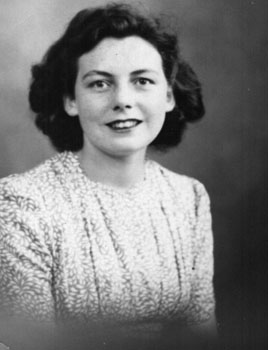
Kathleen
The year was 1940. Hitler was sending his bombers over England most nights, Churchill was broadcasting his moral-boosting speeches regularly and the whole country was geared to defeating Germany and winning this dreadful war.
Young men either volunteered or were conscripted as soon as they were of age. Young women joined the Women’s Army, Navy or Air Force units. Others joined the Womens’ Land Army or were directed to work on munitions and had to go where they were sent. School children were evacuated to safe areas, some to relatives, others to complete strangers.
We had a girl from Scarborough living with us who worked in the aircraft factory in Trafford Park alongside my married sister Josie. My other married sister, Flo, was a crane driver at the steel works and my sister Eileen had joined the Womens Army unit known as the A.T.S.
My friend Celia and I were fifteen, to old to be evacuated and to young to be redirected anywhere. At first when we left school, we went to work in a shirt factory, but after three months there, we found it boring. The shirt factory had started making Khaki shirts. Even in the carpet factory where we now worked some of the looms had changed to making khaki material.
We were employed as Crealers. It was our job to ensure that the wool bobbins behind the looms, were kept full at all times. The foreman, (Ted Bromley) designated us both to a particular Weaver, who's job it was to keep the loom running. Weavers were on piecework and got paid according to the work they did. If we let any bobbins run empty, a fault would develop on the carpet in front of the loom. Then they would have to stop it. The weavers would get very annoyed then, so it was up to us to do our job properly. Sometimes the last bit of wool would get knotted. The foreman told us to break this off and throw it under the loom, but not to let the big boss, Mr. Odernall see us, or we’d be in trouble. This particular day, we had just finished our dinner and still had half an hour to spare before starting work again.
“Let’s get our bobbins filled.” suggested Celia. “Then we can have an easy afternoon.”
I agreed and we ran down to the factory floor. It was nice and peaceful with all the machinery stopped. Celia worked a short distance away from me. I surveyed my bobbins. About ten needed changing. They were each about eight inches long, but more bulky than heavy. We could carry ten in a pyramid style on our left arm, keeping them steady with the right hand.
After selecting the colours I needed I took them back to the loom and set about replacing the emptying bobbins. When I had finished I had a handful of wool left which had been knotted on the bobbins. As I threw it under the loom, a big voice boomed behind me,
“Get that out of there.”
I jumped at the sound and when I saw the big boss, I scrambled under the loom, retrieved the wool and I got covered in fluff as well.
“Now go for your cards.” he bellowed angrily.
The office was overlooking the factory floor. I ran up the stairs but nobody was there. All the staff were still at dinner. Undecided what to do, I remembered that my brother Allen’s girlfriend Phyllis, worked in the winding shed. She would know what to do, so I made my way there. She was just returning from dinner with her friends. After telling her what happened, she said,
“That’s not fair. Let’s go with her to see Odernall.”
So the group of them went to him.
I had started to cry with all the sympathy I was getting. Mr. Odernall could see he had trouble on his hands, so he decided to compromise.
“You did a very wicked thing.” he said. “You know there is a war on and the country can’t afford any wastage. Everything is in short supply. You are suspended for a week. Go home now.”
I had dried my tears as soon as I left the factory gate and was actually pleased to have a week off. My mother was amused when I told her just what had happened. A few weeks later, the factory disappeared during a heavy bombing raid. I was delighted. I would never have to go back there again.
Kathleen Sharkey.
Carrington Manchester.
© Copyright of content contributed to this Archive rests with the author. Find out how you can use this.



 Story with photo