

- Contributed by
- Clive2209
- People in story:
- Albert Carter and Otto J Hamer
- Location of story:
- Ashbury Crossing Signal Box GWR at Shrivenham
- Background to story:
- Civilian
- Article ID:
- A4081286
- Contributed on:
- 17 May 2005
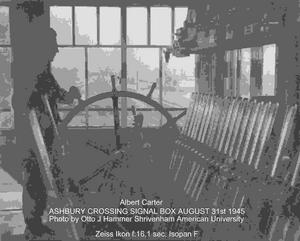
Ashbury Crossing signal box with D-Day sidings in distance
My father was a signalman on the GWR having moved to this location in 1936 following a fatal train accident just outside the village as a replacement for a member of staff who was relocated. The signal box was a convenenient way of making contact especially with farmers who used the level crossing regularly. The box had an iron air raid 'shelter' in it. We kept poultry at home and many of these were sold to colleagues on the railway during the war. There was quite a black market trade! An additional task my father carried out was in the building of sidings for hospital trains and meant an extra 8 hours a day.
Visitors to the box included our family, children of professors at the nearby RMCS (after the war) and American Service personnel also just after the war. One of these, Otto J Hamer was a student of photography and he took the photo shown. Besides, the operating wheel for the level crossing gates with my father in control, you can see the sidings in the misty distance where the D-Day hospital trains were located. This is where injured soldiers were brought for treatment. I have vague memories of these being seen. Some suffered from shell shock and I remember being pursued along with others by such a patient when we were quite afraid.
The SAU only stayed a year before the British re-assumed posession of the barracks.
In wartime some farmers had Italian PoWs placed with them aand there was one who would appear in the field adjacent to the box who would shout up tto my father for a newspaper. This fellow remained for years afterwards.
There was a German PoW camp at Watchfield3 miles away. We used to see the prisoners wandering about in clothes with big patches on them to dnoote their status. The Germans would make things like ships in bottles which my father obtained for 2/6d each. My brother still has one of these at his home. He also has a German striking clock my father bought in the war which nobody else seemed inclined to buy. It was obtained from Leverton's jewellers in Faringdon.
© Copyright of content contributed to this Archive rests with the author. Find out how you can use this.



 Recommended story
 Story with photo