

- Contributed by
- Vachary
- People in story:
- Neil and Ellen Marchant, Lesley, Derek and Barbara Young.
- Location of story:
- Shoreham Beach, West Sussex.
- Background to story:
- Civilian
- Article ID:
- A4502080
- Contributed on:
- 20 July 2005
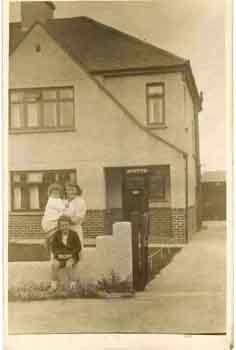
Our Home by the Sea 1939. "Mostyn", Kings Drive, Shoreham-By-Sea, Sx.
The Evacuation of Shoreham Beach.
Shortly before the outbreak of World War 2, my grandparents Neil and Ellen Marchant sunk their savings in the purchase of a new home for retirement, “Mostyn”,
Kings Drive, Shoreham Beach. This was a semi-detached house, just a few hundred yards from the A259, in a road leading down to the sea and near to the little church.
My father Reginald, as a keen TA soldier, was called up many months before Mr. Chamberlain announced the outbreak of war. At that time, my mother Lesley, myself and my baby sister Barbara were living in the Croydon area. After my father left for France, my mother felt Croydon might be subjected to bombing and moved us all down to Shoreham. The little church became our family church. I became a member of the Sunday school and also attended St.Monica’s school for young children, further along the beach. Although we missed father, life for youngsters was so happy close to the beach. At one time, Bertram Mills’s circus set up in the fields between our back garden and the river. My grandfather and I got permission to remove elephant’s droppings to fertilise our back garden, but we could only carry a little at a time in a bucket.
Not long after the fall of Dunkirk, I was about eight years old and was playing one day in the fields where the circus had been, when my attention was caught by the arrival of a small group of army men and one in particular. He seemed to be the leader and wore a kilt. After they had walked around a bit, the leader climbed a little hillock and swung his walking stick in a wide arc towards the sea. Little did I know it then, but I believe that movement of his walking stick signalled the end of our cosy existence and put us on a course of lamentation, grief and financial loss, from which we probably have never recovered.
URGENT, ATTENTION. I cannot recall how the message was communicated. The Hun was coming, invasion was imminent and we were all to be moved back from the coast for our safety. Be ready outside in 24 hours, one suitcase of personal items allowed per person. The time came and we were lifted into trucks. My family was taken along the coast to a house in North Farm Road, Lancing. This might be some two miles back from the coast, but at least it was north of the railway line and no doubt that would hold the Germans back! I don’t know where our neighbours went, but I remember that first night, lying sobbing on adult’s overcoats on the bare floorboards of the bedroom. However, the adult’s attitude was one of gratitude for our being made safe from a fate, the scale of which we had no comprehension.
After a few days, when Hitler’s Stukas and storm troops had not been seen, the feeling started that we should soon be going back. But in the meantime, we were allowed to return for a short while to snatch up some more belongings. In fact we went back a few times, but without petrol, let alone a car and the difficulty of getting a truck, it was just not possible to transfer all our contents. By this time the beach had been mined and on our last trip back, a mine went off with a terrifying bang and with the sound of shingle hailing down on the road.
2.
Then it was seen that soldiers had been billeted in the properties, followed by stories of carpets and furniture being sold off the back of army lorries in the town.
One of our neighbours — a Mr. Bell — had worried deeply about shortage of coal and he had built up a huge pile in his garden. I remember we met him one day in a rage in Shoreham. He was on his way to the Town Hall to complain that soldiers were selling his coal off their lorry to customers bringing their own sack(s). Although our situation was nowhere near as bad as that experienced by those who were to get caught up in the bombing, we were never the less like refugees. Up till now we all felt that it was only a matter of time before we could go home, but then there came a “bombshell”, all the homes in the roads were being bulldozed flat.
The reason given for the bulldozing was that our properties along the coastal strip, would have obstructed the view of our artillery when firing towards the sea, when our guns had been positioned up on the Downs. We knew of no one who had actually seen any guns up there yet. The reason given for the extensive demolitions was widely ridiculed. There must be miles and miles of buildings along the coastal edge of south east England and all equally in front of the Downs, but no-one started bulldozing down the seafront of Hove or Worthing, for instance. So why had Shoreham been singled out for such treatment? I have never subsequently read any account of Hitler’s invasion plans, which suggested that Shoreham had been his favoured landing zone.
As the war drew to a close, my mother decided to return with us to the Croydon area. My grandparents passed away without ever having their dream retirement and title to the property passed to my parents. As soon as I had a motorcycle, I was often looking up my old friend at Lancing. One day, passing our Shoreham plot, I saw a hoarding on it, saying something like “This desirable building land for sale”. Hurrying home and telling my father, he said “It’s a mistake, they have put it in the wrong place. Don’t worry, we have the deeds”. But quickly after, we received notice of a Compulsory Purchase Order, taking our land for the construction of a Promenade. How ridiculous, who would want it? A Promenade linking what with what? After all, Shoreham is really more a residential and commercial town than a holiday town.
We wanted to go back and have our home built again. But the Compulsory Purchase Order blocked that. We were offered an alternative plot, way down by the footbridge, near where my parents thought factories and warehouses would be built, so reluctantly, they accepted the alternative pay off, which I think I remember rightly as £7 per foot of the plot’s frontage, of about 38 feet. I also believe that my grandparents had previously received some intermediate compensation payments.
3.
Shortly after, I was again down on my motorcycle and saw that the hoarding on our plot that was, had been changed. Now it said “Luxury apartments coming here, or a similar sales wording”. What about the Promenade? Already angry at our loss of the original plot, my father contacted a solicitor. In brief, the solicitor advised that the land was no longer of concern to us, as having been acquired by Compulsory Purchase Order. Rightly or wrongly, we could not clear from our minds a feeling that a monstrous injustice had occurred. The way things had gone might have been in accordance with the law, but it just did not seem right to us. The financial situation had hit the family hard, but the grievance has always been that somebody, somewhere, had determined that we should not have our land back and rebuild “Mostyn”. One day some man made contact and said he was investigating what had happened. He came and we told him everything we could, but as far as I know, no more was ever heard.
© Copyright of content contributed to this Archive rests with the author. Find out how you can use this.


 Recommended story
 Story with photo