

- Contributed by
- actiondesksheffield
- People in story:
- ARTHUR WARD, Brigadier Fowler
- Location of story:
- Tunis, Mjez El Bab, Tebourba, Gambett, Hamma Plaisance, El Kroub, Constantine, Djedjelli, Sousse, Sfax, PACHINO, Mt Etna, Sicily. Vizzini, Catania, Raddusa, Adrano, Milletto
- Background to story:
- Army
- Article ID:
- A4517778
- Contributed on:
- 22 July 2005
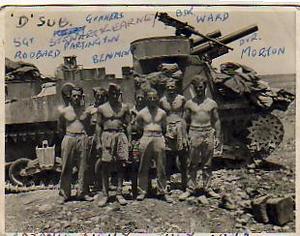
July 1943 - Bombardier Ward, Gunners Beaumont, Kearney, Jackson, Stewart, Sergeant Rodbard, Driver Morton of ‘A’ Troop, ‘A’ Battery 5 Don Sub Section on Catanina Plain, Adiano, Sicily. 105mm Howitzer on Grant chassis (USA) called Priest, the first self-propelled gun to be used by the British army.
This story was submitted to the People’s War site by Roger Marsh of the ‘Action Desk — Sheffield’ Team on behalf of Arthur Ward. and has been added to the site with his permission. The author fully understands the site's terms and conditions.
Refer to Chapter 1-- A4345544 -for links to other chapters.
LIFE IN THE ARMY
by
ARTHUR WARD
Chapter 17 — The Invasion of Europe - Sicily
May 21, 1943
We had a lecture by Brigadier Fowler, who was commander of the 1st Armoured Division and then the Medical Officer gave us a lecture all about malaria.
We then loaded on to transporters and moved through Tunis, and we passed 70th Field Reg. moving in the opposite direction. We carried on to Mjez El Bab and stayed the night near Tebourba. We had a swim in the river.
We then moved on via Gambett and Hamma Plaisance.
Here we were able to exchange our clothing for new ones at a mobile laundry. We saw a film at an American Hospital.
We then moved to El Kroub, which was 15 kilometres from Constantine.
The Priests all went to the Ordnance Depot to be water proofed so it looks as though an invasion was waiting for us.
We had three days' rest which counted as leave.
We were able to go to Constantine each day. Constantine was the largest town in the area and was built on two sides of a very deep gorge through which flowed a river.
The two parts of the town are connected by a very high suspension bridge, which was a frightening experience to cross over, especially when windy.
June 09, 1943
At this camp, a railway line ran past the boundary and many trains full of Prisoners of War passed by. Some stopped to pick up coal and water, and most of the German troops just gave us sullen looks.
We took pity on some of them and offered them food and drinks. Some were friendly and accepted, but some were very arrogant and would not accept anything, although they must have been thirsty and hungry, all packed into cattle wagons.
June 10, 1943
We left camp and joined the Regiment at Djedjelli, which is on the coast, and we were told that we were here to practice landing on enemy beaches.
The next few weeks, the dates are only approximate, as I did not fill in my diary for quite some time.
We were able to have a swim each day in between invasion exercises.
We spent 3 days on a large 'Landing Ship Tank', but the sea was too rough to make a landing.
June 15, 1943
This date is correct. On this day we carried out an exercise on a small ship called a 'Landing Craft Tank'. These crafts only carry 4 tanks and several vehicles. The area where we had to land was very isolated because the exercise was so secret. After a time the sea became very rough and when we tried to land, the Landing Craft was blown sideways onto a sandbank. The waves were coming over the sides and it was decided to "abandon ship". The pumps were working flat out but were unable to cope. We had to get ashore, carrying water and rations. A breeches buoy was rigged up to help the poor swimmers. Everyone was wet through to the skin but no one was seriously hurt.
On shore, we gathered brushwood and made a huge bonfire, and we were able to make hot stew and mugs of tea.
The beach looked a sorry sight with clothing and equipment spread out in the sun to dry; it was like a shipwreck in a film. After we had eaten the stew, the heavens opened and down came the rain so we were all wet through again. Darkness came and there was nothing more we could do, only lie down and try to sleep in the rain.
It rained nearly all night, but when dawn came, we had brilliant and very warm sunshine. We were able to cook some breakfast from our emergency rations, then an American fighter plane flew over and dropped a message, which said, "Are you all OK? You cannot be reached on the rough sea so you will have to march over a mountain to the nearest road". We all sat down on the sand and formed the word YES, and then prepared to march.
The Commanding Officer had a leg wound and he had to be left behind with his staff to be rescued when the sea became calm.
An Arab guide appeared from somewhere and he knew the best tracks through the undergrowth, so he led the way. We carried haversack, rations and water bottle but it was more a struggle than a march in single file through very thick undergrowth, but the tall trees did give us some shelter from the very hot sun.
At about 17:00 hours we reached the plain where there was a farm where we were supplied with tomatoes, lemonade and water. After a rest of about 1 hour, we set off walking again - already we had covered 9 miles and had at least another 2 miles to go. After a short time now on a road, several cars appeared and in the leading one was one of our Battery Officers complete with hot tea and more stew - what a welcome sight!!!
The cars ferried us in turns to a river, which had to be crossed, by a very primitive ferry, which had to be pulled across by hauling on a rope.
On the other side another very welcome sight were several 3 tonne trucks. We scrambled aboard and they took us back to camp where the cooks had prepared a hot meal for us.
I shall always be proud of the fact that I marched or scrambled at the head of the column with the Arab guide and officer who I think was Lt Onslo. We were first to reach the farm.
In a book of the 11th (HAC) Regt written by Major Boulton he wrote:
"The men of A Battery will long remember that march, which was led by an Arab guide. It was necessary time and again to climb up to 1,000 feet up one hill and then descend to the valley and up again. We did not reach the plain until 17:00 hours. Then we reached a farm were the French farmers gave us tomatoes and fruit and sold us wine and lemonade.
We were able to phone the Town Major who gave a message to the Regiment. At 18:00 hours we started marching again towards the main road, but we were met after five minutes by the Second in Command with a fleet of small cars. Hot tea and rations were supplied. The cars made quite a few journeys to a ferry across a river where, at the other side, a convoy of 3 tonners took us back to camp."
He also added:
"The men throughout the 2 days never made a single murmur or grumble. Many of them worked for 4 hours at a time in water in difficult conditions".
INVASION OF EUROPE - SICILY
JULY 1943 DJEDJELLI
During our time in this area, we had to move, and during the day, we were involved with a 'plague' of locusts. There were millions of them on the move, in fact the sky was black and it nearly turned into night. Also the buzzing of their wings was monotonous and lasted all day. The local farmers dreaded them coming and were fearful that they would land as wherever they did so they would strip all the vegetation and crops in a very short time.
Many of them must have been exhausted, as they fell to the ground and could hardly crawl away. It was also dangerous when moving if one flew into your face, a nasty injury could be caused, as they were pretty solid and about 3" - 4" long.
Suddenly just before dusk the continual buzzing stopped and the majority of them had passed by. It was a sight and sound that would stay in our minds for a very long time.
We were able to swim every day until about 21 June 1943. We moved into trucks to the docks (we had been issued with new equipment to replace the ones lost or worn out).
We boarded a LCI (Landing Craft Infantry) with no vehicles to Sousse, which was a 2 day journey. We moved to a camp 15 miles from town.
We were issued with a brand new priest then we had to hand it over to ‘B’ Battery.
We moved to another camp near Sousse called Brentford, where we were issued with another new priest, which we took to a depot where all vehicles were waterproofed. That is, they were made so that they could 'wade' through up to about 6 ft of water. The exhausts had to be welded so that they stuck up above the top of the priest; this took 3 days.
July 03, 1943
We boarded LST 361 Landing Ship Tanks, which are the larger type of landing craft. They were real ships, and large doors opened at the front from the large hold below (similar to modern day ferry's). We moved into the harbour at Sfax. We were sitting ducks here if we had an air raid, which we did, but were lucky, as no damage was done. We stayed here for 3 days waiting.
July 04, 1943
When everyone was on board we set sail for Europe but we still did not know where we would be landing.
The commander of the convoy was on board our ship, which was the largest in the convoy. With our LST were 42 LCT, 4 minesweepers, 3 destroyers and 2 light cruisers.
The invasion was then postponed for 24 hours due to the very rough weather.
July 09, 1943
Friday. The sea was very rough and we all felt very ill, but I was not seasick. We passed near Malta where we could see some battleships in the harbour.
July 10, 1943
SATURDAY
Zero hour was at 02:45 hours.
The infantry of 51st Highland Division were first to land, but they were repulsed, so the navy put down a tremendous barrage on the beach with cruisers, rocket guns etc. the landing was then a success.
When daylight came we were amazed to see that the whole area was filled with ships of every description and although we did not know until later, the Queen Mary was there having brought troops from Canada.
The barrage was frightening. The shells from the big ships and the rockets were flying over our heads as we approached the beach. We were praying that none of them fell short, as we wouldn't have much chance with them.
The air was filled with choking smoke and the smell of cordite from the gunpowder was really bad.
PACHINO
The landing craft edged slowly to the beach, then the ramps were down and we trundled off under our own steam. It was very scary travelling through about 5'-0" deep water, and we were just hoping that our engine did not cut out. Fortunately, it didn't and at 08:30 hours, we were on the beach expecting to have to negotiate mines, obstacles and withering machine gun fire. What a shock - the sun was brilliant, the birds were singing, and now the barrage was eerily quiet. We drove off the beach quickly and took up gun positions in an orchard full of red and ripe tomatoes!!! It was the first time we had seen them growing outdoors.
We did not know at the time that we were the first artillery regiment to land in Europe.
We moved forward and travelled for 9 miles without firing or having a shot fired at us.
We were very surprised and were hoping that the information we had was wrong, and maybe the enemy had vacated the island. What a hope!!!
July 11, 1943
I did not mention that when daylight came over the far side of the island, we could see smoke pouring out from a mountain, this turned out to be a volcano, Mt Etna, and all the time we were in Sicily, we were overlooked by this dark and smoking volcano. We realised that it was a perfect observation post for the enemy, as from the top, all the island could be seen. We always felt that they were watching our every movement.
We advanced along a rough road through the villages of Scordia and Nuto, just firing a few rounds at intervals.
We thought it was going to be easy, but approaching a town called Vizzini, we were in for a shock. First we saw a Sherman tank at the side of the road. It had been hit and set on fire, and smoke was still drifting away from it, but scattered around it were several bodies of British Troops who had been burnt to death. Men burnt to death looked really awful and the smell of burning lasts in your mind for a very long time. We all thought, "Here we go again".
We took up a gun position and learned that the Germans were well dug in and waiting for us on a hillside.
More bad luck when ‘C’ Subsection Priest (No.1 Ernie Knell), accidentally caught fire and was burnt out.
Sicily was not a very good fighting countryside for tanks, so we were used to support infantry regiments.
We were held up at Vizzini for 2 days, although progress was slow.
We were in a mountainous region, and many of the hilltop villages and towns had just been reduced to a mass of rubble by both sides and the occupants had fled.
July 18, 1943
Held up near Catania (the capital), in front of Mount Etna, and we fired many rounds including large concentrations of fire, but Jerry was holding on grimly and blowing all the bridges over very wide rivers. ME's strafed our gun position many times and we were once strafed by American Lightening Fighters. These planes were easily recognised, as they had twin bodies like a catamaran (ship). Fortunately their aim was not very good and no damage was done. It was known at the time that if the American planes bombed the allied troops, they sent a letter of apology and a parcel of goodies for the troops involved.
July 23, 1943
We then moved back for 1 mile for a rest for 48 hours, but we still had to fire on regimental targets at intervals.
We had another problem at this time, as it was reported that enemy parachutists had been dropped in the area. This worried us a lot, as we would have had no chance against them, as they were highly trained and had weapons for this kind of work, and we were not infantry trained and only had rifles which would have been no use in close combat. We had to have men patrolling the area every night, watching out for them.
For the next 18 days we continually moved from one sector of the front to another, firing barrages at night and during the daytime.
We supported the Canadians, Infantry of 78th Division (yellow hatchet sign), Infantry of 51st Highland Division and the 23rd Armoured Brigade.
We rested at short intervals near Raddusa.
The battles are now taking place on and around the slopes of the volcano Mt Etna.
July 30, 1943
I took over Priest No. 169301 and became No.1 on ‘C’ Subsection.
I was only a bombardier (2 stripes) at the time, which was unusual for this to happen in action.
We were very much under strength at this period, as 75% of the forces went down with malaria. We all had to take Mepacrine tablets (Quinine) every day and should have slept under mosquito nets every night, but this was not possible when in action.
I had a slight attack of malaria but I was not ill enough to go back to hospital. I did my best to fight the illness, as I did not want to lose my job as No. 1. Later in the action, it was discussed among the senior officers if I should be promoted to Sgt. in field (in action), but it was decided not to. If I had had this promotion, the only way I could have lost three stripes would have been by a court martial (very rare).
The rough stony ground now hampered us, which was lava from the volcano. The tarmac roads were mined and it was almost impossible to find level ground for gun positions, it would have been impossible for 25 pounders to go into action, so the infantry were very pleased to have the priests behind them.
Our address now changed to Central Med Forces (CMF).
August 06, 1943
I received a birthday cake from my mother (5 weeks late), but unfortunately it was wet through and must have been in some seawater on its voyage out to me.
We fired a very big barrage, then had 2 days rest before moving over to the Canadian sector.
We took part in another barrage, then went through the forward troops across a wide river at Adrano, until we went into action at the roadside on the slopes of Mount Etna 4 miles off Milletto.
Our gun position was just off the road on the rocky lava which made things very difficult for the priests to manoeuvre and we had to take great care not to strip a track, which was easily done. Many Germans retreated to Messina and escaped by sea to Italy, the remainder surrendered after 6 weeks of hard fighting.
Pr-BR
© Copyright of content contributed to this Archive rests with the author. Find out how you can use this.



 Recommended story
 Story with photo