

- Contributed by
- andyhardiman
- People in story:
- William Joyce, Marjorie Joyce, Ronald Hardiman
- Location of story:
- Bristol
- Background to story:
- Civilian
- Article ID:
- A8756076
- Contributed on:
- 22 January 2006
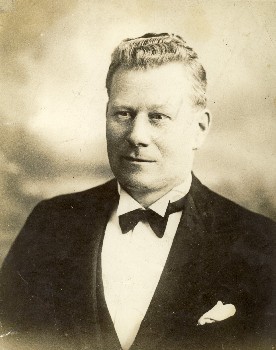
William Joyce picture taken in the 1920s
Mums Story.
I am writing this to relay to you the war memories of my Mother Marjorie Joyce and her family from Bristol.
Prior to the war, mum can recall being in town with her father William Joyce and seeing a group of Moselys black shirts marching, bystanders were booing the marchers. William Joyce was also the name of Moselys second in command later to become the infamous Lord Haw Haw. My grandfather, well known locally for his work as a swimming instructor and entertainer, had two sisters who worked in a sweet shop called Melhuish in Castle Street, customers who new the family would comment “ fancy your brother being mixed up with Mosely”. My grandfather had a disclaimer placed in the newspaper The Evening World denying any connection with the fascists.
Mum recalls helping her Mother in the kitchen peeling potato’s for Sunday lunch on September 3rd 1939 when on the radio Chamberlain announced war had been declared on Germany.
Jumping forward her next recollection is seeing the troops that had been evacuated from Dunkirk being billeted in tents in Eastville park. Her father organised entertainment for these troops June 1940.
Later in the year on November 24th 1940 at around 6pm the blitz came to Bristol. Mums sister Sadie was out with a friend on the other side of town when the blitz started, she recalled seeing the whole area being lit up as flare bomb was dropped, they made there way to her friends house then Sadie carried on alone to get back to her house in the St George area, meanwhile her father, worried, was making his way into town looking for his daughter, the two met in the Lawrence Hill area, Sadie recalls her father, a strict disciplinarian, first words being “ when you get home I’m going to kill you” she would say she was more afraid of her fathers reaction than she was of the bombs.
Mums next recollection was the day of the daylight raid on the aircraft works in Filton. Mum was crossing St Georges park on her way to work when a air raid siren sounded, a German reconnaissance aircraft flew low over the park, low enough to see the markings on the aircraft, mum ran on and as she got to the factory two men grabbed her and bundled her down to the shelters.
Jumping forward again to the 16th march 1942. On a night time raid German bombers appeared to be targeting the Strachen and Henshaw engineering works. The factory was not hit but surrounding properties were destroyed. A HE bomb fell in mums road Victoria Parade knocking down two or three
Houses, an air raid warden standing nearby was unharmed. An incendiary bomb came through the roof of mums house landing on her parents bed, her father scooped up the bedding containing the bomb, kicked the bedroom window out and threw the burning bedding out of the window, mum recalls running out of the house and seeing the bedding hanging out of the window on fire the only casualty was her fathers hands which were burned. In May 1942 Mums mother was diagnosed with throat cancer , within days she was dead, William always maintained it was the stress of these events that had triggered the illness.
Another recollection was the co-op funeral parlour in Lawrence Hill being hit by incendiaries, after the all clear sounded, Sadie wanted to go down Church road to see the fires when they got there a large crowd had already gathered, they had hardly arrived when the sirens sounded again heralding the heavy bombers, the crowd scattered mum and Sadie hotfooting it back home.
Mum can recall walking through the Old Market area of town with Sadie, next to the Kings cinema was a record shop, in the fanlight above the door was a loudspeaker playing Glen Millers American Patrol,
A half a dozen or so American servicemen were jitterbugging in the street outside the shop, passers by stared at this un-British display of freedom.
My last anecdote is VE night Mum who always hated having her sleep interrupted was woken by Sadie
Saying “ listen the church bells are ringing” (mums not sure if the bells were ringing that night or if it was the noise from the street that woke Sadie up)Sadie made mum get up and dress and they went out to see the bonfires and dancing in the streets. It was a family joke for many years that the war had ended but mum was grumbling that her sleep had been disturbed .
Post Script.
William Joyce had an American cousin, Bill Hurkett who was stationed in England during the war.
When Bill was on leave he would make his way to Bristol to see his relatives, he turned up out of blue on the day that would later become VJ day. Mum and Sadie already had tickets to see a performance at the Hippodrome theatre, they contacted the theatre and obtained a third ticket, the three of them went off to see the show. When they came out of the Hippodrome the city centre was alive with people celebrating the victory.
Mum lost contact with her American relatives over the years, using the internet I made contact with Bills son Steve. In 2003 I took mum to the US to stay with Steve and his family and see the New England autumn Bill had talked of so fondly all those years ago.
Dads Story.
My father Ronald Hardiman was not a Bristolian he didn’t come to Bristol until after the war.
Dad was born in 1920 he was called up into the navy at the beginning of the war.
Dad would never talk much about the war I guess it was painful for him and better left in the past.
He said that he had been around the world on board ship. He served on the Russian convoys taking war material to Murmansk, he talked about visiting America, I remembering him telling me about a race the crew had organised between a British Matchless motorcycle and an American Harley Davidson. The Americans were dismissive of the lightweight British machine until the Matchless accelerated away leaving the lumbering Harley in its wake. I also recall him telling me about being in New York when an air raid siren sounded, he said they watched as New Yorkers fled, using his expression, like headless chickens, at the false alarm.
He served on several ships but the main one was the aircraft carrier HMS Indomitable. The ship was bombed and torpedoed at different times, I remember him saying it was repaired in Grand Harbour Malta by plugging the torpedo hole with a concrete bung.
He was involved in the relief of Malta, a large convoy, known as Operation Pedestal was sent to re-supply the Island, much of the convoy was destroyed by German and Italian attacks, the other carrier in the convoy, HMS Eagle was torpedoed and sank in minutes, Dad recalled seeing the huge ship going down . The Indomitable took several bombs, the blast from one lifting Dad off his feet and smashing him into the metal wall of the room he was in.
These few anecdotes are pretty much all the stories that Dad ever told us about the war.
© Copyright of content contributed to this Archive rests with the author. Find out how you can use this.


 Recommended story
 Story with photo