

- Contributed by
- medwaylibraries
- People in story:
- Brenda Franklin (nee Gilbert,) Charlotte Gilbert (mother,) and Alfred Gilbert (brother.)
- Location of story:
- Tilbury, Holt, Erpingham, Sheringham and Staffordshire
- Background to story:
- Civilian
- Article ID:
- A7069476
- Contributed on:
- 18 November 2005
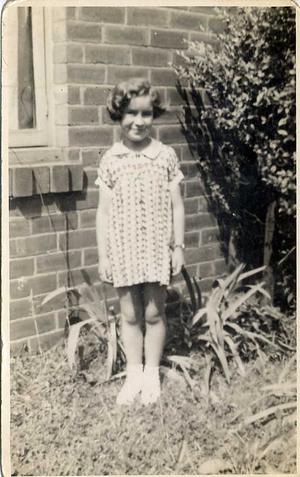
Brenda Gilbert aged 7 - Leek, Staffordshire
Evacuation to Norfolk
I was six years old when the war started and my brother was thirteen. We lived in Tilbury, Essex. We were evacuated on Sunday, 2nd September 1939, my brother’s birthday and we thought we were going on his birthday treat.
We went on a boat, the Royal Daffodil or Royal Eagle, I’m not sure which, and we went right round the coast to Great Yarmouth. It was a very dangerous thing to do really but we weren’t in charge. I’ve got lots of vivid memories from that time, of places we lived in, but I think I must have been a ‘foody’ child because I remember being given a carrier bag with things I’d never heard of in it. It was a brown paper carrier bag, because they always were, no Mr. Tesco then! This bag contained, I was told, Collyonny, which I now know was condensed milk; bully beef, which was corned beef, and chocolate. They are the only things I remember.
Arrival
The first night, after we got off the boat, (and I don’t remember how we got off the boat,) we slept on sacks on the hall floor of a school. I can still remember the smell of those sacks, because they had contained hoof and horn fertilizer. It was a dreadful smell.
From there we travelled on, in a Charabanc, to a village called Holt where we stayed one night. I think we knew by then that it wasn’t my brother’s birthday treat! Then we moved on to Erpingham, where we lived in a cottage.
Living in the old cottage
It was a very olde-worlde cottage, but at six years old that didn’t mean much to me. I know there was a pump in the yard, and if I put it crudely, a ‘bucket and chuck it’ further down the garden! They had a black spaniel dog, and I was given a knife and dog biscuits so I used to sit and cut them in half for the dog, but it used to be half for the dog and half for me!
They also grew a lot of apples there and, again, I can still remember the smell of an apple loft. But whatever the apples were, as you bit into them the flesh was pink, that’s me being a ‘foody’ again.
On to Sheringham and Staffordshire
Then we went on to Sheringham. My mother was with us because she had been newly widowed. Mother was responsible for the children who developed things like scabies, impetigo and head lice; and she got them ready to go into an ordinary billet.
Eventually we finished up in Staffordshire and I have her worksheet from the nursing home there. It’s a very interesting document. It says, “children’s clothes — washing those clothes which cannot be sent for laundry”. “Responsible for bathing and changing of clothes and the cleanliness of heads of children other than their skin cases.” These are just some of the notes from the worksheet. She worked a very long day and she told me that at one time, just before she went home with my brother, she had sixty two children to look after, single handed. It wouldn’t be allowed now!
These children were from all over the place. We had children from Coventry, Manchester and Liverpool, and for one reason or another they stayed with us because they had head lice, or whatever, and they weren’t fit to go into another home. I have tried to find out about it, but not very enthusiastically. One group of children was from Kent, and they’d been living in the tunnels between Dumpton Park and Ramsgate.
When my brother turned fourteen, she and my brother had to come home for him to be put into an apprenticeship, because they wouldn’t give boys jobs in Staffordshire. So I was left alone until the day after V.E. Day when she came to bring me home. I hadn’t seen her in all that time. I didn’t know whom this strange lady was that had come to take me home. I wasn’t aware of V.E. Day at all; all I could think of was travelling home with this strange lady.
A happy childhood
I remember lots of things that happened during that time, silly little things, of no great importance. I remember we were never allowed to look at newspapers and we hadn’t got a radio. I didn’t know anything but I had a very happy childhood.
There was no bombing where I was. The closest I got to a bomb was in the market square. It was ‘Wings for Victory Week’ and there was one turned into a moneybox. That was the closest I got!
I was aware that there was rationing. One house I lived in, one of the girls who lived there worked in, at that time to me, a big store, and anything that was going she used to bring home. Another girl worked in the chemist’s, and used to concoct her own nail varnish. I don’t remember what it was but she used to come home with nail varnish on. The staple food to me then was oatcakes, but not like the Scottish oatcakes, these were like pancakes with yeast in and oatmeal. I have made them since. Again in that particular house they had a trivet that they laid over the fire, and everything was cooked on the open fire.
Coming home
It was difficult to adapt to life at home after the war. I was twelve and a half then and had to go to a strange school for the last couple of terms. My late husband had gone to the Rochester Maths School, and during the war he was sent to Porthcawl, near Pontypridd, but he went with the whole school.
My brother was at home and by then he was working. He’d nearly finished his apprenticeship at Tilbury docks. He was an electrician and he worked for a firm of shipbuilders. It was a father to son apprenticeship, my father had been in Tilbury docks and my brother got his job. But he was my big brother and we were worlds apart. There was seven and a half years difference in age between us. He got me out of a lot of scrapes and that and I was very interested in his friends, as I got older.
I certainly remember rationing then because I got married in 1953 and we were still on ration books then! My husband was a Rochester man, and he had to do fire watching during the war. He was apprenticed at Short’s and he had to fire watch from the top of the cathedral — he said that he’d never been so frightened!
We’ve come on over the years. I remember as a child going in a car for the first time. Also seeing a motor van coming down the street and I ran and told my mother there was a van from the ‘coop’ but of course if was the Co-op. But it was quite unusual, as we still had horses and carts. Our families were closer then. Both my mother and father’s families were strictly East End, London, but when they built the Tilbury Docks in 1925/26 they built housing for the docks and the families got split up. Now life is completely different.
© Copyright of content contributed to this Archive rests with the author. Find out how you can use this.


 Recommended story
 Story with photo