

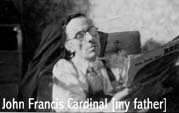
My Father: John F. Cardinal, London 1950's
- Contributed by
- Madeleine Smith
- People in story:
- John Francis Cardinal
- Location of story:
- London
- Background to story:
- Civilian
- Article ID:
- A5832272
- Contributed on:
- 20 September 2005
My Father’s thoughts on VE Day
He wrote as follows:
“It is May 8th 1945, and now, after five-and-a-half years of privation, horror and suffering in the most devastating war in the history of the world, we come to what has been called VE day. It is the day of victory in Europe of all the allied forces which had been hurled against the evil of Nazism.
But the war is not yet ended.
In Burma, and in far-off jungles and pestilious swamps our sons and husbands are still fighting, matching their skill and daring against the yellow peril which sought to dominate the east. For these men there are no celebrations, or even a short respite, for they dare not relax for a moment. But they know that their task will be made easier by events in Europe, and that soon, now, they too will be celebrating victory — total victory.
As I sit here on this night — VE night — my thoughts travel out to these brave men who have been through so much, and who have had to face not only Jap cunning, fanaticism, and ruthlessness, but all the natural obstacles which nature has placed in their path. Now they will go forward with renewed vigour, and some day in the not too distant future we shall join them in celebrating the final victory of good over evil.
In the meantime, I would like to record my thoughts on this historic occasion, although I never expected that I would survive to do so. [My father was unfit to serve in any way during the war as he had a curvature of the spine. He stayed in London for the duration. MS]
For some days the people of England had been keyed-up in eager expectancy. They knew that victory was near. Whole German armies had been surrendering. Hitler, Goering and Goebbles had been variously reported as having fled, been murdered, died in battle, and even credited with taking their own lives. Rumour was rife, and optimistic speculation caused many a flutter. But whatever their end, if end there was, one thing was certain — Victory in Europe was assured.
Already Mussolini had been captured and quickly executed, together with many of his henchmen. The allied armies in Italy, accepting the surrender of the remaining German forces which had been opposing them, had pushed on as far as Berchtesgarten, Hitler’s Bavarian hide-out, and mass surrenders were the order of the day.
Then in the midst of all the speculation and rumours came the announcement over the radio that Mr. Churchill would announce VE day some time during the next few days. Here at last was something definite, and on the evening of Monday May 7th the statement was broadcast that Mr. Churchill would give the long-awaited news the following day at 3 p.m.
Hastily, streets were decorated with gay bunting. Flags of all nations appeared as if from nowhere. Bonfires were lit, and dancing and singing crowds thronged the streets.
All this happened on the Monday previous to the great announcement. This was a “taster”.
Then suddenly the sky was lit by vivid white flashes.
People looked, and with thoughts of rockets and buzz-bombs still fresh in their minds began to wonder.
Quickly the flashes were followed by reverberating and deafening roars, the heavens opened, and the mafficking crowds were caught in the most torrential downpour of rain that London had experienced for some years.
The storm lasted for over five hours, and was punctuated throughout by the majestic roll and crash of heavy thunder, and the blinding flashes which in split seconds transformed the blackness of night into the brilliance of brightest day.
Thus we came to the birth of a new day, a day as historic as any in the chequered history of the world. A day which awoke to fresh clean streets, and wholesome-smelling earth. And above it all the sun shone in all its glory. It was as if God had assigned to the forces under His command the task of cleansing the earth of all evil, to leave only purity and sweetness.
This, and the following day, had been declared a holiday, but to the mothers it was just another day, except that on this day there was more to do, and time was short. But there were no grumbles. The qualities of self-sacrifice and service which make mothers what they are became even more evident, and had you been there on this day of days, you would have seen at 7 o’clock in the morning, long before the shops opened, queues of people outside the bakers, the grocers, and the greengrocers, all intent upon getting in a short supply of foodstuffs to carry them over the two days’ holiday. Even so, supplies were limited, and those who took advantage of the special circumstances to snatch a little extra time in bed, soon found that shops had sold out early. However, it is safe to record that nobody really went short — there was always a neighbour with something to spare.
The crowded hours sped by with alarming rapidity and at 3 p.m. came a partial, temporary lull in the festivities and arrangements, when the people listened to the historic speech by the Rt. Hon. Winston Churchill, England’s most popular premier. That over, jollification began anew. Bigger and even more bonfires sprang up and, as I looked out of my window at the flames, and the ruddy glows reflected in the sky, I was reminded of the big air assault made by the Germans during the big “blitz” of 1941, when it seemed the whole of London was burning from end to end, as indeed it almost was. But it is not my intention to dwell upon the terrible ordeal through which we had passed. That has been recorded by abler pens, and doubtless the history of the second world war will have paid adequate tribute to the heroism, the steadfastness, and the self-sacrifice of the people of London, and to the nation as a whole. The main thing is that we have survived, with, for ourselves, no more visible scars than blown out window-frames, repeated smashed windows and damaged roofs.
12 o’clock Midnight, and even as the words, “This is the midnight news” issue from the radio set, the surrender of the whole German nation became effective.
Only now can we say that the war in Europe is ended. It is the signal for more great cheers, and the rest of the news is drowned by the laughing, singing and shouting crowds. The festivities continued well into the early hours.
Now it is 10 a.m. Wednesday, May 9th and all is quiet except for the roar of bombers overhead engaged on the more peaceful mission of bringing back to this country thousands of our men who had been made prisoners of war by the Germans, but who had been liberated by the combined Allied armies.
And at this moment, some of you — Grace, Madeleine, and Peter, hundreds of miles away from your parents are also rejoicing, happy in the thought that soon you would be returning to your own home. Therefore I hope that as you read these words, you will remember those kind people who opened their hearts and homes to you, adding to their own burdens in order to keep you safe for us, and to lavish upon you the care and attention which, as future citizens of this country, you were in need, but which were impossible under the conditions which existed in London.
Finally, these newspapers, which I have saved, [I don’t know where these are: M.S.] will convey much more to you than I could possibly write. Read them and put them away again, for they are historic. Perhaps in future years they will be read by your children also.
And I sincerely trust that by that time, nations will have learnt to live in peace and to share without fear or favour the goodness of the earth, remembering at all times that we are all God’s creatures, and that in our hands lies the instrument for good or evil.
It is up to every one of us, therefore, to help wield that instrument for the betterment, not to the detriment, of mankind.
[signed] John F. Cardinal [died 1959 aged 54]
Sent in by Madeleine Smith 2005
© Copyright of content contributed to this Archive rests with the author. Find out how you can use this.


 Recommended story
 Story with photo