

- Contributed by
- Dunstable Town Centre
- People in story:
- Reg Geary
- Location of story:
- Dunstable, Thorney Island, Ireland, Iceland
- Background to story:
- Royal Air Force
- Article ID:
- A8948271
- Contributed on:
- 29 January 2006
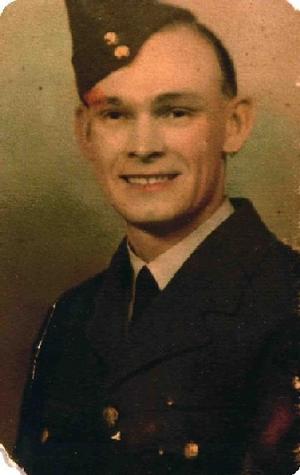
Reg Geary age 29
This story was submitted to the People's War site by the Dunstable At War Team on behalf of the author and has been added to the site with his permission. The author fully understands the site's terms and conditions.
When war broke out I was working in my father’s cafe in the High Street, Dunstable. I lived over the premises and had joined the ARP in the town as soon as it was formed in 1937. I found it very interesting and on one or two occasions I put my first aid training into practice. I then became a full time ARP warden; the pay was very good at £5 per week. I helped my father with his business during the day and carried out my ARP duties at night. It was during the ‘phoney war’ that I went to the recruiting centre in Edgware and volunteered. When I told my CO in the ARP, he told me that I’d signed a contract and that I couldn’t join up. I replied by telling him that no-one could stop any man from defending his country and that I was to report back to Edgware in two weeks time.
I went for a medical and was told I’d got heart problems and would not be able to fly, so they suggested that as they badly needed engineers, l could train to become one. Engineering was, and still is a hobby of mine and I took a piece of my work along with me to show the officer in charge. After looking at my work he said he’d put me down as a flight mechanic. Then he said, “We’ll give you promotion straightaway. You can be a fitter.” I said, “What’s the difference between a flight mechanic and a fitter?” Well he said, “It’s a shilling a day more and you’ll get promoted quicker!” So from there I was kitted out and received my injections. I’d told my wife I would see her later that day but I was sent straight up to Morecombe for very intensive drill training. From there I was sent to Cannock Chase in Staffordshire for ten months technical training and passed with flying colours.
In early December 1940 I got a fortnight’s leave. Towards the end of the second week a policeman came to see me with a message to report to Thorney Island. I’d never heard of it! Luckily when I got off the train I met a couple of chaps that I’d been with, while training in Staffordshire.
It was very noisy because there were 49 guns on Hayling Island, helping to defend the south coast. At first I was afraid that the camp could be bombed at any time, but we only had one daylight raid. On my first night, a group of chaps that had been stationed there for some time were sitting round a table calmly playing cards with all this gunfire going on. I was sitting on my bed in the corner when one of them said, “Don’t worry; someone will let us know if there’s going to be a raid. This happens every night.” I was surprised just how quickly I got used to it all.
We were sent to various places. At one camp in 1941 we met several young ladies that flew bomber aircraft, smashing looking girls in beautiful uniforms. One of them called me up into the cockpit of a Blenheim. “Corporal,” she said. “I haven’t flown a Blenheim for some time; will you run over the controls for me?” I told her that I’d be only too pleased! I met her after the war. She was one of only a few girls that could fly four engine bombers.
Shortly afterwards we started to look after Hudsons, originally designed as a passenger aircraft. We were posted to Ireland in 1942, working on long range Liberator aircraft. Occasionally I’d be posted to Iceland where on two or three occasions I was in charge of the ground crew for three aircraft and was mentioned in dispatches. I thoroughly enjoyed my time there.
© Copyright of content contributed to this Archive rests with the author. Find out how you can use this.


 Recommended story
 Story with photo