

- Contributed by
- Hilda M Taylor
- People in story:
- Hilda M Taylor, Stanley L Taylor, Phyllis Parry, Marjorie Parry
- Location of story:
- Lancashire, Yorkshire, Portsmouth, Dundee
- Background to story:
- Royal Navy
- Article ID:
- A4422971
- Contributed on:
- 10 July 2005
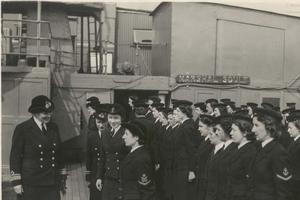
Inspection of Wrens by Director of WRNS, Dame Vera Laughton-Matthews
MY WAR, part 3
Life wasn’t all ‘doom and gloom’ for us though. In Southsea there was the beach of course, and on warmer summer days we could enjoy a swim in the sea. Winter or summer, in the evenings we could go to any entertainments that were available, admittedly in war time not all that many, but dances at the local ‘hops’ were popular; there were good cinemas and the occasional concert performance, and, particularly when we were short of cash, the very popular NAAFI canteen where we would congregate, drinking tea or coffee and exchanging news.
NAAFI, Toc H and Salvation Army did so much to ease life for Forces personnel. I often visited Stanley who by this time was stationed with the RAF near Bedford where he would book a bed for me at either the Salvation Army, YWCA or Toc H hostels. It was always good, clean accommodation and with an enjoyable ‘light’ breakfast in the canteen in the mornings. Return journeys from Bedford were a bit daunting. The last train to London Kings Cross left at 10.30 pm then on arrival around midnight I had to walk to Waterloo station to sit, usually on a wagon and often outside the station, very cold, until about 5 am when I could join the long queue of matelots, with just the occasional wren, waiting for the first train to Portsmouth. There was a waiting room at the station, of course, but it was always filled to capacity, even to having some people sleeping on the tables. I would arrive at Portsmouth at 8 am and sit drinking tea in the ‘dockyard mateys’ café’ just outside the dockyard until it was time to enter the dockyard and walk to the Marshal Soult.
Stanley and I were on trains returning from two weeks’ leave when the end of war with Europe was declared. We had to part our ways at Crewe to then travel in our different directions and we asked at each station stop on the way if there was any news announcement … But no. Had the declaration been announced a few hours earlier, we would have been allowed an extension. Stanley left the train…. At London I departed on the Portsmouth train from which I left at Fratton station then had a long walk back to quarters only to find the place practically deserted as the wrens were all out celebrating “Victory”. With my friends away, there was nothing more to do than just go to bed. A few more months were to pass, however, with work carrying on as normal, before the war with Japan ceased. Shortly thereafter began the demobilisation programme and what destruction I saw then…..
Desks, tables, chairs etc were attacked with hammers and axes. All sorts of equipment were smashed up and one day the sea around us was completely red when bottles of red ink were emptied and thrown overboard. The next day the sea was a deep blue when bottles of blue ink received the same treatment. Light bulbs were thrown overboard and after anyone had drunk a cup of tea or coffee, the cup wasn’t washed — it was just thrown overboard. When I discussed all this with my officer, he just explained that such destruction created a market for new goods when we were all back in civilian life. Stanley, still in Bedford, reported similar happenings there, when large trenches were dug and RAF equipment such as cathode ray tubes, radio transmitters and receivers, etc were buried. Inevitably some items survived and were available for purchase through dealers for several years later. Stanley purchased many such items of radio equipment in Dundee during the early part of our married life in 1947. It was all for nostalgia, of course, and none of it was ever used.
Once married, housing became our problem. When, in Dundee, we enquired of the possibility of council housing we were told quite literally “Never in our lifetime”. We then got land on which to build, had house plans drawn up but then discovered we were one week too late to obtain a permit as the government declared no more building would be allowed. Councils had erected many prefabricated houses that were indeed very comfortable and much sought after, but all had been allocated by then and so, for three years our only accommodation was with my husband’s parents. Not the best way to begin married life. A big difference from Ireland, where, when on a short holiday we saw a notice indicating the government would grant £200 to anyone who agreed to ‘build’ their own house.
The Food rationing imposed during the war was gradually coming to its end, but bread was rationed for a long time and with our coupons, I regularly had to join the early morning queues at the local baker’s to buy bread and/or cakes. If cakes were purchased, then the amount of bread allowed was reduced accordingly.
Clothing coupons were still in use for a long time and there were two ‘tiers’ of goods. Those marked with the symbol “CC41” were government price-controlled and others with the mark “0||0” being uncontrolled and therefore much more expensive. Clothes, furniture, etc marked “CC41” were usually of reasonably durable quality but very basic in design, and furniture, particularly, lasted for very many years. In 1950 we managed to purchase our first home, furnished by a mixture of “CC41” and “0||0” and self-made soft furnishings. We never resorted to hire purchase. Just worked, economised, saved and bought, saved and bought until we had our ‘basics’ and not until then did we feel we could afford to raise a family our first child, a daughter, born in 1953.
So ended my war
© Copyright of content contributed to this Archive rests with the author. Find out how you can use this.


 Recommended story
 Story with photo