

- Contributed by
- JonGodfrey
- People in story:
- Philip Gontarsky's experiences
- Location of story:
- From Boot Camp to Germany
- Background to story:
- Army
- Article ID:
- A4409570
- Contributed on:
- 09 July 2005
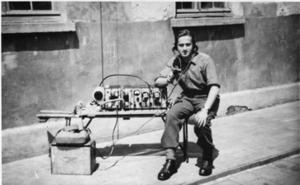
This is my father with his radio circa 1945
What did you do in World War II grandpa ?
Well, that was 50 years ago, let me see what can
I truthfully remember. Call up to serve in the
Army was 18 yrs of age. My turn came on
my birthday when Papers and a Train Travel
Voucher arrived, to report to a Basic Training
Centre at Canterbury,the Headquarters of the East
Kent Regiment. At the railway station there were
several hundred other young recruits; we were all
marshalled together and marched through the
town to the Barracks. We were to spend three
months at this Camp. Once inside you didn't
wander about, you MARCHED!! everywhere!!
With much shouting! ? and standing to Attention!!
we were sorted out into smaller units called
Platoons. Each Platoon was commanded by a
Lieutenant, assisted by a Sergeant and a
Corporal. Having just arrived from Ciwie Street,
it was all a bit bewildering.
The following morning the first parade which
was to be a daily routine for everyone, from the
Colonel down to the Privates. Our Platoon which
was now known as "A" Platoon was marched
off to the "Quarter Masters Stores" to be fully
kitted out from top to bottom; Kit Bag, Uniform,
Two pairs of boots, Two sets of underwear, and
every item of clothing and paraphanalia you
cared to name. Later we were marched to the
Armoury to draw weapons, a rifle, but of course
no ammunition , at least npt yet!!!
More Marching about, this time to the M.O. for
a thorough medical examination and prodding
about. Several of the new recruits were sent
straight back home for health and disability
reasons. There were numerous inoculations
against various diseases.
The Corporal lived with us in our sleeping
quarters. The Corp was a great one for keeping
fit. I do remember that he used to wake some of
us for three mile runs at Sam, this was before
reveille was blown!! Life was very hectic
Marching with your arms swinging to your
shoulders, endless Drilling, -never ending-
Drilling and Parades. Learning all the basic
things that soldiering required, how to handle a
Lee Enfield rifle, firing practise with live
ammunition. One scary thing was pulling the pin
out of a live hand grenade, releasing the spring
trigger and counting up to three before chucking
it.!!! Another difficult procedure was, putting
together a Bren Machine Gun blindfolded.
There were long route marches carrying full
kit, and myriad other things. You were kept
on the go all the time !!! After several
weeks, if you weren't on evening Guard
Duty Roster you were allowed out of Camp,
on the town.
Canterbury had more Pubs than I've seen in
any other town since. The Beer was
something else. Real Ale that you don't taste nowadays.
Above all you were taught the importance of
discipline, and to obey orders instantly. What
you got out of it was the comradeship of your
fellow recruits in the Platoon.
At the end of three months basic training if
you, survived physically, you were accepted
for further training. My assessment was to be
trained as a Driver/ Wireless Operator.
After a brief home leave; Regt. Part2 orders,
had my name up to travel to Whitby in
Yorkshire for further training .
At Whitby we were given Driving Instruction
on vehicles up to 15cwt. (Half a Ton) The
course also included basic vehicle
maintenance, which was great. Intensive
practise in "Morse Code" speeds up to 75
WPM. The main part of the training was to
gain the expertise to operate a mobile
Transmitter/ Receiver known as a "101 set"
which would be housed in a 15cwt truck,
nicknamed "The GinPalace" and how to keep
the apparatus going under fire in the field.
After three months I passed Muster to join
an active service unit. Another selection
panel confirmed my posting to the Royal
Artillery
The 98th HAA Regiment Royal Artillery
consisted of three units called " Battery's" each
one in turn had three smaller units called
"Troop's". 1000 Men including "Officers" and
"Other Ranks" as we were called.
The Regimental headquarters posted me to 365
Battery, where I was placed in "F" Troop. In The
Artillery you were known as a "Gunner".
At this period of the war all sorts of changes
were happening within the armed forces.
Innovations to the traditional roles of Army units
were being introduced, though we rookies were
not yet aware, preparations for the assault on
Hitler"s Barbarism across the Channel were in the
planning stage. I have to say at this time in
writing about this experience that the average
British Serviceman had no idea what atrocities
they were going to be witness to when they
began to travel across Europe uncovering the
horrors of the Nazi's.
The 98th HAA Regiment Royal Artillery w as one
of these units to be given a new role. Large Guns
were not very mobile. The 3.7" Ami Aircraft Gun
was one of the bigger guns that were designed to
be fired from a purpose built static site. The
innovation was, that this gun with some
adjustments could easily be used against the
enemy on land, and then be hitched up in
minutes to a new faster towing vehicle which
would also cany the gun crew, and follow our
advancing forces, giving both Anti Aircraft and
Ground support. The Wireless crew could go
forward with our attacking troops and radio back
firing instructions to the guns who might be out
of sight up to five miles away.
Training as a fast Mobile Regiment went on for
nearly two years. The Regiment travelled the
length and breadth of England and Wales.
Sometimes driving all night through the country
without lights, arriving at some remote
unpopulated area where the guns and wireless
where set up to practise with live ammunition. If
it was a coastal venue the "Wireless Ops" would
have to go out off the coast in a speedboat to tow
a Target behind and report back on the accuracy
of fire.At one rehearsal, the regiment embarked
at Southampton onto Tank Landing Craft to
practise landing the Guns on the beach at
Studland Bay near Swanage in Dorset. As we
sailed down the Solent past the Needles, the
weather which wasn't very promising, turned
really rough, these fiat bottomed boats virtually
stood up on end as we crossed the open sea at
Poole Bay. I'll never forget the magnificent
seamanship of the Royal Navy.
All this training finally culminating with our
arrival off the Coast of Normandy at Arromanches
6am on the 6th June 1944. "D DAY"
This area was the British Sector known as
"SWORD" We got ashore without much
difficulty. The innovation needed here to get these
heavy Guns and Towing vehicles off in 20' of
water were large pontoons, consisting of huge
hollow square steel boxes bolted together to make
a rectangle about 50 foot by 30 foot. Propelled by
a simple outboard motor and one US Seaman to
Pilot it. The pontoon was pushed against the
landing craft ramp, held fast whilst the Guns and
their Towing Vehicles drove down the ramp on to
the Pontoon, which ferried them to very shallow
water where the Gun Towing Vehicles could run
out of the surf via specially laid matting to give
them a grip in the sand.. The British forces known
as the 21st Army Group were all pouring ashore
at this area known as "Sword" and "Gold" The
main assault to capture this sector had taken place
during the hours of darkness.365 Battery were
allocated a field quite close to the beach, near
"Ver sur Mer" The guns were ready to fire within
15 minutes by their Gun Crews, the rest of the
Troop were involved in unloading hundreds of
3.7" Shells, and also digging Slit Trenches in
case ofstraffing by any enemy fighters. I'm happy
to say none appeared. My Wireless equipment
came ashore in the back of a Jeep. I had already
tuned it in to RegimentalVHeadquarters on the
Landing Craft that bought us across the Channel.
Though for the landing, wireless silence was
observed. Then and only then we had a Brew Up
As the days went by there was very little action
for the Regiment. Many of the men were
seconded to help at the floating harbour called
"Mulberry" This was another marvellous
innovation, towed across the English Channel in
sections then bolted together. Large Cargo Ships
appeared day and night unloading fresh troops,
supplies of food, ammunition. Field Hospitals,
Our vehicles were borrowed to help cany me
thousands of tons of supplies from the
"Mulberry" to large storage dumps scattered
around the countryside.
By August the American Tanks under General
Patton broke through across France towards Paris.
The British forces broke through the Falaise Gap
making a long thrust towards Belgium and
Brussels. The 98th HAA Regiment were sent to
the Belgian Coast near the Dutch Border at
Knokke, to assist a Canadian Regiment, to
winkle out the German Norwegian Division that
had been left there to stop the Allies using the
River Scheldt. The problem was that until they
surrendered Allied shipping couldn't use the
River Scheldt which led into the City of Antwerp
a huge Port urgently needed by the Allies. The
only Port available to the Allied Forces at this
time was the "Mulberry" in Normandy, over 200
miles back. The Port of Calais which was only
100 miles back, was still in the hands of the
Germans. Pockets of Germans were also on
Walcheren Island on the other bank of the
Scheldt. The 98th Regiment were given the task
of shelling the enemy. The Germans would
eventually be overcome as they were cut off from
their supplies, their Main Armies were being
pursued back to the River Rhine by our forces.
This task was a bit Bloody, we shelled them all
the hours of daylight, whilst the Canadians
harassed them by night. Major Besley chose a
Church with a Tall Spire to observe from, it had
a rickety Belfry in a little village called Dudzeele.
We had to drag our Radio Transmitter up to the
belfry each day. The Jerries could see us, and
would fire Mortars around the Church, but
luckily mostly missed us. When we were set up
the situation was reversed, once our Guns were
correctly aimed the Jerries kept their heads
down. The surrender came after a couple of
weeks. To our dismay a large number of the
prisoners were only about 14 to 16 years old.
Many wearing SS Insignia, looking very
frightened.
From Belgium the Regiment travelled quickly on
our way around Antwerp into Holland and onto
South Beveland, to help deal with the German
remnants who were on the north bank of the River
Scheldt on Walcheren Island. This was sticky, as
the only way onto the Island was along a
causeway, we couldn't shell them for fear of
damaging the causeway .1 cannot clearly remember
the detail, but after some lengthy weeks I believe
the Commandos went in from the river, the Navy
cleared the mines in the river and it was all over.
The Allied Cargo Boats began to pour into
Antwerp. This was virtually the end of my war.
The Germans made one last try in the battle of the
Ardennes which failed. Allied forces crossed the
Rhine into the heartland of Germany.
Even before the unconditional surrender of the
Nazis forces, the 98th HAA was decommissioned.
We drove all our Guns and Transport into huge
Parking areas near Brussels. "Swords into
Ploughshares" All the Officers and Men who had
served the longest were very quickly Demobbed
and sent back to Blighty. The rest of us were
dispersed into Germany to serve as an Army of
Occupation. I was posted to another Royal
Artillery Regiment near Brunswick. After another
year my turn came to go to Cuxhaven a German
Port, to sail home to Blighty. The Demobilisation
Centre was at Hull in Yorkshir.e Once again put
through a Medical, fitted out with our "Ciwie
Suits" And once more the Train Travel Voucher
to get back "Home"
© Copyright of content contributed to this Archive rests with the author. Find out how you can use this.


 Recommended story
 Story with photo