

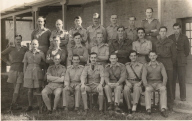
2/Lt. Millem (2nd left)and fellow officers. RAF Bomber Station "Z", Burma 1942
- Contributed by
- Patricia Pringle
- People in story:
- Fred Millem
- Location of story:
- Burma
- Article ID:
- A8062869
- Contributed on:
- 27 December 2005
PART 3
The Anti-Aircraft Company
It was during the second spell that I left the Armoured Cars. One Tuesday morning in the middle of January the Adjutant came dashing out to the airport, sent for me and told me to pack my things and return to Battalion HQ as soon as my relief car commander arrived that afternoon. The Rangoon Battalion were forming a new Anti-Aircraft Company in which I was to get a commission. Needless to say I was delighted, especially as it meant getting away from the airport for a bit. Thus ended my career with the Armoured Car Section, which Section I was, in a way, very sorry to leave, but at the same time glad that I was going to get an opportunity to hit back at the bastards.
I duly reported to HQ that Tuesday evening, and was cordially greeted by the CO, Lt. Col. Hodge as if I had just returned from the battle-front, which I suppose, in a way, I had. I was told to put my pips up immediately, spend the next day getting such kit as officers need and be ready to leave with the new Company at 07.00 hours on the Thursday morning — quick work! Thus from Corporal Millem No. 4851 of the Armoured Cars I became 2/Lt. Millem, No. 4 Platoon Commander of the Anti-Aircraft Company. My new OC was Major Oppenheimer and my brother officers were 2/Lts Jack Villiers, Donald Price and Jimmy Hunter, all of whom were old friends of mine. The new Company consisted of four platoons of 30 men each which together with cooks and followers made a total strength of 131 men. They were a mixed bunch of Anglo-Indians, Anglo-Burmans, Karens and a few Burmans. We were to be a completely self-contained and self-operating unit, our mission in life being aerodrome defence with Browning .5 guns.
Promptly at 07.00 on the Thursday morning we left HQ in convoy for our training camp — once again near Mingaladon airport. I was allowed to take my own car, which, in fact, I had with me before on the airport. The first few days at our new camp were spent, as usual, pitching tents and digging slit trenches and what a joy it was for me to direct operations instead of having to wield pick-axe and shovel and fill sandbags myself! And how nice it was to have a tent and a chair and a table all to myself instead of having to share the same sized tent with seven other men. And to have an orderly of my own and to receive smart salutes from fellows who a few days before had been my senior NCOs!
We were given an intensive eight day course on our new weapons which were the very latest thing from America — the Browning .5 Water-Cooled Anti-Aircraft Machine Gun on ack ack mounting — a simple and very fine weapon, the details of which I won’t bore you with, as, in any case, they may still be “secret”. Unfortunately, soon after our training began, I got a touch of fever. I tried hard to carry on attending the demonstrations, but with a temperature of 102° found it impossible to concentrate for more than half an hour at a time. After a couple of days I had to go to the BMH where I was detained in bed for four days. Luckily I only had dengue and not malaria. Whilst in the hospital there were one or two more raids but as I was in a nice comfortable small private room well sand-bagged in, I did not bother to get out of bed. Soon after I left, the BMH was hit! Incidentally, that was the only time I have ever spent as a patient in a hospital and I quite enjoyed the novel experience.
On coming out of hospital I had little difficulty in completing the mastery of our guns but, much to the annoyance of myself and my platoon I missed being the first to go into action on the airport, which privilege had originally been allotted to my platoon. As it happened, however, my platoon got a far more interesting job. A few days after my return to duty my platoon was ordered to another aerodrome some 30 odd miles from Mingaladon. This was a bomber station known as “Z”, the exact location of which was a well kept secret and must remain so in case we retake Burma. There we were to take over eight .5 guns and the arrangement was that our four platoons should alternate between Mingaladon and “Z”, each platoon doing one week on the guns and one week at base camp.
On arrival at Z I found that only three of the guns had been placed in position by the RAF, so I had a very busy time from the start — sighting gun positions and getting gun pits and trenches dug, and camouflage fixed. It was obvious that this part of the job together with the organisation of efficient operating methods would take more than a week so arrangements were made that my platoon should remain for a fortnight before being relieved so that the succeeding platoons would merely have to follow out the routine which I was to establish.
The RAF Ground Defence Officer was a fellow called Strong who was very cooperative and we soon became firm friends. Others whom I had to work in with and who were also very helpful and friendly were the Station Commander, Wing Commander Milward, and young Toby Nash who was in charge of a troop of Bofors guns and the Doctor, a youngster called Pratt.
As soon as we arrived I was given a tent in the Officers’ Mess and the men were also given quite comfortable quarters. Milward showed me round and told me that, so far, the Japs had never been able to locate Z although they had looked hard for it. The last time they had tried for it their bombs had fallen harmlessly over a mile away. For this reason he told me that on no account were my guns to open up until it became obvious that the Japs had spotted us — we had to remain silent even if they passed directly overhead. I did not like this much as both my boys and myself were itching to have a crack at the bastards who had pasted us so often when we had nothing to hit back with. Still less did I like Milward’s orders that, in any case, my guns were not to open up at anything over 1,500 feet! It turned out that no one at Z had ever seen a .5 ack ack in action so I arranged to give a demonstration the next morning. I prepared my No. 1 gun which was just by my tent in the Officers’ Mess, loading a special belt with all tracer. Before a large gathering of RAF fellows I showed them just what the gun could do with the result that I became the authority for issuing range orders which were immediately changed to our effective maximum of 6,000 feet.
As regards the Japs not being able to find Z, I warned the RAF chaps that I was never long at a place before it was bombed and, as by this time the moon was just getting ripe for night bombing, I betted that the Japs would not be long before seeking me out. And, sure enough, on only the second night, they did. It so happened that W/C Milward and I found ourselves in the same trench together with Strong and the Doc. Over came the Japs and we could see their exhaust flares quite clearly as they flew straight down the main runway no higher than 4,000 feet — an ideal target for all my guns — but they did not drop anything. Milward was in great glee but I still had my ears, well trained by this time in detecting from afar the unmistakeable drone of a Jap formation, well cocked, and warned the others to stay in their trenches.
Sure enough, in a few minutes back came the Japs straight down the 2,000 yard runway in the reverse direction. This time there was no mistake about it. We actually saw what I have never seen before or since at night — the momentary flash from the planes as their bombs were released. From the angle of the planes at the time and from the direction of their run we all realised, most uncomfortably, that the stuff was going to hit the approximate position of our trench. And we were not far out in our calculations! After the terrific row had subsided and we could hear that the Japs had passed over us, we popped up our heads to find that most of the stuff had dropped just the other side of the runway abreast of us about 100 yards away although when the bombs were bursting they had seemed even closer. I turned to Milward and asked him to decide there and then whether or not the Japs knew where we were!
Actually, the damage from this raid was very slight — only one AVG Tomahawk was put temporarily out of action by splinters from an AP bomb. It was, however, only the forerunner of yet another series of nightly visitations and during this series both Mingaladon and Z were bombed every night. It was also about this time that the air raid warning system ceased to function with its former efficiency. The Jap land forces had got near to Moulmein with the result that many of our observation posts ceased to exist. At Z we were therefore in a very difficult position. Not only were we getting little or no warning of raids but the Japs often passed directly overhead on their way to Mingaladon and we did not see the sense in opening fire on a bunch of planes which were destined for Mingaladon and thus attract Mingaladon’s bombs to us as well as our own share. We therefore evolved a system whereby Milward would order a “key” gun — a Bofor — to open fire as a signal to all the other guns, including mine, to do likewise if he thought that the raid was intended for us. I liked this no better than the original orders and would have preferred to have a smack at anything within range but there was nothing I could do about it. In fact, the wretched key gun never did open up!
By this time I had developed a sixth sense. Under the conditions at this time it was hardly possible to sleep soundly at night especially after the moon rose and it was amazing the number of times I woke up and already had my tin hat, revolver and respirator on by the time the sirens sounded, when they sounded at all. And it was very seldom a false alarm. With the warning system all haywire the safety of everyone on the aerodrome often depended on one of us in the officers’ quarters hearing the Japs in the distance and shouting across to the nearby WT tent, where our siren was situated, for the alarm to be blown. We posted our own “listening sentries” and as an additional precaution I made my gun crews, each of three men, do two hours on and four hours off per man on each gun position throughout the night so that there would be no danger of the crews, who slept by their guns, being caught napping.
On the second night of this series the Japs took a diagonal run across the aerodrome, and, apparently trying for the main dispersal point, dropped all their bombs harmlessly between the dispersal point and a petrol dump, in fact all round my No. 4 gun. Apart from my gun this was one of the very few areas on the whole aerodrome where there was nothing to hit and the Japs obligingly dropped their bombs in this area (which was, all the same, uncomfortably close to me) for about five nights in succession. I switched my crews round every day so that none could complain of getting more that his fair share and whoever was on No. 4 gun had a fairly rough night. The next night an AP bomb fell five yards from the gun pit and, although some of their kit was damaged, the men were unscathed and quite boastful about it when I went my rounds the next morning. The following night No. 4 again had a remarkable escape. It was “fighter night”, which meant that our few night fighters which we had by then acquired were in the air so that the guns did not open fire and the crews had the option of taking to their trenches near their guns or sheltering in the gun pits. No. 4 elected to dive into their gun pit that night and their trench was hit fair and square by a high explosive!
It was the next night to that when I had my only casualty — again at No. 4. On hearing the Japs coming over, the crew commander, L/Cpl. Innes, lost his nerve and tried to run for it across open country. He didn’t stand a chance in the open, of course, and had only got about 25 yards from his gun when an AP bomb fell right in front of him. Fortunately the other two members of the crew had the sense not to run with Innes although he called on them to do so, and they were safe and sound in their pit. The bombing occurred about 05.00 and I had a miserable time of it collecting the body in the ambulance with the MO, advising HQ to make arrangements for the funeral and let the next of kin know, sending the remains back to Mingaladon and writing up a report on the affair, etc, etc.
I also had quite an anxious time with the men that day. As I have said, they were a very mixed bunch of local boys with none of the toughness of regular soldiers and the death of Innes, who was very popular amongst them, hit them rather hard. I decided that the best way to keep a grip on the men and pull them together would be to carry on the usual routine with absolutely no fuss whatever. I had a word with each man on my normal daily inspection of guns and quarters and by keeping them hard at work soon made them realise that casualties even amongst themselves were all in the day’s work. They took it very well and I had no difficulty in finding volunteers for No. 4 gun again that night.
Whether or not I would shift my No. 4 gun presented a more difficult problem. The Japs had hit the same spot for about five nights in succession but I considered that that was all the more reason why they would not hit there again especially as there were many far more valuable targets on the aerodrome — the officers’ quarters for instance. I therefore ordered No. 4 to be manned as usual. In the meantime, however, young Nash in charge of the Bofors had withdrawn his gun which was in the same area which meant that my boys on No. 4 would be all the more jittery and I feared a repetition of the Innes affair. So I persuaded Milward to order the Bofors back and it was just as well because that night the Japs again bombed the same area. This time they succeeded in hitting a petrol dump and the Bofors crew with my own were, being on the spot, very useful in stemming the fire.
Thereafter the tempo of bombings rose considerably and instead of one raid a night we got several. A final crescendo was reached when we sounded our alarm no less than eight times in the one night to the sound of approaching aircraft. Fortunately six of the waves passed over us on the way to Mingaladon and only two lots attended to us. By this time the warning system had failed completely and we had to be pretty nippy. Once the moon rose sleep was out of the question and I was always far too busy during the day to get an afternoon nap. It was extraordinary how we all managed to carry on and hardly feel the effects of having had practically no sleep for days. All this time, for the reasons I have already given you, we never had an opportunity to open fire on our attackers. I was very fed up with this so with only three more nights to go before we had to return to our base camp I told all my crews that, in the event of another raid, all guns were to open up if they heard No. 1 gun start firing. I myself became gunner on No. 1 which was near my tent and my intention was to have a crack at any Japs that came over. The boys were all keyed up to get their revenge for the death of Innes, but alas, the last three were the only nights the bloody Japs did not visit us.
© Copyright of content contributed to this Archive rests with the author. Find out how you can use this.


 Recommended story
 Story with photo