

- Contributed by
- pete probst
- People in story:
- REGINALD KENNETH PROBST
- Location of story:
- Bath
- Background to story:
- Civilian
- Article ID:
- A4011968
- Contributed on:
- 05 May 2005
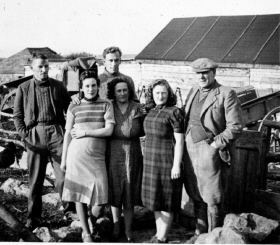
The Knight family of Treliga farm, Cornwall, 1939. Reg is on the left.
We were running out of work as anything we worked upon would not be normally ready for operation for several months and it was obvious that the whole aspect of the war would change. We made a few tentative attempts to think up what the Germans would do on retreat and what we could design to offset it. During air raid red alerts we had a bridge school and at this time we played now and again when boredom set in. We were playing bridge the morning the invasion started.
Years later at the celebration of the 40th Anniversary of ‘D’ Day, the Western Morning News gave a full commemoration issue and a Reporter came around to talk to me about my contribution, we chatted for a time, when he said “What were you actually doing on the very day”. I replied “Playing bridge” and told him that our type of work was always well in advance of the actual event. When I read the paper it was interesting to read what various people in Plymouth were doing at the time, and in the middle page I had a column headed “The man that was playing cards on ‘D’ Day”.
It was one of our chaps, Jellot, later to become Chief Civil Engineer Southampton Docks, who went off on one of the flat ships, detailed for the purpose, to supervise sighting in and placing of all the parts of the portable “mulberry” harbour, and for a brief period of hectic days he became Captain Jellot R.N. The harbour was successful. The American counterpart was not so lucky and the whole operation “Overlord” hinged on the British at harbour Aramanche until Cherbourg was relieved.
Shortly after the war people were discussing the necessity for housing and suggestions via the news media were put forward that as the services of the armed forces could make and export a harbour, couldn’t they make houses and take them where they were needed. We drafted a reply that we made a harbour and transported it and we reckon it was about 70% successful and it won the foothold to victory; but we doubted that the public would like a house that was a 30% failure. However, prefabrication was starting in the building industry and we got on with the job of modernisation of all the naval support establishments.
The City of Bath in general had a great VE Day celebration. We were in Kingswood School on Lansdown having been bombed out of the Domestic Science College. The Kingswood School had moved to Longleat House for the duration of the war and were making requests for repossession, and as V.J. followed on fairly quickly it was obvious that our department would be required to move. The Department decided that they would have a referendum on whether we would move to one of the new commercial areas in Bath or return to London. The result was a foregone conclusion mainly because the establishment had not read the small print on the release of people directed to departments like ours, instead of the armed services. A clause read that should any department move out of the area they were in; staff would not be expected to move with them. The vote was for London by a large majority, and as soon as arrangements began there was an immediate exodus from the department as staff promptly resigned and returned to their pre-war employment, much to Management’s surprise. Those of us who had been in the civil engineers department before the war went where we were posted and I was going to Cuckoo Hill, Northwood.
I feel I must mention that during this time my elder brother John was in the R.A.S.C. and had the unpleasant task of supplying the 51st Highland Division that went a “Bridge Too Far” at Arnhem. Dick was in the R.A.F. and was stationed in Malta, but was fortunate to miss the siege. My mother had her house in Cricklewood blasted through. It was her son-in-law Eddy, who she treated so badly, (He was the director of Fridgidaire at Hendon) that got a gang of workmen to clear all the rubble and do a few emergency jobs so, that when the builders came to do the houses, they started on Ma’s house as they could not get into any of the others.
© Copyright of content contributed to this Archive rests with the author. Find out how you can use this.




 Recommended story
 Story with photo