

- Contributed by
- Robert Hunt
- People in story:
- Miss Madge Hunt, Robert Hunt
- Location of story:
- Wharncliffe Gardens, St Johns Wood, London
- Background to story:
- Civilian
- Article ID:
- A3489366
- Contributed on:
- 07 January 2005
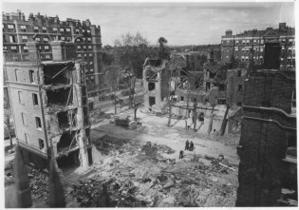
Wharncliffe Gardens Bomb Damage Photograph with permission of Westminster City Archives
A doodlebug incident at St Johns Wood, London
In August 1944 I was 6years old and living in Westway, in West London. I was well aware of the sound of the V1 flying bomb or doodlebug as it was known and the effect it could have. It made a putt putt putt sound before the engine cut out. You then counted 30 seconds for the missile to glide down and explode, hopefully not nearby.
My paternal Grandmother and two Aunts lived in a ground floor flat at Wharncliffe Gardens just off St Johns Wood, London, near to Lords Cricket Ground.
On the evening of Monday 21st August 1944, a doodlebug flying parallel to St Johns Wood, cut out and glided across Lisson Grove then over the roof of an empty Orphanage exploding directly into the 5 storey Wharncliffe Garden flats where my Grandmother and Aunts lived.
My Grandmother and one Aunt were killed together with about another 20 families. They are buried in a mass grave at St Marylebone Cemetery just off the North Circular Road at East Finchley and a monument with all the names, provided by the Local Authority, marks the grave.
The younger Aunt survived and the following is her account of the terrible event of that night and the aftermath.
MISS MADGE HUNT
“Date of the incident Monday 21st August 1944
“My Mother, sister and myself had not long had our dinner. We were all sitting in the same room in the ground floor flat of a five-storey building. At about 8 o’clock our flats had a direct hit from a flying bomb.
I ran to the side of the fireplace and my sister followed me when we heard the terrible screech of the bomb. The next thing I knew, I was pinned from my shoulders to my right arm across my chest, my left arm was free and I could just move that and was able to put it out at the side a little way.
It seemed a very long time and difficult for me to make a noise, as my mouth seemed full of debris, anyhow I made as much noise as I could, and was greatly relieved when I felt somebody get hold of my hand. He said he would come back. After some time I could feel that the wall at the back of me was being loosened and I was able to move the top part of my body.
I was gradually dug out with the men taking turns to release me. There was a doctor giving me attention, we were all in a very small space. I had a drink through a tube, and was given injections in my arm, but was conscious all the time. Finally I was hauled up by ropes, put in an ambulance and taken to Middlesex Hospital.
Mr Patey was awaiting my arrival which was about 4.20 a.m. I remember having my clothing cut off, and my ring being sawn off my finger, then I remember no more until I found myself in bed. I must have looked a terrible sight as I was black and blue, and I must have taken up all of the nurses’ time with the attention I required. I had penicillin injections every four hours, my ears syringed twice a day. I was given oxygen twice a day and had my mouth washed out regularly on account of ulcers that formed, besides various other things.
Then there was a place on my left arm that was dressed and stitched and my right arm was badly crushed. Compound fracture and laceration to right leg fracture to left leg and lacerations to left ankle.
I went to Stoke Mandeville Hospital near Aylesbury on the 1st September 1944 by American Red Cross Ambulance. There I continued to make progress. I still had penicillin injections for several weeks and also a blood transfusion of eight pints of blood.
The plasters were taken off my legs, these being saturated in blood. I had another one put on the right leg and a piece was cut out so that the wound could be dressed before having it stitched. The left leg was put in a splint and the foot was giving me a lot of trouble where it was lacerated and was causing shooting pains up my leg also my foot seemed to drop. I had poultices put on my left foot but could not feel the heat from them.
The next trouble I had a pain in my chest and every time I breathed it hurt, for this I was poulticed and bound up. I had inhalers from the first day at Stoke Mandeville Hospital. One morning I moved slightly and accidentally spilt boiling water over my crushed arm. Large blisters formed and I had to have a great deal of attention.
Then I had shock pneumonia.
Next I had an operation to have my right leg stitched. After having stitches out, I had to do exercises in bed. Then I had another operation to have my right knee moulded and another plaster put on.
My left foot was still painful. My crushed arm and hand improved daily with exercises and finally I could use my hand.
After a time I had a walking plaster on my right leg and was taught to walk on crutches, and then using sticks. I was only allowed up a little at a time.
Dr Cummings asked me if I would like to leave hospital and I went to live with my younger brother and his family in Wealdstone.
The date I left hospital was 21st December 1944, still with the plaster on.
During the time in hospital I was paid an allowance of 24/6d per week.
I attended Harrow-on-the-Hill Hospital after a month. They X-rayed, and I attended weekly for another month (taken by car). Finally I had plaster taken off on the 23rd February 1945, and my leg was put in Elasto plaster.
I was unable to go out until about April 1945.
I attended Harrow Hospital from 19th January 1945 to 8th July 1945.
My pension from 21st December 1944 until 20th April 1945 was 35/- per week, and from 21st April 1945 until 16th October 1945 was 40/- per week.
I then came to London to live in a flat in Maida Vale and attended Middlesex Hospital from 12th July 1945. They took another X-ray of my left foot after I complained of continual pain.
I started having exercises on the 21st July 1945 and electrical treatment and exercises from the 17th September 1945 until 11th February 1946, and had manipulation of the left foot on the 10th December 1945.”
My Aunt remained crippled for the rest of her life and could only walk with a stick. She never married and died aged 83 years of age in 1981.
I often think that if the engine had cut out a few seconds earlier then the bomb might have glided into the empty orphanage and although there would have been damage to the residential buildings it might not have been so devastating.
I never really thought that there would be much noise until the bomb exploded but the “screeching” sound as the bomb glided towards the building must have been terrifying.
One redeeming aspect of the whole incident was how efficient and wonderful were the rescue services and the organisation of the hospital care. Something we, as a nation, can be proud of.
© Copyright of content contributed to this Archive rests with the author. Find out how you can use this.



 Recommended story
 Story with photo