

- Contributed by
- stow-hist
- People in story:
- Harold Williams and Emil Weingaertner
- Location of story:
- The High Seas
- Background to story:
- Royal Navy
- Article ID:
- A3243665
- Contributed on:
- 08 November 2004
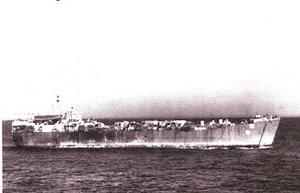
LST 63 off the Bay of Naples. 1943
September 9th 1943
Harold was at the start of the invasion of mainland Italy at Salerno with the British 8th Army on board. He describes Salerno as a very rough place where a small beach was surrounded by mountains and they were under constant fire from German 88mm guns. The Germans were also using ‘glider bombs’ which were remotely controlled to land on targets. One which landed close to LST 63 caused minor damage but Harold and other members of the crew were able to pick up some of the bomb’s remains, including wing parts, for further examination back at base. They continued running supplies to the beach head through to January 1944 which Harold describes as a very ‘hairy’ occupation.
January 22nd 1944
Harold’s craft was involved with the Anzio landings. He describes Anzio as being a little seaside town with a small harbour. One British division and one American division took part in the landings, which, although unopposed, was held up for four months due to the fact that the beach head was surrounded by the German Army. The constant bombing and shelling made the craft’s job of ferrying supplies like petrol and ammunition from Naples another very hazardous job. They also had the job of ferrying the wounded and dieing civilian and military casualtie back to Naples. Harold remembers being envious of the crews of the invincible looking destroyers and battleships etc. that were in the area as thhey passed by. Compared to these bigger ships, his relatively small (300ft) craft seemed very vulnerable. These feelings were being felt as he watched the cruiser HMS Penelope pass by, but a few hours it was Harold’s LST that was picking up Penelope’s survivors.
April 1944
Harold left the Mediterranean in convoy and docked at Swansea and had seven days leave. From there they then went through the Channel to Felixstowe where they were loaded up with tanks before being sent back down to the Isle of Wight.
May 30th 1944
During this period Emil was taken off his boat along with other gunners to releive some of the regular land based soldiers. So for the next few months (including the period covering D-Day landings) Emil manned a gun emplacement at Caen in Normandy.
June 5th 1944
Harold took part in the night time crosssing of the Channel to a position just off the Normandy coast.
June 6th 1944
Harold, on LST63 with Canadian soldiers on board, landed at ‘Sword’ beach where his craft got wedged on a submerged Sherman tank that had failed to get ashore on an earlier wave. The craft was put hard astern to try and release her but this manouvre only caused her slew around until it struck another submerged tank. This time the gun barrel destroyed the twin screws rendering the craft immobile. The tide went out leaving 63 wedged partly on the top of the tank so that crew were able to walk under her keel. Harold remembers picking up live mortar shells that were embedded in the sand and had a game of throwing them at his mates deliberately ignoring the potential dangers. When the tide returned the crew got back aboard and the craft had to be towed, backwards, back across the Channel to Portsmouth where Harold and his crewmates were given a seventy-two hour leave while the boat’s propulsion mechanism was repaired. Despite Harold and some friends being told not to leave the South Coast Militarised Area (strict security was imposed and enforced during this sensitive time) they boarded a train and got to London. They crossed London unopposed despite being described as being “crawling with Military Police” (MP’s) and got on a train at Liverpool Street Station back to Stowmarket. So the day after D-Day he walked in on his mother at her Poplar Hill house where she had been listening to the unfolding events of the last 24 hours on her crystal set radio. She said that she was “glad that he wasn’t caught up in all this lot”, to which he replied, “I’ve been there and back again”.
After his unexpected leave he rejoined LST 63 and continued taken supplies to the Normandy beach heads for several more weeks.
© Copyright of content contributed to this Archive rests with the author. Find out how you can use this.







 Recommended story
 Story with photo