

- Contributed by
- Brian Brooks
- People in story:
- Brooks and Ames families;Mr Cuddiford ARP Warden
- Location of story:
- East Acton, West London
- Background to story:
- Civilian
- Article ID:
- A7266963
- Contributed on:
- 25 November 2005
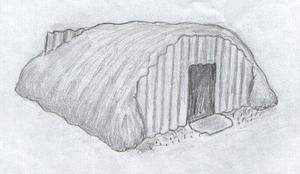
Corrugated-iron Anderson Shelter at 18 The Green, East Acton 1939. As installed by the Council: just a tin box in a hole with 2 benches. No steps access, door, splinter-proof blast wall to protect the entrance or weather protection as officially recommended. ARP was very DIY. picture: Brian Brooks
We lived at 18 The Green, East Acton. The Green was a big half-circle road of about thirty houses round a big, grassed centre. ‘We’ was my Mum (34), sister Beryl (9), and me (almost 4!). Dad, Corporal Harry Brooks, was in the Army, with a searchlight.
One day I was taken round to my Gran’s house at 16 Taylors Green, about five minutes walk away. Taylors Green was two small half circles with grassed centres, on Long Drive. Apart from my grandparents (Will and Tilly Ames), two aunties, Glad (27) and Audrey (16), and someone called The Lodger also lived there. I played in their back-garden, which was quite small, like ours. Then Mum collected me and took me home.
I had been kept away for a good reason, something had arrived - and my Mum was very angry about it. My Mum was often angry about something. Sometimes a cuddle from me would help, sometimes not. This particular ‘angry making’ thing was in the back garden, in fact most of our tiny back garden. Was it a tin castle?
I ran out to see it. A great mound of earth was outside our back room window, with a corrugated iron front and an opening for the entrance. Corrugated iron corners stuck up out of the earth further away. I looked inside - there was no floor and I nearly fell in, being caught by my Mum’s quick hand and my pants. I had to promise that I would never, ever, ever attempt to go in it on my own again!
Was this my birthday present at last? No, it was called an Air Raid Shelter. We would sit in it if the Germans dropped bombs on us. I knew about Germans (who were also called ‘Jerries’ because their helmets looked like the ‘jerry’ chamber pots used by us children — or was it the other way round?) and bombers and fighter planes from the ‘Hotspur’ and ‘Radio Fun’ comics, it sounded exciting.
“It’s ridiculous, there won’t be another war” said my Mum very firmly. She often said things ‘very firmly’ as if that would make them come true. I wasn’t convinced, having mentioned my birthday ‘very firmly’ many times now and it still hadn’t arrived.
Then I remembered we had seen one of these shelter things before. Ages ago (well, probably three months) we had set out on one of our visiting walks. You couldn’t get large prams onto buses, you had to walk. Our big black pram had removable bottom pieces, and with the middle one out it became a seat for a larger child. So with me (reluctantly) in the pram Mum would walk to Hammersmith. We would visit family and her old school and work friends.
In Fulham we had come across a display of the Anderson Air Raid Shelter, named after a Minister of something. Everyone looked very unhappy about leaving a warm, dry house to sit in a tin shed. Anyway, there wouldn’t be another war, it was just propaganda (whatever that was). But here was our Air Raid Shelter, which was real.
My friend ‘Jimmy’ (school friend) had helped his dad build their shelter (or so he claimed) and told me all about it — not fair, I wasn’t even allowed to look in ours! My Mum was angry because she had wanted the shelter put behind our shed and the apple tree, “out of the way as it will never be used”. There wasn’t enough room there, so she wanted it against the back fence.
But the workmen discovered some buried lengths of pipe. The pipes were almost certainly drainage from the former golf course (all our roads had golf related names) but the workmen simply dug their hole in the easiest place — destroying my Mum’s precious rockery. To add insult to injury they even used her rocks in the shelter’s concrete base! That Adolf Hitler had a lot to answer for, I wondered if he knew just how much trouble he was in?
As my Dad was serving in the army our shelter was free. Others, like our neighbours, Mr. Middleton at number 17 and Mr. Stephens at number 19, had to buy theirs from the council, I think I later learned that they had cost about a pound.
I finally got inside our shelter that seemed huge to me (6 ft. long, 4 ft. 6 inches wide; 173 x 137cm). But for grown-ups it was a struggle, hitting their heads on the sharp edges of the small entrance, and the sticking-out nuts and bolts everywhere. Much later Mr. Stephens showed me the pamphlet he got with his shelter kit, with recommended installation of a flight of stairs, full height door, splinter-proof blast wall and weatherproof porch protecting the entrance, wooden floor, etc. which he had done.
Our shelter, installed by the council, was just a tin box with a hole in it, in a hole in the ground — no door, weather or blast protection, not even a means of climbing down inside. Our old kitchen chair had to have the back sawn off to become a step stool; the back was higher than the entrance ledge and tripped us or got kicked over.
The floor was concrete with a round dip sunk in one corner to collect moisture (!) and the sides were concrete up to three feet (91cm), ground level. Concrete was a rather grand name for what was little more than sand and water, I broke a piece off just by prodding it and was told off for ‘damaging’ the Air Raid Shelter! If I could damage it what would those Jerries do to it? If they dropped four-year-olds it didn’t look good.
There was a bench either side, about eighteen inches wide (46cm), made of rough sawn timber frames with a few rusty crossed wires as bed bases. Another, about two feet wide (61cm), fitted across the width of the shelter at the back, resting on the concrete ledges. This was child size, mine, and Beryl’s sometimes.
All the timber had been soaked in ‘Creosote’ (wood preservative fluid) and the stench was very powerful - and long lasting. A broken piece of paving stone was set outside the entrance but as the earth settled the metal edge of the corrugated panel stuck out more, catching heels and scraping knees and hands. More black marks for Adolf. An off-cut of old carpet helped that problem.
But what about the entrance opening? A curtain wouldn’t have lasted very long or have worked very well. Fortunately, my Mum said, at such times ‘cottage industries’ appear to meet the needs. Mr Cuddiford, our ARP Warden, found a local retired man from the Shepherds Bush side of Old Oak Common Lane, who looked about a hundred years old to me, who made shelter doors from old fence panels, etc. for half-a-crown ( 2 shillings and 6 pence = 12p). Ours was four or five vertical strips with two narrow horizontal cross-pieces on the inside; these had small block pegs on the ends that could be turned outwards to hold the door in the entrance. Two old drawer handles helped with dragging the door into place. It was painted lumpy blue, and I thought it looked very smart. A small diamond shaped hole cut near the top and covered by a piece of perforated zinc (from an old meat safe) passed for ventilation. But showing light during the blackout wasn’t allowed, so later even that had to be covered with a little drawing-pinned curtain. But ventilation would seem much less important by then.
My Gran wouldn’t have an air raid shelter at her house because it would ruin her small back garden, and she also thought there wouldn’t be another war. If there was a war they would shelter in the cupboard under the stairs. (We didn’t know it then, of course, but our shelter would play a big part in our lives in the next few years.)
Revised extracts from ‘A Sheltered Childhood ~ Wartime Family Memories of an East Acton Child’
© Copyright of content contributed to this Archive rests with the author. Find out how you can use this.


 Recommended story
 Story with photo