

- Contributed by
- difarfa
- People in story:
- Walter (Eduardo) Westbrook
- Location of story:
- Castelnuovo di Farfa, Italy
- Background to story:
- Army
- Article ID:
- A6180761
- Contributed on:
- 17 October 2005
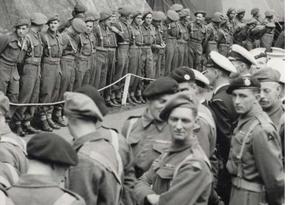
Walter Westbrook attended the Victory Parade in London.
My father, Walter Edward Westbrook was in the South African Defence Force (SADF)- he was based in North Africa and Italy during the war. He was captured in North Africa and shipped to a POW camp in Italy. He escaped from two POW camps in Italy and a train taking POWs north from Rome to Germany. He escaped from a moving train with two other South Africans, Frank Frane and Steven ?. This was around September 1943? They managed to kick in the steel louvres on the train train to the point that they were loose. About an hour north of Rome the train stopped - and the guards got off the train. Just as the train was about to leave - one of the guards shouted: "Die Yster is kaput! ..." More or less translated as "The iron is damaged!" Fortunately one of the other guards instructed him to get back on the train. The train guards sat on the front of each carriage. The three South African soldiers knew they had to make their escape soon. They tried to persuade some of their fellow-prisoners to escape with them, but all declined. Frank and Walter were the only POWs on the train who had escaped from camps before and knew how to survive - and could speak Italian. Frank (in his early 40s at this stage), Steven and Walter managed to kick the louvres out and jumped as the train was moving about 30 miles an hour. They jump out right next to the Tiber River on the West Bank - about 60 km north of Rome. They believe the train they were on was bombed a few miles further up the track. It was dark when they jumped - and they realised they were a matter of a few hundred yards from a German line. Steven, as bold as brass, walked to the nearest house, which happened to be the station masters house - and he rowed the three men over to the other side - they then walked south east along the Sabina Hills - until they got to a valley between Castenuovo di Farfa and Mompeo. Two families looked after the three soldiers: Giovanni V looked after Steven (Stefano). Frank (Franko) and my father Walter(Eduardo) were looked after by farmer, Giuseppe B, his wife and children (aged between 1 year and 16/17). They didn't go into the villages or to the farmhouses as it was dangerous for them and the locals - but were brought food in buckets, or had food left for them at various places. Usually bread or bean soup. Sometimes polenta with olice oil. They slept in caves, or stables - and were in the area until after Christmas 1943. All the time working on sabotaging the German lines and creating mayhem. One of the caves they slept in was right next to a path that was regularly patrolled by German soldiers. They felt they were safer right under the noses of the enemy. Walter was eventually re-captured in early 1944 and temporarily imprisoned at the POW camp at Granica near Castelnuovo di Farfa in the Province of Rieti. The camp was mostly occupied by British POWs.
My father could not have survived the war without the help of the Italian families who put their lives at risk to look out for the soldiers.
© Copyright of content contributed to this Archive rests with the author. Find out how you can use this.


 Recommended story
 Story with photo