

- Contributed by
- bedfordmuseum
- People in story:
- Mrs. Anne Misselke nee Alexandre, Gene Le Ray, Mrs. Elsie Marr, Barbara and Gwen Marr
- Location of story:
- Coventry, Warwickshire, Netheravon, Wiltshire
- Background to story:
- Civilian
- Article ID:
- A8848759
- Contributed on:
- 26 January 2006
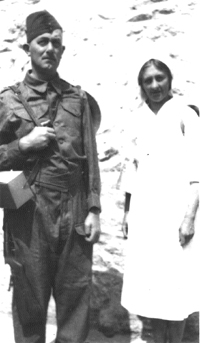
Mr. Jim and Mrs. Ruth Alexandre on Guernsey - Home Guard and First Aid Volunteers. Taken 1939.
Part three of an edited oral history interview with Mrs. Anne Misselke (née Alexandre) conducted by Jenny Ford on behalf of Bedford Museum.
“The day after she’d taken me to Coventry my mum went back on the train to Rochdale to where my cousin Gene had been evacuated with her school. Her school, States Intermediate School for Girls was evacuated to Rochdale so she went and fetched Gene down for the rest of the school holidays and that was lovely. We had lots of adventures. One in particular — my mum had said, ‘While we are in England we must see as much of it as we can’ so we used to go out a lot and this particular day we had decided we would go to Nuneaton for the day. We got a bus very early after breakfast with grandpa and auntie Dulcie and we three children and off we went to Nuneaton. We had a lovely look round Nuneaton, we had some lunch in the Kardoma and then we thought we would make our way back to the station to get the half past two train back. As we were walking along across the road were some of these toilets that you go under the ground into. Grandpa said, ‘Oh, I really need to go to the toilet’ so my mum said, ‘well that’s a good idea the stations only just round the corner, we’ll all go to the toilet. We’ll see you here father, at the top.’ ‘Right!’ So we all went to the Ladies and grandpa went to the other and we came up and we looked for grandpa, we couldn’t see him anywhere. There were a lot of people on the pavement and we thought, what is going on? My mum was getting worried because he was 86, you see. So she said to a very nice chap, ‘Oh, I’m ever so sorry to disturb you, my father-in-law, who is 86, has gone down there to the toilet and we’ve all been to the Ladies and he hasn’t come up yet. I’m worried in case he’s had a heart attack or something, would you mind going to look?’ He said, ‘Certainly not. I’ll go and have a look.’ So he went down and he came back up and he said, ‘I’ve opened all the toilet doors, there isn’t anybody down there at all.’ So my mother said, ‘Oh dear, where is he? Where is he?’ A lady walking passed said, ‘Oh, he’s not coming yet, duck! He’s not due until two o’clock.’ So my mum said, ‘Who?’ She said, ‘King! He’s passing here at two o’clock.’ So we thought grandpa must have heard that, I bet he’s standing at the front! And we walked to the corner of the road where the King was due to go round the corner and sure enough there was grandpa, right on the front! He’d heard that the King was coming and he was going to get a good place.
So we didn’t get the half past two train we got a later one because we did all stop to see the King. But that was the sort of adventure that we would have. And then of course Gene had to go back to Rochdale. My mum took her back to Rochdale. Gene was the only cousin of school age in England but she was in Rochdale and my other cousin Imelda, they hadn’t come, my auntie Mabel and uncle Cyril, they decided to stay in Guernsey. David and my grandma I think had gone to London. Auntie Dulcie’s little boy Michael was too small to go to school. I started school in Coventry. I couldn’t go to the nearest school which was just round the corner because it was full so I had to walk quite a way to my school and I would come home for dinner though, walk home for dinner. My auntie Dulcie would have the dinner ready.
We had one or two raids but then sort of towards the end of October we got more raids and at the beginning of November, on a Friday, my auntie Dulcie said, ‘Now your mummy is having the afternoon off work today.’ I don’t know why I wasn’t at school on that day but I wasn’t. ‘We are going to meet her down in town and we are going to look for a new winter coat for you and a winter coat for Michael. So to be quick we'll have chips today and you and Michael can go round to the chip shop and get the chips.’ So at twelve o’clock we had our little string bag and our two shillings or whatever it was for the chips and off we went. We were walking back and Michael wanted to carry the chips because he was a big boy he thought and so he had the little string bag. We were walking back with our chips down a road which is like so many roads in England with nice neat little semi detached houses or terraced I can’t remember on each side and they all had a little wall and a front garden. A nice little wall with a gate and little path up to the front door and there was nobody else in the road but us and it was a lovely sunny day I remember. We were walking along nicely and suddenly without any warning, eeewowwwooo, du du du and there was a German plane very low machine gunning. Right opposite where we were walking in this road there was a house on the opposite side of the road there was a baby. You know how mums used to put babies out in their prams and the handle was towards the front door and the hood was up so it must have been quite a small baby and this machine gunning was going du, du, du, all on the wall around the door, du du du. I could see the stones flying out of the wall and all the bullets going all round, the mother opened the front door, dragged the baby in and slammed the front door. Then he was going du, du, du along the road then and he was so low I could see him grinning, I could see his head and everything. My mum had always said to me, ‘Now when you are coming home from school at dinner time if any Germans are machine gunning you must run into the nearest garden and lie right up under the wall, as close to the wall as you can. It doesn’t matter that you are in somebody’s garden, they won’t mind.’ So I said to Michael, not worry him, I said, ’Come on Michael we are going to play a game now called ‘keep the chips warm.’ I said, ‘Now come in this garden. You put the chips down on the floor, you lie on the chips and then I’ll lie on top of you.’ So that’s what we did and we lay there. Suddenly he flew over the top of the house across the road behind which there was a field with some barrage balloons in, he dropped a few little bombs on the barrage balloons and off he flew. In the middle of all this the warning had gone off and so we waited and then a few minutes after he had flown away everything was quiet and then the ‘All Clear’ went. So I said to Michael, ‘We can go home now.’ So we got up and we were walking along and an Air Raid Warden came along and he said, ‘Children where have you been?’ I told him what we’d been doing and he said, ‘Oh that’s very clever. Who told you that you should do that?’ I said, ‘My mummy told me to do that.’ ‘Right’ he said, ‘where do you live?’ I said, ‘Clayton Road, just round the corner.’ So he picked Michael up — in his arms like this you see, Michael was lying there with the chips on his tummy looking up at the man. And he was talking to this man, I can’t remember what he was saying but as we were walking towards Clayton Road so my auntie Dulcie came running and when she saw Michael lying (in this man’s arms) she said, ‘Oh, my baby, my baby!’ And she came running up and he sat up and he said, ‘Hello mummy, we kept the chips warm!’ So we went home and ate our fish and chips. We did go into Coventry and I was bought a lovely winter coat. It was brown speckled with orangey bits in, it had a velvet collar and a little hat. Michael had a lovely new grey winter coat. I kept saying to my mummy, ‘I want to go in the Cathedral, I want to go and look in the Cathedral.’ And she would always say, ‘No, no we haven’t got time, we must go home now, we can’t stop.’ She would never let me go and look in that Cathedral and of course a few days later the Blitz started in earnest you see.
We were all sitting in the dining room under the table, we had a little conservatory off the dining room with French doors going into it and we sat under the table first of all. My grandpa was in the cupboard under the stairs sitting on a cushion on the gas meter. My dad was walking up and down with his First World War (tin hat) - which he had brought with him in his one small suitcase - plus all our silver spoons so his suitcase was very heavy. He was walking up and down the hall looking either out the front door or the back door where everything was going on. Suddenly there was a very close bomb and the conservatory blew in, the French doors blew in so we crawled out from under the table and went in to the sitting room. We put two chairs together and put Michael to sleep between the two chairs and there was a sofa and a divan in there so we all sat together, not my dad, on the divan. Then my mum said — the bombs were falling thick and fast by then — ‘Jim, you must go next door and see if Mrs. Smith is alright’ because we’d made friends with the lady next door who was a widow. So he went out of the back door and into Mrs. Smith’s and she said to him, ‘Go and look in my shelter Jim, here’s a torch, go and look in my shelter and see if we can all get in there.’ And of course when he looked in it was flooded so he said to her, ‘Well, you’d better come in with us Mrs. Smith, we’ll all be safer together.’ Because he could hear that water was pouring down from upstairs and he could see it pouring so she must have had a hole in through her bathroom or something, so she came in with us and we all sat on the sofa.
All these bombs were coming down, thicker and faster and I was getting very worried and I can remember saying, ‘Everybody’s got to have a number!’ Daddy, you are number 1, mummy you are number 2, auntie Dulcie you are number 3, Mrs. Smith you are 4 and I am 5 and every time a bomb drops I want you to all to say your numbers! I was shouting this out all the time and of course half the time my dad, who was number 1, was outside wasn’t he with his wretched tin hat on looking to see what was happening. I kept saying, ‘Daddy, daddy say your number, we can’t say our numbers ‘til you say yours.’ I’ve got all my mothers wartime diaries and she says we were absolutely sick and tired of Anne shouting, “say your number, say your number until thankfully after three quarters of an hour she fell asleep”. That was the night of the worst night of the Coventry Blitz.
In the morning my mum and dad got up, you know struggled up from where they were sitting and tried to get themselves washed and then they got on their bikes and tried to get to where they were working. Auntie Dulcie, Michael and I took the push chair out and we went off to try to get some bread and some milk. I can remember we walked up and down these roads and you walked where you knew there was a little bakers and there might be a big barrier across and the Policeman, ‘You can’t go there, dear there’s an unexploded bomb.’ Or another road you’d go in and there would be water gushing out, pouring up from there and another sign saying GAS, it was very frightening really. So we had to come home again empty handed. My mum and dad came back because they couldn’t even get across Coventry to where their factories where so auntie Dulcie had to cobble up a meal out of tins and they had to have their tea without milk in. We went to bed and the next day they went off to try to get to work again. Auntie Dulcie and I went off, we did manage to get some bread and some milk the second day but it was a big struggle, we had to walk ever such a long way. But they couldn’t get to their factories because it was totally impassable.
So after we children had gone to bed they had a committee meeting and they decided that enough was enough. Auntie Dulcie said she would like to go to her friend in Exeter because if Uncle Leslie, her husband, he was a Wireless Operator on a Merchant ship, so if a ship came in it might come into Plymouth and Exeter would be closer to Plymouth. So they said we would go to Jack’s. So they packed what they could pack in a suitcase for each of us. Then in the morning we had a quick breakfast and we walked down to the Birmingham Road and got a bus to Birmingham to the coach station. We all had a cup of tea together and then we put auntie Dulcie on the coach for Exeter and we got on the coach for Salisbury. When we got to Salisbury of course we had to get on the ordinary bus to get to Netheravon where the pub was and when we got in there, there was my grandma and David! They had gone to their friends in London but they had been bombed out so they were there. While were we just all sitting down to something to eat there was a rat-a-tat on the back door and in comes a cousin of my mum’s — Elsie who lived in Norden, which is South London and her two little girls, Barbara and Gwennie. The house next door but one to them had had a direct hit so they had no windows and no doors and she had brought the girls and left her husband and two big boys to batten down the hatches at home. So of course we were a house full but that didn’t matter because there was plenty of room. So Elsie, my grandma and my mum, they all helped with the pub and my dad once again helped in the bar in the evenings and we children were left to our own devices.”
© Copyright of content contributed to this Archive rests with the author. Find out how you can use this.


 Recommended story
 Story with photo