

- Contributed by
- Marian Ivey (nee Simmonds)
- Location of story:
- Nuneaton, Castle Donnington
- Background to story:
- Army
- Article ID:
- A7623759
- Contributed on:
- 08 December 2005
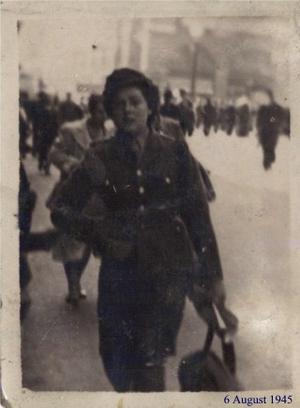
London, 6th Aug 1945
After the ups and downs of Bicester, I was posted to Nuneaton and I shall never forget the smell of coal or coal gas that hit me as I got off the train. We were billeted in a huge building just off a main road, well away from the station. I don’t recall ever knowing what the building was used for before the war, but it had been adapted for war-time use and, among other things, there was a red light set high on a mast on the roof, presumably serving some purpose for the nearby airfield. You can guess at the kind of remarks tossed around by uncultured servicemen about our being housed in a building with a red light!
The huge vehicle park was some way from the billet and, the order given the night before, we were usually woken at some ungodly hour when few of us wanted breakfast and driven to the park in a personnel carrier. On arrival we were directed to the particular vehicles that were being moved, got into any one of them and set off. With the war drawing to a close, I didn’t do very many convoys — the best of them was to Leith Docks outside Edinburgh with an overnight stop (or staging as it was known) at Catterick and Weymouth dockside, staging at Newbury. In those days traffic was light even on A roads (I cannot recall a single traffic jam in all my driving) and there was lovely scenery to enjoy.
The most exciting convoy was taking armoured vehicles to Reading when we had two drivers per vehicle, one standing in the turret giving directions as the driver had just a narrow slit which gave her, all the way, just a view of the road ahead; one needed to have great trust in the lookout! (On the other hand, thinking about it, anything that might have got involved with us would have got the worst of it!) The only other armoured vehicle I ever drove was a tank and had its driver or I been caught we would have been in trouble! I didn’t drive it far — round and round a circular drive outside a large restaurant where we had been having morning coffee and had been chatted up by real soldiers.
The very worst trip however, turned out to be the one that called a halt to my army driving. We were taking tall and very narrow Bedford radio vans to a garage in Chelsea for work to be done on the brakes. Before we set off, we had to sign a document which stated that the foot brake might fail at any stage and that there would be a need to rely solely on the hand brake (I still have in my ATS archives the slip acknowledging my awareness of this).
The finger of fate was at work for me that day. I couldn’t start the first van I climbed up into and quickly abandoned it for another. All went well until the Edgware Road, London, when after applying the foot brake at very low speed, I suddenly found I was slowly going round in a circular fashion and ended up facing the wrong way. Despite the barracking I was getting from some young bloods on the pavement, I soon sorted myself out and continued, not unduly concerned, until stopping at traffic lights in Grosvenor Place. As I slowly moved off, the same thing happened. Looking around as once again I corrected the situation, I saw a woman lying on the pavement. I hooted to the girl in front to stop — by then, as often happened in the cities, the convoy had been broken up and we were the only two at that point. I had no idea as to what had happened, feeling quite sure I had not hit anything but also fairly sure that I had had something to do with the woman on the pavement.
It was all very confusing at this stage and I was very distressed. People were attending to the injured woman and my colleague had raced from her vehicle to my side. From that point, she took charge and, as we were very close to a War Office building we went in there to complete the usual written report. I was too shaken to write and my colleague did all that was required. We asked about the woman and learned that she had been taken to a nearby hospital. Calmer, but still bewildered
I was able to get back behind the wheel and we carried on to the garage. The rest of the convoy was already there and after reporting it all to the ATS Sgt in charge, we made our way to the railway station for the journey back to Nuneaton. Before taking the train, however, I rang the hospital and learned that the unfortunate woman had been transferred to the Atkinson Morley Hospital in Wimbledon, which to this day still specialises in neurological problems.
Still very upset on our return, I was given a sleeping pill and was not called with the others in the morning. I was eventually woken and two senior male NCOs appeared to tell me, very gently, that the woman had died and they wanted a statement from me. They asked some searching questions — had I seen her before the incident? Why did I think I was responsible and so on, all done in the kindliest fashion - and I was told I would have to attend an inquest. I can’t remember anything about the following days until the day of the inquest which took place in Wimbledon. A very pleasant ATS officer accompanied me and, together with my eldest sister Kate, we went into what I think must have been the Magistrate’s Court. I said my piece and it wasn’t until an Army captain gave his evidence that I finally found out what had happened. He had been coming out of the same War Office building where we had made out the report and said that when the vehicle did its slow skid, part of the metal superstructure projecting from the back of the vehicle had struck the edge of the umbrella the woman had been holding and she was thrown back against the wall of Buckingham Palace Gardens. He also said at some point that “the driver was clearly correcting the skid”, which was naturally a relief to hear.
My officer made a statement on my behalf, expressing condolences to the family of the poor woman. The coroner questioned the wisdom of 19-yr-old girls being expected to drive vehicles in such a condition and then it was all over. Strangely, I can’t remember his verdict and can only assume it was Accidental Death or Death by Misadventure; neither have I certain memory of the journey back to Nuneaton. However, I have just come across my Railway Warrant for that day in my ATS archives and discover that it was 9th June 1945, so I must have had a slightly happier birthday the following day than I might have expected.
I stopped feeling responsible but felt I couldn’t face the prospect of another such occurrence and asked to be re-classified. I was interviewed by an army psychologist who said very little but listened carefully to what I had to say. Finally, in response to my expressed conviction that I would never want to drive again, he said he thought it would be better that I changed my job but told me emphatically that there was no reason why I should not at some future date feel happy behind a wheel. And that proved to be the case although it would be several years before I did so.
So it was I found myself on the switchboard at the HQ of No.3 M.T. Group, billeted in a roomy house on the main road of Castle Donnington, which was little more than a village. The major event there was the end of the war. It was the night of 7th May and most of us were asleep when a noisy invasion by some soldiers headed by a Captain Page came up the stairs, knocking on doors as they came. There was a large personnel carrier outside the house and we were “ordered” to come as we were: so, with slacks and battle dress tops over our pyjamas, we drove to Donnington Park where we found a makeshift dance floor had been laid, coloured lights strung, a swing band ready to go and beer by the barrel-load. We all knew of course that the end of the war in Europe was imminent but had no idea that any preparations to celebrate had been organised. Chaps, who didn’t know they could dance, danced and even one lieutenant whom nobody liked had a few partners that night! We were all deliriously happy and I can’t remember at what time we rolled into our beds.
I cannot recall any celebration of the absolute end of the war in August. I was on
leave in London when a street photographer snapped me just after I bought a newspaper headlining the explosion of the first atomic bomb on Hiroshima (see attached photo). That I think was on 6th August and I can recall nothing of the following days. Sadly there are no documents surviving to remind me of what I did or thought so I can only speculate and there is no place for that in a document such as this.
Writing my account of what it was like to be a teenager during those six years (not that the word was known then!) has made me reflect on the differences between now and then. I think that if one excludes the advance in technology and all the material comforts that has brought in its wake, growing up is essentially much as it has always been. Hope, aspiration, excitement and fear are all there at times and in varying degree, but when all is said and done, it is very difficult not to be happy most of the time when one is young.
© Copyright of content contributed to this Archive rests with the author. Find out how you can use this.


 Recommended story
 Story with photo