

- Contributed by
- olney_folks
- People in story:
- Miss Lillian Betty Timpson and Mr Harold Leslie (Les) Callow and their families
- Location of story:
- Olney
- Background to story:
- Civilian
- Article ID:
- A8939758
- Contributed on:
- 29 January 2006
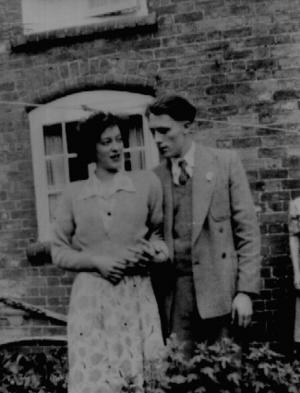
The war years over Lillian Timpson and Leslie Callow get engaged
These are a few snippets from my mum (Lillian) and dad's (Leslie) wartime memories. It tells of the main events that happened during that time and how they started a friendship which eventually led to their marriage in 1951. They still live in Olney Buckinghamshire and this piece is told with their permission
My mother Lillian Callow (nee Timpson) was eleven when the war began and my father was the same age but lived in Trafalgar Road Dalston London, He was evacuated to Olney on the 2nd Sept 1939, the day before war was declared. For my mum the war seemed a distant event in those early days, but for my dad Harold Leslie (Les) Callow his early evacuation away from London and his mother, father and baby sister Sylvia (aged 2), the war was all too real. The day before the evacuation his mother gave dad (aged 11), his sister Flossie (aged 8) and his sister Francis (aged 5) a brown paper package tied with string. This was their belongings. Early the next morning the children and their mother went to Queen’s Bridge Road School, the children had a label tied to them and walked to Dalston Junction Railway Station. The next they knew they had waved goodbye to their mother and they were on their way to Wolver ton Station.
From Wolverton Station the children were put on London Transport Buses which took them to Olney. Mr Ashley the billeting officer was in charge of finding the children new homes. But first food…. All the children were amazed to see a huge spread at Mrs. Lovell’s house. Tea was set out; there were jam sandwiches, bread and cheese, a “bit” of cake and tea. So overwhelmed was my dad by the spread that he hid a sandwich or two in his pocket for later!. The evacuee children ate everything and after tea they went to the pictures at the Olney Picture House before settling into their new homes. The girls went to stay with the Garner and Allen’s families, whist dad over the next few years stayed with Mrs Lovell, Mrs Pipes, Charlie Lovell and Mrs Longland until at last after almost 3 years dad’s mother Rose came to live in East Street Olney, bringing Sylvia and a new baby sister Joan with her. The family were together again.
For most of the war years mum and dad were at school in Olney, they did not get to know each other, as often the evacuee children had special classes away from the other children. Life was fairly uneventful until late one night a bomb went off. It had landed between the railway line and the “bathing place”. At that time there was an archway at the Two Brewers and the blast was so powerful it blew the windows out of houses in the High St and Linco’s store. Everyone rushed to have a look.
At the beginning of the war Dad’s sister Alice (14) was left behind to work for her aunt in a pub in Tottenham. His brother Joseph joined the Lancashire Fusiliers and later became a Military Policeman (MP), while his sister Ivy joined the land army. His Father Joseph Callow was engaged in camouflaging the aerodromes and later, when the docks were bombed in London, he worked on the barges in Southampton.
My mother’s family the Timpsons lived in Near Town Olney when war was declared. Ada Timpson my mother’s mum was already suffering from breast cancer at this time and although she had pioneering radiation treatment at Northampton she died in August 1940. So my mum lived with her dad Reginald and her sister’s Joan and Olive. Her brother Arthur lived with his Aunt Beat and cousin Mary Weed. As the war progressed Arthur was called up into the army and served time in Aden. Joan and Olive worked in nearby Bozeat at the Boot and Shoe factory, until Joan eventually joined the NAAFI and became a firewatch warden in Olney. When Joan was on duty she would sit on the steps of the Cowper Museum on watch and her sister Olive and her cousin Mary would join her and keep her company. Joan didn’t like the dark!
When they were 14, the war was still on, and mum and dad had to go to work. Mum joined the accounts department at the International Stores. She worked on the cash desk, which was situated in an open wooden box in the middle of the store. Dad did the bread round on a bike. He whistled a lot of mostly classical music and people always knew when he was around. As time went by he would throw my mother a bread roll over the top of the box and she would “find” a little chopped ham and some butter to make herself a delicious snack. The friendship was forged.
On their way to work they would watch the Flying Fortresses from the local airfields gathering in the sky above them. When the planes were all assembled they would move into formation and then fly to Germany. In the evening Olney folks would hear them returning, some sounded OK, but many limped back with damaged fuselage and engines, and injured crew. On one occasion one of the Flying Fortresses did not make it back to the airfield and crashed on to the road near Bozeat. Sometimes in the night sky some 50 miles away the glow of burning fires in London could be seen. Later in the war the flying bomb also known as the doodlebug would whine across the sky, but luckily none stopped over Olney.
On VE day the whole town celebrated dad returned to London to be in Piccadilly Circus, whilst mum and a friend celebrated with a whole flagon of cider and thick heads…….At last the war was over. Olney escaped with the minimum of disruption and all of families were reunited, unharmed, after the war except Alice. Over the war years she had been a frequent visitor to Olney, but sadly she contracted TB in London and died when she was only 17.
These memories are but a snapshot of the 5 years of war in a small town in Buckinghamshire. Now this small piece of history will sit in the archives with many other snippets for generations to come and will help to piece together the events and times of WW2.
© Copyright of content contributed to this Archive rests with the author. Find out how you can use this.


 Recommended story
 Story with photo