

- Contributed by
- ritsonvaljos
- People in story:
- Brian J. Scott, John Farrell 'Jack', James Jolly 'Jim', Patrick Kelly 'Pat', James Tweedie 'Jim', Alan Aitkenhead, Thomas Bryan 'Tom', Thomas Horne 'Tom', Peter Scholes, Patrick Gomont Mayor of Bayeux.
- Location of story:
- Normandy, West Cumbria
- Background to story:
- Army
- Article ID:
- A3941057
- Contributed on:
- 23 April 2005
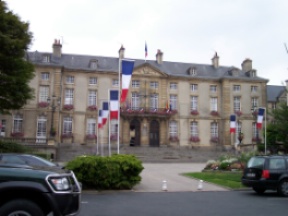
Bayeux Town Hall, summer 2004. Bayeux was the first French city liberated in 1944. Many Normandy Veterans hold fond memories of the friendship and welcome they received from the citizens of Bayeux both in 1944 and in subsequent years. Merci beaucoup ("Thank you!")
Introduction
This article is submitted on behalf of a number of members of the Normandy Veterans Association (West Cumbria Branch No 51). Several members of the Branch have kindly assisted me with information about the Battle of Normandy over a number of years. I am pleased to acknowledge this assistance.
The information in this article was given to me in 1999 which I first used for a university project. Members from the Branch have agreed that the information provided could be released, donated to an Archives and read by others if they wished. The terms of “The People’s War” website have been read and understood.
Reflections about the war by Normandy Veterans
1. Guardsman Brian. J. Scott, Grenadier Guards, Guards Armoured Division.
Brian landed in Normandy at 12:00h on D+23, 29 June 1944, at ‘Gold Beach’.
Brian said:
`“I think the crossing to Normandy took about six hours. We landed at 12:00h on 26 June 1944 in the area of what had been ‘Gold Beach’ initially. During the crossing we played ‘Pontoon’. We went to Bayeux, Caen, Vire and Vassey, St. Charles-le-Percy, Cagny and Caumont.
After the “break-out”, our tank was acting in a liaison role, the first tank into many villages, and telling the Resistance fighters to hold their prisoners until M.P.’s came along to cage them — not always carried out!”
“It was odd seeing shops in Bayeux full of butter, cheese, etc. which was severely rationed in Britain. They had no paper and wrapped it in cabbage leaves.”
Brian used to live at Seascale, Cumbria and is now enjoying retirement in Blackpool, Lancashire. He still keeps in touch with his comrades in the Normandy Veterans.
2. Trooper Jack Farrell, ‘B Squadron’ East Riding Yeomanry, Royal Armoured Corps.
Jack landed in Normandy at just after 14.00h, D-Day, 6 June 1944 at Luc-sur-mer, ’Sword Beach’.
Jack said:
“We had lots of contact with civilians in Normandy. We often traded canned food for fresh food with them. I have visited Normandy once since the War — to Caen and around that area.
We were very lucky in many instances to come out of it alive. Our tank was actually hit a few times, without any of the crew being wounded. On one occasion, our crew commander, who was a Sgt. Tom Horne, got a shrapnel wound to the face and was sent back to ‘Blighty’.
When the East Riding Yeomanry was disbanded at the end of the War, each member received a book called ‘Europe Revisited’. It is a record of the Regiment’s exploits leading up to and including the campaign. It is very interesting.”
It was chaotic for about five weeks. People were shooting at each other because they didn’t know where the front was.”
Jack retired in 1988. He still lives in his hometown of Cleator Moor, Cumbria.
3. Gunner James Jolly, 68 Light Anti Aircraft Regiment, Royal Artillery.
Jim landed in Normandy at 10:00h, D+20, 26 June 1944 at Arromanches(‘Gold Beach’)
Jim said:
“We left from Canning Town docks, River Thames, London, and landed at ‘Gold Beach’ near Arromanches. During the crossing, I was hoping that the ship was not bombed, shelled, or mined before landing.
I was a gunner, driver and wireless operator. I was a qualified Wireless Operator with the Royal Artillery — ‘BOFORS’ Light Ack Ack — but due to the absence of the ‘Luftwaffe’, the ammunition was changed to armour-piercing shells and we became anti-tank guns. We were then transferred to field guns, 25-pounders and were trapped in the ‘Falaise Gap’.
I then contracted yellow jaundice, and was flown to Brussels in December 1944. On my return to the Regiment, we were shipped back to the U.K. — Woburn Abbey, Worksop — where training took place on two ‘super-heavy (155 mm) guns and returned to De Panne, Belgium where the guns were turned to fire on Dunkirk. The town was held by the Germans until the end of the war.
When the war finished I volunteered for the Military Police for the rest of my service until my discharge, 8 February 1947. I applied for the civilian police, but without success.”
Our association, the Normandy Veterans, along with the British Legion, is trying to relate to the younger generations. It is important that no one ever forgets. They should know of the sacrifices made in these two World Wars, particularly the First, because that was a savage war.”
Jim is originally from Billericay, Essex. He retired in 1987 and lives in Cleator Moor, Cumbria. Jim has been Secretary of the West Cumbria Branch of the Normandy Veterans since 1989.
4. Driver Pat Kelly, 173 Armoured Division Company, Royal Army Service Corps, 11th Armoured Division.
Pat landed in Normandy on D+11, 17 June 1944 at ‘Juno Beach’
Pat said:
“We were just glad to get over there because we had been waiting so long. We landed on Juno Beach and I was driving a three-ton ammunition lorry. I was glad to get rid of it.”
Pat retired in 1984. He still lives in his hometown of Whitehaven, Cumbria. Pat has been Treasurer of the West Cumbria Branch of the Normandy Veterans since 1989.
5. Private Jim Tweedie of Whitehaven, East Yorkshire Regiment, 3rd British Infantry Division.
Jim landed on D-Day, 6 June 1944 at ‘Sword Beach’.
Jim said:
“It was an experience and an honour to be there and it is something that no one should be allowed to forget.”
Jim has been retired for a number of years and lives in Whitehaven, Cumbria.
Jim’s best friend in the East Yorkshire Regiment, 4546584 Private Peter Scholes was killed in Normandy shortly after landing on D-Day. In June 2004 Jim was able to visit Peter’s grave at the Commonwealth War Graves Commission Cemetery at Ranville while visiting the area during the official 60th Anniversary commemorations of the Normandy landings.
6. Marine Alan Aitkenhead, Royal Marine Commandos.
Alan landed in Normandy on D-Day, 6 June 1944 at ‘Sword Beach’
Alan said:
“We received the order to be among the first wave of troops for the assault on ‘Sword Beach’. It was to begin early in the morning, a little after 07:00h‘H-Hour’.
Our holding camp was at Cowplain near to Southampton in Hampshire. On the night of 5 June we were on board an L.C.T. (NB - ‘Landing Craft, Tank’). The crossing took about 8 hours. I was thinking about things that were going to happen, the future and survival!
I had the good fortune to survive Normandy. After France I went on to assist in the campaigns in Belgium, Holland and eventually Germany. It was a great honour to take part and they were great fellows to be with.”
Alan has been retired for a number of years. He lives in Gosforth, near Seascale in Cumbria.
7. Private Tom Bryan, 8th Irish Battalion, King’s Regiment, Liverpool.
Tom landed in Normandy on D-Day, 6 June 1944 at Graye-sur-mer, ’Juno Beach’
Tom said:
“We stayed in a tented camp in Dorset. I think it was the 2nd or the 3rd of June we must have learnt about the D-Day Landings. In our case we landed on what was ‘Juno Beach’ at Graye-sur-Mer.
I think the Channel crossing took close to 20 hours in our case. Like many others, we were trying to avoid being seasick! Some of the other troops were on board their vessels for two or three days. A lot of them suffered seasickness.”
Tom sadly passed away in 2004. He came from Maryport, Cumbria.
Conclusion
It has been a great honour to submit this article on behalf of these members of the West Cumbria Branch of the Normandy Veterans. I would like to thank all of them for sharing some of their personal memories. Their story should be told and more importantly remembered.
Members, family, friends and supporters of the West Cumbria Branch of the Normandy Veterans have made a number of visits to Normandy in recent years. The Branch had a pilgrimage to Normandy in 1999 just before the reminisces written above were given to me.
However, the most notable pilgrimage in recent years for Branch members occurred in 2004 when they were based in Bayeux, which had been the first sizeable French city liberated in 1944. Many veterans hold fond memories of Bayeux and its citizens from 1944. They now hold even fonder memories of the special welcome and kindness shown to them in June 2004. This included a ceremony hosted at Bayeux Town Hall (Hôtel de Ville) hosted by the Mayor of Bayeux, Monsieur Patrick Gomont.
As well as telling their own personal stories, Veterans regularly tell me it is important to remember the stories of their comrades who died during the war. Members of the Normandy Veterans Association regularly commemorate their fallen comrades and continually reaffirm that their sacrifice was not in vain. I dedicate this article to the memory of those who died during the Battle of Normandy, the Veterans of the Normandy campaign and the friendly citizens of Bayeux.
“N’oubliez jamais” (“Never forget”)
© Copyright of content contributed to this Archive rests with the author. Find out how you can use this.




 Recommended story
 Story with photo