

- Contributed by
- Hilda M Taylor
- People in story:
- Hilda May Taylor, Stanley Lindsay Taylor,Phyllis Parry, Marjorie Parry
- Location of story:
- Lancashire, Yorkshire, Portsmouth, Dundee
- Background to story:
- Royal Navy
- Article ID:
- A4422656
- Contributed on:
- 10 July 2005
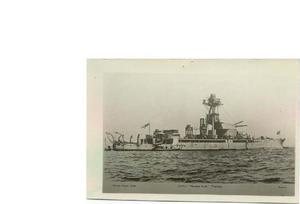
HMS Marshal Soult
My War, Part 1
I lived in Bolton, Lancashire, was still at college when War was declared and my parents, like the rest of the population, had about three days to make sure all windows were blacked out so that no lights at all would be showing outside. No more street lamps to light our way, torches to be dimmed if we were to use them outside. Car headlamps were fitted with shields to deflect a dim light downwards to the road. Food rationing was imposed; all manner of recycling, savings, and re-using instituted, and our lives would change totally for many years to come, probably for ever.
Not long afterwards I left college and obtained my first job, but continued with education by going to classes at night school three evenings per week. All transport had been curtailed, so that the last tram for home was at 9pm and if I didn’t manage to catch that I had to walk my way home in total darkness. Not very pleasant, to say the least. On the other four evenings I worked 2 hours each for a chartered accountant, regularly typing out Trading, Profit and Loss Accounts and Balance Sheets, the latter being typed ‘blind’ as the sheets were so large. They were folded in half, the first half typed then marked lightly with pencil to effect alignment when the second half was typed with the underside of the sheet not visible. For this work I was paid one shilling per hour, out of which I had to pay my tram fare of 3 pence, leaving 1/9 (one shilling and nine pence) for each evening’s work.
It didn’t seem very long thereafter before the enemy planes were visiting us and the air raid sirens were sounding most nights. We lived in a reasonably ‘safe’ part of Britain, but bombs could be heard in the distance, particularly on a bad night such as when Manchester was a prime target and we could see the sky lit up for miles around as buildings burned. One such really bad night was in 1940.
After I had gained extra qualifications, I gave up the evening classes and evening work and started to enjoy life more by joining a dance class, going to opera, cinema, or to hear visiting orchestras. It was at the dance class that I met Stanley, who, many years later, became my husband. I was just sixteen then and marriage was a long way from my thoughts. Stanley, from Scotland, was in the RAF and on an ab initio course in Bolton. There were many such RAF personnel billeted in Bolton and dancing partners were in abundance.
A lot of people joined the various organisations trying to ‘do their bit’ towards the war effort — WVS, Salvation Army, Toc H, volunteer firemen, helpers in canteens, air raid wardens, firewatchers, etc. I was one of the latter and teams of us took turns at patrolling the block of buildings in one of which, a health insurance office, I worked during the day. We slept in one of the offices - a bank - the upper storey of which was equipped with bunk beds, and, during an alert, we would go out on patrol looking for incendiary bombs etc. that had not ignited, or be on the alert for any fires that may start. We had had training on how to douse fires with a stirrup pump in a bucket of water.
August 1943 came and I reached the age of 18. I could ‘join up’. The ‘idea’ had often been on my mind, but I knew I couldn’t do this until I became 18, and so, after some further thought, I volunteered for the ATS. My parents were none too pleased to hear this news, no doubt thoughts of World War 1 being still in their minds, even after so long a time, my father having fought on the Somme…. However, when my employer was contacted, he vetoed the idea, stating on the form that he received to complete that I was required at his office and thus I was rejected on the grounds of being in a Reserved Occupation. Respite and thankful prayers for the parents! Eventually he agreed that I could leave if another secretary could be found to take my place. After a few failed secretaries he was satisfied, but by this time I had decided to apply to join the WRNS. My application was acknowledged and I was told to wait and I would be contacted again in due course. ‘Due course’ didn’t happen until about March 1944 when I was called to Manchester for a medical examination. More despair for the parents, father being so annoyed that he declared, “I had made my bed and could lie on it.”
I arrived at some large school building in Manchester, already seemingly congested with volunteers, and we were instructed to strip off all our clothes. Fortunately we had been asked to take a dressing gown; that didn’t seem too bad until it was my turn to enter for examination. I went into a very, very large room (assembly hall?) at one end of which was a doctor and nurse, but, I had to strip off my gown at the door and take the long walk, naked, to that desk. The walk seemed like a mile long. Worse was to come….. after various questions and poking and prodding, I was then asked, in my nakedness, to bend down and touch my toes! Whatever was being noted must have passed muster, for I was told to go and, once again, “I would be contacted” which I was, about a month or so later.
In June I received my call-up papers. Father took the day off work to say goodbye at the station, having come to terms with the fact that his beloved daughter was about to leave home, and soon I found myself on my way to Wesley College, Headingley near Leeds to meet many more in the same call-up batch. We were issued with our ‘blue-ettes’ (a blue overall like a dress) as wrens didn’t wear uniform until a fortnight after entry when they passed the initial course, during which time they could be rejected or they could leave of their own free will. Had they been of ‘call-up’ age, they could have been conscripted to join ATS, WAAFs, or Land Army of course — those working on ‘munitions’ were exempt. Thankfully all in our batch were ‘clean’. In the batch to arrive the following week, someone must have been infected with head lice, thus passing them on to many more and such wrens were to be seen with cloths wrapped round their heads, covering hair that had been soaked in paraffin.
It was a hard — and harsh - beginning. We had to rise at 6am, wash, then tidy the room and make our beds. Hospital corners were a must and naval, blue counterpanes had to be especially neat and tidy. Failure meant we were punished. Apart from the usual squad drills we were kept occupied largely by scrubbing and cleaning and I must have scrubbed all the long corridors in Headingley College. No kneeling mats to ease the task, either — just kneel down with a bucket, block of hard soap, scrubbing brush and cloth for yard after sore yard, the only relief being to rise to one’s feet and stand to attention every time an officer passed by. Once the assigned length of corridor was finished, another job would be found and, in my case, it usually proved to be cleaning the lavatories — about 20 of them — and empty the sanitary bins. We were handed a box of matches to set the contents alight in an incinerator in the grounds — an almost impossible task without other means of ‘kindling’. I think cleaning out the pig bins was one of the worst jobs. Cleaning the outside was OK, but oh dear, scrubbing out the insides ….. that was a bit stomach churning. Some — the envied few - were assigned to just punching out names and numbers on identity tags. Often the afternoons were better, at least for those designated to become “wren writers” as we had to attend classes on secretarial procedures in the navy, at the end of which course we had to pass an examination in order to achieve our goal and get our “Writer’s” badge.
Mealtimes were a bit of an ordeal. We sat at long wooden tables from which the one who sat at the end had to serve the first course, and the one at the opposite end had to serve the second course. If the food looked pretty awful (as often it was), those in the middle got rather large helpings. Of course, the helpings for those centrally placed were considerably smaller should something more palatable be on offer. Everything had to be eaten; anyone leaving a dirty plate meant the whole table being ‘gated’ , making that person most unpopular indeed. Thank goodness for our “blackouts”. Standard black knickers with elasticated legs, commonly called “blackouts” wear worn — something I found invaluable when it came to disposing of inedible contents on my plate. Not pleasant when holding bits of meat and gristle, but it was only until I could find another receptacle, usually the toilets I so often cleaned.
But the two weeks’ training passed …. And I passed too, with my Writer’s Badge and a change from ‘blue-ettes’ to WRNS uniform.
© Copyright of content contributed to this Archive rests with the author. Find out how you can use this.


 Recommended story
 Story with photo