

- Contributed by
- Geoff Thompson
- People in story:
- Frederick Thompson
- Location of story:
- Gt.Britain,N.Africa, Italy, France, Belgium
- Background to story:
- Royal Air Force
- Article ID:
- A8415650
- Contributed on:
- 10 January 2006
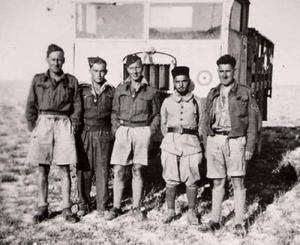
RAF 80 Wing Type 'M' Signals Unit Service team 'on the road' somewhere in N. Africa 1943. Left to right : Flt Lt D.P. Taylor, LAC Green, Sgt Fred Thompson, "Pierre", Cpl Frank Baxter.
This is my dad’s story, told mostly in his own words, taken from letters he wrote. After he died in 1990, I discovered the existence of letters he had written in 1986 to someone researching a book. The particular book I don’t think was ever written, but I was able to get copies of some of my dad’s letters. They tell most of the following story.
Frederick Thompson was already a very experienced radio hobbyist when the war broke out. He had been a licensed radio ‘ham’ since 1925, (call signs G5LH and G3SD). In the late 1920’s and early ‘30’s Fred Thompson worked as a commercial radio operator with the Marconi Company on board merchant ships. However, by the time war broke out he was back “on the hard” and married. He had a small daughter (my sister Judith) and was employed as a Buyer in the Radio Dept of Fenwick’s in his home town, Newcastle-upon-Tyne when he joined-up with the RAF.
GETTING INVOLVED
From here I’ll let him take up his own story …. “I served five years in 80 Wing RAF during WW2. This wing was engaged in Radio Counter Measures known to the general public for its “beam bending” activities but infact engaged in some more sophisticated work classified as Top Secret. I was with the Wing in all its overseas ground based activities as sergeant, flight sergeant and Warrant Officer. My rating was Class 1 Wireless Mechanic.
After recruitment I was attached first to a wave bending “Aspirin” based at Hagley,near Birmingham. (An “Aspirin” is described in the book Most Secret War by Prof. R.V. Jones as the name given to high powered equipment developed to deal with radio beams from what the Germans called Knickebein Beacons which were used to guide their bomber aircraft — the British had codenamed these “Headaches”. The Aspirins transmitted a ‘dash’ like the dash in the 'dot-dash' signals from the Knickebein beam. The dash from the Aspirin overlapped the German signal to give the impression that the aircraft was flying off course, so the pilot would compensate and thus really fly off course.) When I was at Hagley, during an evening watch, a little man in a blue suit and bowler hat turned up sat on a tool box and introduced himself as Sir Henry Tizard. The head Boffin at the time. I’m quite sure we didn’t ask him for proof of identity, civilians didn’t think like that….
THE SECRETS OF MEACONING
I was soon transferred to 80Wing H.Q. at Radlett, Herts, under the command of Group Captain E.B. Addison, and I became attached to the Meaconing project.
Meaconing (Coined from the term ‘Masking Beacon’) was developed by the Post Office and was a system of denying Direction Finding (DF) bearings to enemy aircraft. Briefly this was achieved by picking up the signals from German aircraft calling their DF stations for a ‘fix’, passing the signals to a transmitter and then re-radiating them. Special aerial arrangements and phasing equipment was used at our receiving sites to eliminate the local transmitter signal and leave only the aircraft signal in control. The bearing was of course destroyed by the double signal received by the DF station, and being on exactly the same frequency the German receiving station was unaware of the deception.
At our end the result was achieved by a system of spaced vertical antennas. And phasing circuits which rejected the signal from our transmitter, which was located several miles from the receiving end. In effect the enemy aircraft signal was used to drive our transmitter and the subsequent radiation was rejected at our receiving end.
I was a mechanic, but being a ham and also having been a commercial op I had a double use. And having become something of an ‘expert’ on the scheme I toured the length and breadth of the country visiting sites and checking on the effectiveness of the operation. Not always welcome. The C/O’s were mainly ex-BBC engineers but they seemed to stay at the transmitter end and I seldom met one at the receiving end, where the business was done. Hi!
My major work, sometime later, was assisting in the preparation of Meaconing unit No.22 for overseas operation. I spent some weeks at the Post Office Research Station at Dollis Hill where preparatory technical work was being done. A fascinating insight on how the “Boffins” go about it. By this time I had reached Sergeant status!
OUT TO NORTH AFRICA
To cut a very long story short, myself plus another sergeant Frank Baxter, an expert on Diesels, and our C/O D.P.Taylor (then F/Lt, later Sq Ldr) also ex BBC, and a fine gen’ man, sailed on the “Queen Mary” from the Clyde, on Christmas Eve 1942, for the middle east. We had ten thousand other blokes with us.
We sailed a zigzag course down the middle of the Atlantic stopping at Dakar and at Capetown for fuel and then the south Indian Ocean some time before turning north for the east end of the Suez Canal. I think the journey took twenty-one days.
We spent about six weeks in Egypt waiting for the arrival of the equipment on other slower transport. Baxter and myself were put to work in the caves at Tura about 10 miles south of Cairo. These caves were made originally by the extraction of white limestone for encasing the Pyramids. We overhauled Type 1031 VHF transmitters. Some 35T’s returned to the UK with me later on.
Eventually the gear arrived and we drove 1000 miles along the coast road to Benghazi, in Libya. The convoy comprised 17 prime movers and 11 trailers. There were four 60ft low loader “Queen Marys”(articulated lorries)containing the operational equipment. I rode an AJS motor bike the whole way. As go-ahead road scout. The low loaders were in fact so near the ground that road bumps had to be negotiated with great care.
We set up the station at Benghazi and then proceeded to a sister unit (No.20), set up somewhere else. I forget exactly where.
(Based on a photo and a personel list my Dad had kept, there were perhaps up to 100 officers and men in 80 Wing's Overseas
"Type M Signals Unit", as it was called. And, judging by clues he gives as to the date, the front line of battle was by now ‘next door’ in Tunisia and the allies were closing on the last foothold of the German and Italian armies in N. Africa.)
We, the C/O, Baxter and myself, became a service unit, equipped with a 5 ton Bedford and a workshop trailer. We moved about all over on one mission or another, not, I’m afraid, always connected with the job!
(They were in N. Africa for most or all of 1943 apparently. Dad kept a telegram addressed to 22 Type 'M' W/T Stn. RAF, sent via the Marconi office in Cairo dated June 1943, announcing the successful birth of his son back home in Newcastle. Then the main invasion of Italy, their next location, did not start until September that year.)
AN ITALIAN JOB
Again cutting a seemingly endless story short we eventually went to Italy. The main body of the unit flew by air to Taranto in the heel of Italy. Together with four of the LAC’s (Leading Aircraftsmen) I took the four Queen Marys on an LST to Pantaloon ( wartime codename for Naples). After standing on the “hard” at Naples for about three weeks and being joined by my C/O and with the aid of REME we got the vehicles across country via the Apennines in mid-winter, to a small country town called Serra Capriola and here we set up the unit again. No sooner up than orders came to dismantle. This we did and abandoned everything for collection. We had some lovely brand new HRO’s. Wonder what happened to them. (The HRO was a high frequency radio receiver manufactured by the National Radio Company -- this and another type of receiver ,the AR88’s mentioned later, were American made and very successful with radio amateurs and professionals alike. The HRO — the initials infact mean “Helluva Rush Order” — was copied by both the Germans and the Japanese.)
Forty-five men with all their kit packed into a five ton vehicle at Bari and drove down to Taranto where we boarded the French Line’s “Ville d’Oran” and sailed for Algiers. From there I went home on the P and O's RMS "Strathnaver” together with several hundred other NCO’s. We docked at Birkenhead to a band playing.
After leave I was posted to a maintenance unit in the midlands. Stayed there for some weeks, then my old C/O traced me and had me transferred back to 80Wing.
CHASING THE V2s
After much reorganisation and regrouping we went down to Fareham in Hampshire, joining the vast array on the south coast ready for “D” Day in June ‘44. What a sight! We landed on the Normandy beach about a week after D Day. Our mission on this occasion was to try to establish on what frequencies the German V2 rockets were controlled and destroy the signals.
Receiving gear was only HRO’s and AR88’s and a big Standard Telephones transmitter together with diesels and 100ft cigar section masts. Eventually we arrived in Belgium and occupied a chateau, Chateau Brifaut,(at Schepdael, nr Brussels) and later on to the coast near Ostende. Also in Holland sometime during our journeying. I forgot to mention that while we were in France the C/O and I visited some recently vacated German beacons, (Knickebeins) did some dismantling and sketching of aerial systems.One in particular at Mount Pincon near Caen (where a key battle of the Normandy invasion had been fought). I think by this time I had passed through Flt/Sgt and made Warrant Officer. Still have the cap and cuff badges. Near Malmedy in Belgium we had to beat a hasty retreat with jerry tanks coming our way. Quite a number of exciting moments here and there. (In Dec 1944, just south-east of Malmedy in the Ardennes, the German 6th Panzer Army broke through allied lines at the start of the 'Battle of the Bulge' - were these perhaps some of the "jerry tanks" they avoided ?)
That’s a very brief summary of 80Wing’s overseas operations. I always regret not having kept a diary. As a matter of historical interest, we never did hear anything that could be connected with V2’s. On the subject of meaconing, I remember at least one Jerry bomber actually landed on a British airfield.
I was finally demobed at Cardington (where they used to keep the air ships). Went back to my job as Buyer in a large Department Store. Retired in 1971 after some years as assistant G.M. Personal mementoes included, several British gongs - Africa Star with clasp. Italy Star. France and Germany Star. Defense Medal. 1939/1945 Star. War Medal and , a French Croix de Guerre ”
© Copyright of content contributed to this Archive rests with the author. Find out how you can use this.


 Recommended story
 Story with photo