

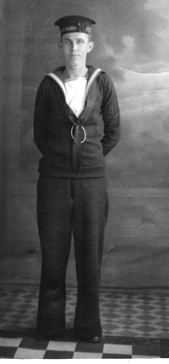
Mr. Stanley C.Legg, portrait taken on 3rd September 1940 when a gunner on HMS Nelson.
- Contributed by
- bedfordmuseum
- People in story:
- Mr. Stanley C. Legg
- Location of story:
- UK, Andernos, Norway, Belfast, N.Ireland, Sierra Leone, Cape Town, Suez Canal, Halfar Aerodrome, Malta, UK
- Background to story:
- Royal Navy
- Article ID:
- A8086250
- Contributed on:
- 28 December 2005
Part one of an edited oral history interview with Mr. Stanley C. Legg conducted by Jenny Ford on behalf of Bedford Museum.
“I was 14 when I joined the Royal Navy in 1932. Those were the days when school ended at 14. I was out in China for three years. But in those days it’s not like now - you went on a Commission - that was two and a half years, there was no argument. Went out to China and because we took passage on a ship they’d have been nearly time up, they transferred us to another one so by the time we’d finished it was two and a half years. We came back for the ‘Spit Head Review’ in 1937 I think it was. But you had the China Station, the West Indian Station, the Atlantic, the Home. If you went on a ship to them you had done your two and a half years - there was no argument. We did the Review and were paid off in Plymouth although we were Portsmouth depot, we had to come back to Portsmouth, because you had three depots then, Chatham, Portsmouth and Plymouth.
Before we had the Conscripts they had what we called the ‘Mickey Mouses’ come in. They recruited people who had done ‘seven’ and ‘five’, seven service, five reserve and they called them ‘Mickey Mouses’ because the first lot we see all had wrist watches! I mean you never had a wrist watch on! You went by the ships bells to tell the time, you didn’t wear a watch! They knew what they were doing alright because if you’d been to the Gunnery School at Whale Island, if you passed out at Whale Island you were good! Then we had the Conscripts!
In September 1939 war was declared, I was a Leading Hand by then and we were sitting in the Mess minding our own business, because in peacetime we use to go to Oakhampton with a field gun - not the field gun in the London rubbish but a real gun, a Howitzer. I was a gunner on HMS Nelson, on a 4.7 gun. The sixteen inch guns were down there, there were three of them and the 4.7 were up here. Now in those days nobody had ear defenders, not only that you had 4.7s here and you had the pom poms here, they were going brrrr, brrrr, brrr all the time, you didn’t worry you had to do it. If you see something coming for you didn’t worry about that! I’ve been on there when they fired the 16” guns and the 4.7s and the pom poms, when the aircraft came over.
Well at the beginning of the war someone had the bright idea to send the field guns to Norway to fight the Germans. Well we went - we loaded I think it was the Black Swan - one of the small ships — we went into one harbour and we come out because I think the Germans were already there. We went round Andernos, we landed there and we unloaded the gun and we went. Somebody gave us a house half way up the hill because there was nothing there for us. We unloaded, got bedded down and all of that and then the Army unloaded, they had I think one Bofor gun, they were down in the harbour. And then another crowd of soldiers came, anyway we were bombed and all that. The Germans came over and dropped incendiaries so they bombed our house down. Oh, and the other people with us were the survivors off the QSR it was an ack-ack ship and they called it the ‘cocoa boat’. They were there with us in the house and we all come out.
Our Intelligence Officer, we had had an Officer with us - we don’t know what happened to him so we were on our own. So we started to walk and somebody said, ‘Well, you don’t want to go that way there are Germans!’ So we walked the other way with the intention if we couldn’t get anywhere the nearest place would be Sweden but that was a hell of a way a way. On the way we had to stop because we came to a Norwegian Camp and they wouldn’t let us through because we were carry rifles, revolvers and ammunition and that, we had to get rid of that. Then we stayed there and had a sleep during the night and then the next morning we marched, or we ambled really and I think there were 19 of us. As we got opposite Andernos, across from the fjord, I think it was the German ships were there unloading, well our gun we’d left behind because it was useless and we only had about 19 rounds against the German Army! But we went around and I forget the name of the port, it’s only about four letters and we got a boat and on the way back I think we got bombed. Anyway we arrived at Gourock on a Sunday morning and it annoyed me because we were all dressed in what we’d got, I mean some were in overalls some were not and they put us on a railway station and they put sheep hurdles round us! And all the other Scotch people - on a Sunday going across on holiday and all that and they wouldn’t let us move because they weren’t sure if we were Germans or not!
After a while a train came in and they gave us a carriage to ourselves but we had civilians monitoring us. Well, we didn’t have paybooks or anything like that, not in them days. Oh, we had a meal, they gave us a slice of corned beef in bread before the train shoved off and that lasted us until somewhere in London we ended up and it was night time then. So they put us in the Union Jack Club and well they wanted to charge us so we said, ‘No! We’d sooner sleep on the floor.’ We weren’t going to pay to sleep there! So next morning we went to Waterloo, we had a train down. We got as far as I think Wimbledon or somewhere there and that had been bombed or something so we stayed at the Police Station. After a while they’d done something and we got another train down and it was getting on for dark then, I forget - it wasn’t Havant, it was some little station and they said, ‘Well, you’ll have to stay here the night’ because they didn’t think the line was clear to Portsmouth. We went in the Village Hall and there was a dance on and they put beds in the corner with curtains round and we laid down while they were dancing with the music — we had a good time! So anyway we made it to Pompey got back on board the Nelson and the first words they said, ‘Where’s all the guns and that?’ The Nelson was a battleship. They’ve renamed the barracks Nelson now.
if you were on a Navy ship then you done your watches - so 8 o’clock in the morning, this is 8 ‘til 12, you’d probably be on. Everybody working but if there’s a panic then you go to ‘Action Stations’. In the afternoon, still work and then there’s the ‘dog watches’. If you’d done the morning watch, what they call the ‘morning watch’ then you’d done the ‘first dog’ that was four to six. Now that was — you could be Quartermaster, guns crew, anything - you were on two hours. Then from six to eight you were off then from 8-12 you were on, you were awake. Then from 12-4, then from 4-8, and we worked all the way round. So if one day you had the first ‘dog’ the next day you had the last ‘dog’ so it changed. The first ‘dog’ is from four to six and the other one six to eight is the ‘last dog’. But I mean come 8 o’clock if you weren’t on watch you were up quick or not necessarily because there might be a scare on. So you all close up but come finish you might have an hour left, but you made your sleep when you could. If you had the eight to twelve and then twelve to four and four to eight you didn’t sleep on four to eight. At 6 o’clock you got up and stowed your hammock away.
We went to Harland and Wolff, Belfast to commission the Formidable, the aircraft carrier. Then we went out, I think we chased something in the Atlantic but there was a scare with the Scharnhorst or one of them. But anyway we carried on to Cape Town and we went to South Africa and they couldn’t export all their fruit and when we got there they made us welcome and everybody had a box of peaches or something and lots of rums! But before that, before we got to South Africa we called at Sierra Leone and took on some stuff there and then Cape Town and then up to the Suez. We went through the Suez but we had to go careful because of ships sunk in the Suez and it took nearly two days to get through, a bit at a time. We arrived in Alexandria.
I’ll tell you a little episode. On the Formidable, when we was going out we had some Free Frenchmen come, they were going to go, well we didn’t know — but they’d got to go out to Alexandria to join the French. In the Mess I was in we always took it he was a Frenchman, he couldn’t speak English he reckoned, and the French — well, they were French! It wasn’t until we got to Alexandria we found out that he was a Conscript, one of ours! He had got away with murder, he had - he was working a fast one! The others cured him!
Then I think we went out of Dumyat Creek and we got hit - I was in the forward turret and well we were there in the turret firing away and over the tannoy came ‘Forward turret has been hit and it has gone’ and we were still sitting in it! So anyway that cleared up and we went in Alexandria and they took so many off because they didn’t have the crew, it killed some. And what was there were ships that had come in from Crete and I think out of the 20 odd only one wasn’t hit and that was because it stayed in habour.
I was not wanted on the Formidable, there was nothing we could do. They were repairing the ship. Then I went to Canopes near Alexandria - while I was at Canopes there was the camp for all the people that had come off ships that had sunk, for the survivors. I was in a tent. I’d been made up a Petty Officer but I know I was in a tent with some more and one of them was doing PE for something to do. One of the Dukes came over, the Duke of Kent or something and they made them sweep the sand level so he could inspect them! I ended up at De Keela - that was a Navy aerodrome. I’d done a couple of trips up to another RAF aerodrome but only visiting. I went back to De Keela and they said, ‘Yes, you’ve got to go to Malta.’ So I ended up in Malta.
I was sent as a Regulator to Malta. They had no aircraft about a month after I’d been there. I think they had one. They had one left a Lysander, of the ‘Faith, Hope and Charity’, Squadron, they had one left and when I was there that went. I was based at Halfar, Halfar aerodrome. It was the 830 Squadron that I belonged, a Swordfish Squadron but they had no aircraft except one I think and that went. Before they used to do raids against old Rommel’s supplies and that. I don’t think 829 Squadron had any aircraft. The Station was bombed and we used to walk from Halfar down to Kalafrana for our meals and to come back again because there was nothing on the top, it was all flattened. The only thing that stood was the corner of the bar! We used to have a cup of tea and the tea had come off — there was a merchant ship sunk in Kalafrana Bay and they salvaged the tea and when you drunk it you could taste all fuel. We had corned beef fried, stewed, you name it, corned beef - that was it!
But what we did mostly was repairing the holes in the runways. When the Italians came, they used to come at a set time, down the runway, that was finished. Filled the holes in and then wait for them, they came back and we filled them in. That was it for the day! But when the Germans came, they bombed everywhere! There was a slit trench there and opposite one of the buildings was a bomb shelter — a lot of them during a German raid went down there. And I was on my way and I thought, well there was a slit trench and there was some soldiers in it and they were from the Kent Regiment so I dived in with them and there was a dog in there! It had a bit of tin over the top and they bombed and that shelter got hit! I don’t think to this day they ever lifted it out, they had a crane trying the lift the bomb out but they really flattened everything.
We got liberated because we were dead lucky because the last bombing raid they’d done, it was a massive one. It was massive, the sky was black with aircraft and they were going to invade I think the next day but the Americans and the English landed in North Africa and the Germans cancelled it. There was nothing you could do. We shot down some planes, oh, yes, Germans and Italian. We didn’t have anti aircraft guns on the aerodrome. We had a rifle - each had a rifle, small arms, that was it! The Maltese had an ack ack and the Army, the British Army but I think they were rationed for ammunition.
I was just organising stuff, like send so many men to a rest camp. They used to send them, if you’d been to Malta, Medina is a big place there, they had a place there they could go to. We had a trick cyclist come, you know a psychiatrist and they were interviewing everybody so the other one in the other Squadron who was with me, he was a survivor off the Rwalphindi I think, a merchant ship and he got this job. I think we’d had a drop of rum so she asked us, this was a woman, and she asked us some questions and we said, ‘Yes, we want to stay here, we don’t want to go home to England!’ So the next day we went to St.Angelo, they took us to Luqa that night and flew us to UK. We stopped to re-fuel and then we went to land, I think it was at Lyneham, a RAF place. Well, we couldn’t care less because they could send us where they liked. But there we were in the heart of England and I think that’s when I went into Barracks and then I went to Combined Ops.”
© Copyright of content contributed to this Archive rests with the author. Find out how you can use this.


 Recommended story
 Story with photo