

- Contributed by
- Dave Richardson
- People in story:
- Jack Richardson and The South Notts Hussars
- Location of story:
- North Africa,Tobruk and Italy
- Background to story:
- Army
- Article ID:
- A8964246
- Contributed on:
- 29 January 2006
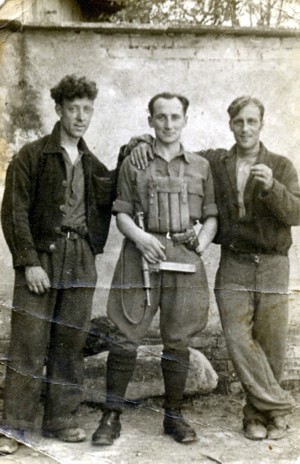
This picture was taken in Italy probably in 1944. My father, Jack Richardson is on the right.On the left is a fellow escapee, I believe his name was Martin. With a partisan.
'The story I have to tell is about my father, Jack Richardson, who died a year ago on the 29th January 2005. My father spoke little about his wartime experiences during my early life, but with his grandchildren growing older and asking him questions he started telling more about those times. Several years ago I made a short tape recording of his reminiscences. This account will largely be a transcript of what my father recorded with some brief outline of his life.
My father’s early life was in and around the Carlton road and Sneinton areas of Nottingham. He was a member of Dakin Street Boys Club, which catered for most of his pastime and gave him a chance to have a break away from the town. His father was a miner who died in his mid forties when my father was a prisoner of war in Italy. When he left school, my father started work first as a Pork Butcher, on St. Ann’s Well Road in Nottingham and then as a labourer at Wilford Brick Works. It was about 1937/38 that he joined the Territorial Army and became a gunner in the South Notts. Hussars, a regiment in The Royal Horse Artillery. In September 1939 the South Notts. Hussars were mobilised and later in September the regiment was moved to Yorkshire for training. In January 1940 the regiment was posted overseas to Palestine.
The following events are as near as possible in my father’s words.
We started by talking about the German tanks:
‘There was a big tank battle at Sidi Rezegh, if I remember right…..the German tanks were miles back and they were knocking our tanks out like shelling peas. I took a party to see what could be done, tanks were burning all over the place; the tanks we had were only like sardine tins…..’
Then he talked about the start of the war and his mobilisation in Nottingham.
‘We were mobilised in 1939 just before war broke out. I was working at Wilford Brick Yard and got called up, we went to get our uniforms and all that, then went to Lenton Boulevard to a school there. We used to go to Garden Street, to a factory there , which was I think Hollins a big hosiery factory and we used the canteen. After one or two weeks we moved up to Wragby, just after war had been declared. There was one part when we were at Wragby, a Sergeant M…….. , he was a character, he said to me, he didn’t use to call me Gunner, he used to call me Jack cause I knew him real well.
‘I’ve got a job for you Jack. Captain B…….rang up to see if we’ve got anybody to ride his horse down to the village, so he come to me and said you can ride a horse can’t you. I said you must be .joking. He said “well get on it“. I got on it, fell off two or three times and finished up walking it. I went to him and didn’t half tear in to him, but he said “well the South Notts Hussars are supposed to be a horse regiment.’
The Regiment had 25 Pounder Guns at the time and my father was with 426 Battery of The South Notts. Hussars.
‘Just after Christmas 1939, the Regiment left for Palestine via Calais and train to Marseille. They set sail for Haifa which took five to six days to get there. A lance corporal, lance bombadier, at the time. I had a stint in Palestine soon after the Italians came in to the war we moved up to Egypt.’
‘When we at Marseille you had to be a sergeant to get off the boat . Me and my mate got one of the lads who was a bit of a handy bloke to paint two stripes on us and that’s how we got off the boat. If you hadn’t got a sergeant’s stripes you were nobody in the Army. When we were in Mersa Matruh we even had a marquee, a Sergeant’s Mess, and at the side they had cloth windows that you could roll up and tie. We would poke our head through and they would say ‘what do you want!’ We want the same as you‘ve got. They used to give us bottles of beer , they had McEwens at the time. Then they’d tell us to get out of there‘.
The Regiment moved to Egypt in June 1940.
‘Mersa Matruh was a dead hole but apparently for the Egyptians it was a holiday resort. In Mersa Matruh, there was a big hotel and we decided we would go and have a look at this hotel which was guarded by redcaps. We couldn’t do anything about it but one day we went down there and said come on lets have a look at this hotel again. There were some officers inside and I went in and all the tables were set out as if there was going to be a function and there was everything you could think of in this hotel, wine and everything, we had a look round and was then kicked out . Some regiments’ officers must have had a right beano, you know.’
‘The stay in Mersa was in flea ridden dugouts and we used to walk miles to the various outposts we had , probably walked through a mine field, but you knew which way to go. We used to take a truck and go up to one of the troops that was stationed towards the Libyan border and they were in a oasis, date trees and all that. Just outside , you wouldn’t believe, it but there were tomatoes growing. Made you wonder how they could grow tomatoes in the sand.’
My father’s troop move to Maktila was, I believe, in December 1940.
‘Our troop, when Italy did come into the war, got loaded up and we were going to a place called Maktila, we went up with a troop of four guns, two were dummies, wooden, and two were real ones. I was on one firing the live shells. The battle only lasted about a couple of days and what tanks were there went in and all of a sudden thousands of Italians packed up. We went on one of their positions and if you had seen the gear they had left; theodolites, binoculars, you name it and it was there; grub and loads of cigars. Not made with tobacco, they were made with……..it used to stink the place out. Them that smoked …..every time you’d see them on the guns, they’d have one of these cigars, no one would go near them.’
‘We lit thunder flashes, they went off in five seconds, just to draw the Italian fire. Then when they fired, we opened up. We spent days clearing the Italian dead and wounded. ‘
‘We used to go up to a place called Fort Capuzzo, which was in Libya, go for a scout round there and come back. We knew the Germans were coming, that was a different kettle of fish.’
After a spell defending the Suez Canal, the Regiment moved to be part of the Trobruk defences in April 1941. I believe the following events took place during late November and early December 1941.
‘We tried to break out but we got hammered. The German ‘88s fired airburst and, I don’t know, the gun I was on must have been one of the unlucky guns. We had four guns, number one, I was number two, three and four. Everything there was firing just where we were and we started off firing, all of a sudden there was an airburst and I was putting the switches on doing a level with all the bubbles when I saw Bill sat on my right. I said are you alright, he replied that he’d been hit in the knee. I looked at him , it was a lot more than a hit in the knee and I got out of the seat to see what I could do and he just went out . We didn’t have stretcher bearers, there was nobody there when it came to medical attention. I just dragged him out, laid him down, fetched one of the few medical blokes that were. Then the next round came up, put the switch on and put the range on, old Bill would normally have done that. Then another shell came over and I thought “that’s close”, then I looked round to my left to the two of them that were there, they didn’t move. I got up to look at them and both of them had been hit pretty bad , both of them had been killed. All the other guns more or less got away with it. The next round that came over, I was putting the range on, the switch , loading it, I was the only one left and there was no sign of anyone coming, reinforcements or anything, and another round came over and lifted me out of the seat! I went flat on my back and the next thing I knew I was moved out. I finished up in one of the field hospitals that we had but I wasn’t actually wounded, only knocked unconscious.’
The battle was still going when my father returned to his troop.
‘At that time we were the unluckiest/luckiest gun because we had a tank shell hit the recuperator and it split the gun in two. The barrel shot up and the recuperator went down and I was covered in oil. The gun was out of action, all of them were in a way, and that was it - the end of it.. We never saw one of our tanks or aeroplanes, but “he” used to come over with his Stukas and do what he liked.’
‘In Tobruk we got bombed plenty of times. They only used to be just skimming above the ground. We had anti aircraft in Tobruk but not around the gun positions. All you had was your rifle or machine guns - you had to look out for when he came over with his bombs as that would frighten the life out of you.’
The following events took place in June 1942 in and around the Knightsbridge Box, on the Trigh Capuzzo, between Sidi Muftah and El Adem, South of Tobruk, Libya.
‘We got captured on June 6th at Knightsbridge. The Germans, with their tanks, were picking off anything that moved, picking off the lorries that were towing guns and the limbers which carried the ammunition. Once they were hit they went up. We were firing armour piercing shells and they weren’t making much impact on the German tanks, but if you hit the tracks you could knock them out. I looked around to my left, I think it was Dog Troop, and saw them walking with their hands up - they had been captured first - the tanks had come on their flank. It wasn’t long before the Germans came and were charging at the gun pits. All the limbers had gone up in flames, the lorries had got knocked out which carried ammunition. We had been expected to fire two rounds and then keep moving but in this case we just stood there like leading lambs to the slaughter. We got quite a few rounds off. You didn’t know what to fire at. You saw a tank in front of you and fired at it but there were those round the side and coming up from the back of you. Then the German tank came. There was a Commander in the turret and he spoke perfect English “come on out, follow that crowd there”. It was walk, walk, walk. We had no water, you couldn’t escape - where could you go? We had no map to find out where were, no compass, it was just a matter of keep plodding away. If we saw an abandoned vehicle we used to have a look to see if there was anything there like water, and if there was no water we finished up drinking from the radiator.’
‘The Germans handed us over to the Italians, but they were as badly off as we were when it came to grub but they had some good equipment. We were in a camp in North Africa for a couple of months and we shipped to Italy to a camp called “Capria”? and another was called “Nasserati“?, Camp 53, then various working parties. There were only about 80 of us in this particular camp we went to, just outside Turin. There was a sports stadium being built and we were doing the ground work. All we were doing was digging and levelling out before they started grass seeding it. I was made camp leader. I said “I don’t want that job”, but I did take it on. I was a Sergeant then.’
‘In 1943 when the Italians packed it in, the Camp Commandant came and said “Jackamo, I want you”, that‘s what he used to call me. He said “the war is finished - I’m going to open the gate, you can either make your way up to Switzerland or try to get down to the line”. I said to Martin, my mate, we were only about 20 miles from Switzerland and our blokes had landed and I said we would wait as they would be up here in 10 minutes!! In the meantime the Germans closed the Swiss border and the British and Americans got stuck at Monte Cassino.’
‘Being on the run in Italy was worse than being in actual battle. It was deadly. The Germans, with the fascist police, had put the clampers on everything. Not only that, the Germans were paying Italian civilians rewards for capturing allied prisoners of war but the worst part was the fascist police; they didn’t mess about. If they caught you, you were lucky to get away with your life. They were shooting left, right and centre. We lived round different farmhouses; some would help, some were scared stiff, but you had to be careful in case they turned you in. We kept on the move. If we couldn’t get a farmhouse we would end up sleeping in the woods and ate grapes off the vines, chestnuts and cherries, plus anything else that was there.’
‘It was two years before Italy was liberated and those two years were the worst. We were at a place called ?Alpetti, I think, with the Partisans there. We got chased up into the mountains but then the Germans came with dogs to search out and the only way out was going further up the mountains. We went up to the top, there was snow up there, and we finished up in a town called ,Cuneo?. Most of them that got out of the camp with us got captured and some were shot.’
‘We had some narrow escapes. We were lucky. We were walking down a winding road up in the mountains and got to a bend and saw two coppers. My mate said “what are we going to do”? I said “it’s no good diving now, see what they do”. They were coming up, we were going down. They called us over. I knew they weren’t fascist police. I spoke to them in English and they said “what are you walking down the road for? Keep off the road and keep to the countryside”. Then they gave us 20 Lira! We got on well with a family in a small village outside Turin, ?Gassimo. There was Victoria and her husband, ?Pannin. We stayed there for about six months helping them on the farm. They were really good people. They had a couple of cows and the grapevines and we helped harvesting the grapes and with the ploughing. “
‘We managed to last out until the Americans came. The family told us that the Americans were in Turin and that we should go there, so we went to Turin, saw an American officer there who took us into an hotel, offered us cigars and wine, and they flew us down to Capri in a Dakota'.
'The worst thing about it was that the British/Americans couldn’t get through Monte Cassino. If they had got through there we would have been alright.’
‘We were too far up North to get down to our own lines, but we could have gone into Switzerland without any trouble at all when the Italians capitulated because at that time the roads were fully open into Switzerland, but I thought our lads would have been up here in a few weeks.’
© Copyright of content contributed to this Archive rests with the author. Find out how you can use this.


 Recommended story
 Story with photo